

Planning an incredible event in Kansas City really boils down to one thing: a rock-solid budget. It's easy to get lost in the creative vision, but without a clear financial map, you're flying blind. Our downloadable event budget planning template is that map. It takes the guesswork out of the numbers so you can focus on creating an experience everyone remembers.
Master Your Event Finances with a Solid Budget Template
A well-thought-out budget is truly the foundation of any successful event. It’s what turns your big ideas into a tangible reality without the last-minute financial panic. Think of it less like a boring spreadsheet and more like a strategic game plan that makes sure every dollar is working toward your goals.
Whether you're organizing a huge corporate conference, a nonprofit fundraiser, or the wedding of your dreams, getting a handle on your numbers is non-negotiable.
This guide will walk you through how to anticipate every cost, from big-ticket items like the venue to the nitty-gritty production details like AV and lighting. The whole point is to eliminate surprises so you can make smart, informed decisions. A detailed budget lets you spot potential shortfalls early, move funds where they’ll make the biggest impact, and stay in control from start to finish. For a deeper dive, check out this comprehensive guide to budgeting for an event.
Why a Strategic Budget Matters Now More Than Ever
In the world of events, things are always changing, which makes precise financial planning more crucial than ever. Imagine you're planning a Kansas City wedding and have Showboss KC lined up for the DJ, LED walls, and lighting—nailing the budget is what makes or breaks the magic.
Here's the reality: industry surveys show that event budgets in 2025 are only expected to go up by about 11%. At the same time, event costs are projected to climb by 12%. That gap, however small it seems, creates a real squeeze for planners. It's a big reason why 79% of event pros now rely on Event Management Systems to keep things streamlined and avoid going over budget.
A proactive budget isn't just about tracking what you spend—it's about making strategic choices that elevate the guest experience while protecting your bottom line. It's the difference between reacting to problems and preventing them entirely.
This forward-thinking approach is absolutely essential. By setting that solid foundation, you’re not just managing money; you’re setting the stage for a seamless, stress-free process. From the first brainstorming session to the post-event wrap-up, everything runs smoother with a clear financial map. Our detailed corporate event planning checklist can also help you keep all those moving parts organized.
Let's start by breaking down the core components you’ll find in almost any event budget.
Getting Down to the Details: Building Your Budget Line by Line
Okay, you've got the big picture. Now it's time to zoom in and build this budget from the ground up. This is where the real work begins, and where a solid plan prevents those "uh-oh" moments later on. A truly comprehensive budget leaves no stone unturned and no expense unaccounted for.
Let's start with the two giants that will almost always eat up the biggest slice of your pie: the venue and the catering. It’s not uncommon for these two to claim over half of your total spend, so getting these numbers right is absolutely critical.
When you're looking at venues, don't just stop at the rental fee. Dig deeper. Ask about mandatory insurance, security deposits you need to float, cleaning fees, and any in-house services they require you to use. For catering, the per-person cost is your starting point, but the final bill will be much higher once you add service charges, gratuity, and taxes—that can easily tack on an extra 20-30%.
The Wow Factor: Budgeting for Production
This is our favorite part—the elements that create the magic and transform a space from just a room into an experience. This is where a partner like Showboss KC makes all the difference. Your budget for audiovisual (AV), staging, and lighting is what sets the entire mood.
Think of it as the difference between a simple get-together and a jaw-dropping, memorable event.
Here’s a quick look at what falls under this umbrella:
- Audiovisual (AV): This covers every sound you hear and every image you see. We're talking microphones, speakers, projectors, screens, and of course, those massive, high-impact LED video walls. A simple PA system for a few speeches is one thing; a concert-level sound system and immersive video is another.
- Staging: Are you featuring a keynote speaker, a panel of experts, or a high-energy live band? The size, height, and style of the stage—along with any custom backdrops or branded elements—are a core part of your production budget.
- Lighting: Never underestimate the power of professional lighting. It does so much more than just help people see. It paints the room with color, sets the mood, highlights your branding, and can turn a bland ballroom into a vibrant wonderland. This can range from basic uplighting to intelligent moving lights and custom gobos with your company logo.
When you're getting quotes for production, the more detail you can provide, the better. Give your production partner the floor plan, your event timeline, and a clear picture of the vibe you're going for. A great team will work with you to figure out how to bring that vision to life within your budget.
The "Little" Things That Add Up Fast
Beyond the big three of venue, catering, and production, there's a whole world of other expenses that can sneak up on you if you're not careful. A detailed budget template needs a spot for every single one.
First, think about the people power. Staffing is a significant line item, covering everyone from the folks at the registration desk and ushers to security guards and the technical crew running the show. Always ask vendors if their quotes include staff or if that's a separate line item you need to cover.
Then you have the red tape. Depending on where your event is and how big it is, you might need permits for street closures, serving alcohol, or fire safety compliance. These aren't optional—they're legal requirements, and they all come with a fee.
Don’t get caught off guard by the small stuff. Seemingly minor items like decor, printed marketing materials, table and chair rentals, and even the software for ticketing all need their own line in your budget.
Finally, give marketing and promotion its own dedicated space. This bucket holds everything from the graphic designer's invoice and social media ad spend to printed flyers and on-site signage. How you slice up this part of the budget really depends on your goals—are you trying to sell tickets, build brand awareness, or woo donors? By mapping out every potential cost, you’re not just making a spreadsheet; you’re creating your roadmap for success.
How to Accurately Estimate Costs and Secure Quotes
Guesswork is the absolute enemy of a solid event budget. To get from a wish list of line items to real, hard numbers, you’ve got to do a little homework and be smart about how you gather quotes. The whole point is to get estimates that are as close to the real deal as possible, so there’s no sticker shock when the final bills roll in.
A great place to start is with some local research right here in the Kansas City area. A quick Google search for average DJ prices, photo booth rentals, or per-person catering costs will give you a solid baseline. Every vendor is different, of course, but this first step helps you plug in some realistic placeholder numbers into your budget template instead of just pulling them out of thin air.
Getting Precise Vendor Quotes
Once you've got a ballpark idea, it’s time to reach out to vendors. To get a quote that won’t suddenly balloon later, you need to arm them with as much detail as you can. An email that just says, "How much for a DJ?" isn't going to get you a very useful answer.
Think of your quote request as a mini-brief for your event. You’ll want to include these key details:
- Event Date and Time: This is a big one. Availability and seasonal demand can really swing the price.
- Venue Name and Address: Location matters. It affects travel fees, how tricky the load-in is, and even power requirements.
- Guest Count: Give your most honest estimate. This number is everything to caterers, rental companies, and bar services.
- Specific Needs: Be crystal clear about what you're looking for. For a production company like Showboss KC, that means telling us you want an LED wall, custom lighting, or a mobile stage.
- Your Vision: Just a sentence or two about the vibe—like "high-energy corporate party" or "elegant, modern wedding"—helps vendors get on the same page.
As you start collecting bids, it's also helpful to understand what you're looking at. Knowing what a proforma invoice means, for example, helps you understand that it's a preliminary bill of sale, a good-faith estimate based on the details you provided before you sign on the dotted line.
You’ll quickly find that a few key expenses tend to eat up most of the budget. As you can see below, the venue, production, and catering are typically the big three.
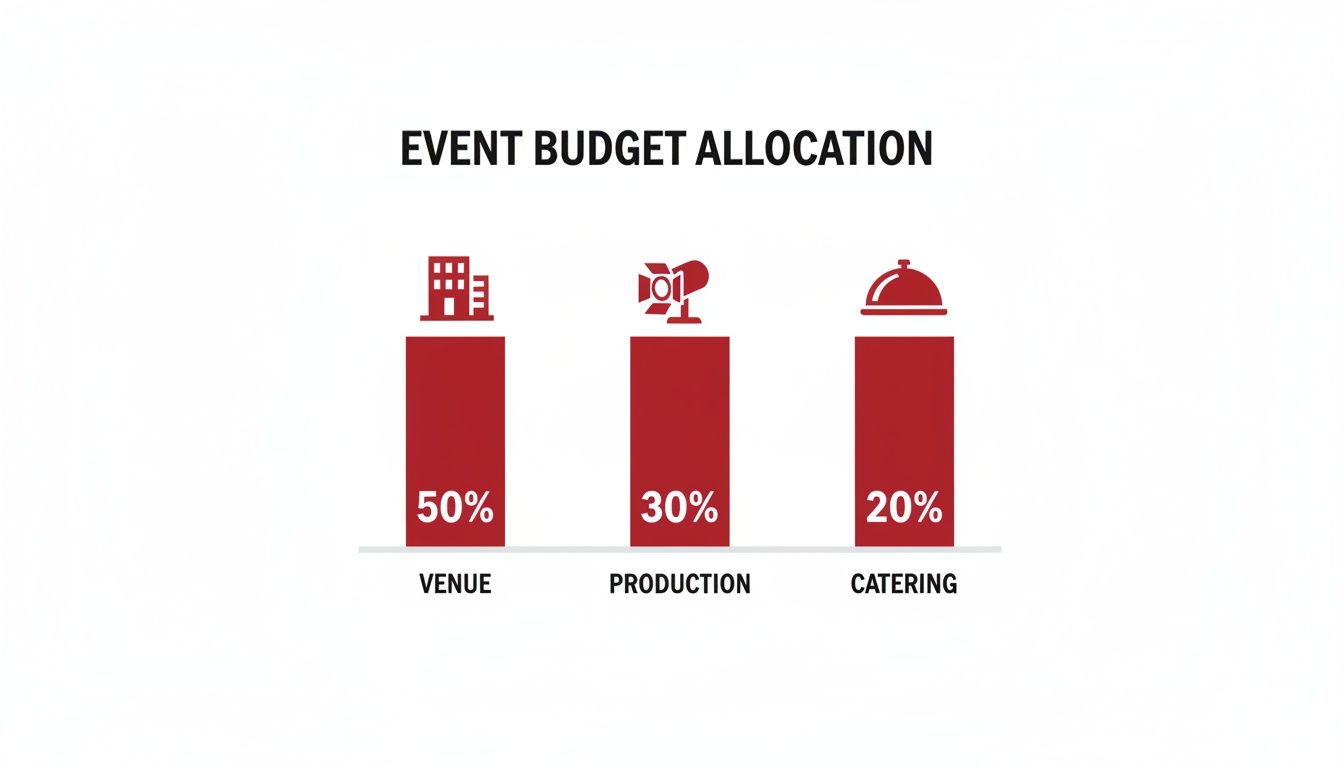
This is exactly why getting accurate quotes for these major categories should be your first and most critical step.
Sample Budget Scenarios
To make this a little more real, let's look at how costs can scale for a couple of common Kansas City events.
Scenario 1: 150-Guest Wedding
For a wedding this size, your production and entertainment budget could cover a great DJ for five hours, a modern photo booth for some fun, and some elegant uplighting to transform the reception hall. This kind of package delivers an amazing guest experience without needing massive staging or complex video setups. For bigger, outdoor events, you'd want to partner with experienced festival production companies who live and breathe those unique logistics.
Scenario 2: 300-Person Corporate Party
Here, the needs—and the budget—expand quite a bit. You’re probably looking at a larger stage for speakers or an awards ceremony, a branded LED video wall for presentations, a high-energy DJ to get the party started after the formalities, and professional audio to make sure every announcement is heard clearly. The scale and technical requirements are just on another level.
Remember: Every quote is a conversation starter. Don't be afraid to ask vendors what's included, what's extra, and if there are ways to adjust the package to better fit your budget. A good partner will work with you.
Understanding budget trends is also key, especially for those planning 2025-2026 events with Showboss KC. While 53% of organizers expect budgets to grow, the landscape is mixed. Data shows that 33% of event budgets are decreasing while 32% are increasing. In major markets, U.S. companies spend around $100,000 annually on events, with event technology being a notable expense where 24% of organizations spend between $10K-$50K yearly.
Managing Contingency Funds and Payment Schedules
An event budget isn't something you create once and file away. It's a living, breathing document. In the real world of event planning, surprises are just part of the job description, and your budget has to be ready to roll with the punches. This is where two things become absolutely critical: a smart contingency fund and a perfectly tracked payment schedule.
Think of your contingency fund as your event's insurance policy. It's the financial cushion that saves you when the unexpected happens. Maybe a sudden thunderstorm forces you to rent last-minute tents, or a key piece of A/V gear goes down and needs an immediate replacement. Without that buffer, these hiccups can turn into budget-breaking disasters.
Building Your Financial Safety Net
The industry standard for a contingency fund is somewhere between 10% and 15% of your total event budget. So for a $50,000 event, you’d want to set aside $5,000 to $7,500 just for those "what if" moments. This isn't just extra cash to play with; it's a dedicated reserve.
Make sure you build this line item directly into your event budget planning template from the very beginning. By treating it as a fixed, non-negotiable expense, you protect it and ensure it's there when you need it. And hey, if you get to the end of your event and haven't touched a dime of it? That’s a huge win—it means your planning was rock-solid.
A contingency fund isn’t an admission of poor planning. It’s the mark of a pro who knows that even the best plans need a backup. It gives you peace of mind and the power to solve problems without panicking about the cost.
Tracking Payments to Manage Cash Flow
Knowing what you'll spend is only half the battle; knowing when you need to spend it is just as important. Every vendor contract is built around payment milestones—deposits to lock in a date, mid-point payments, and final balances due before showtime. Missing one of those deadlines can lead to late fees or, even worse, a vendor pulling out.
A payment schedule tracker is your best friend for managing your event's cash flow. It’s a simple tool, but it's incredibly powerful for preventing financial bottlenecks and keeping everything on track.
You can easily build a tracker right into your budget spreadsheet to monitor key dates and amounts for all your partners.
Sample Vendor Payment Schedule Tracker
| Vendor | Total Cost | Deposit Amount | Deposit Due Date | Final Payment Due Date | Status |
|---|---|---|---|---|---|
| KC Premier Venues | $10,000 | $2,500 | 01/15/2025 | 05/15/2025 | Paid |
| ShowbossKC (AV & LED) | $8,500 | $4,250 | 02/01/2025 | 06/01/2025 | Pending |
| City Catering Co. | $15,000 | $5,000 | 02/10/2025 | 06/10/2025 | Pending |
| Floral Designs Inc. | $3,000 | $1,500 | 03/01/2025 | 06/01/2025 | Pending |
By actively managing these dates, you ensure everyone gets paid on time, you maintain strong vendor relationships, and your event's finances stay predictable from the first deposit to the final invoice. It's all about smooth sailing.
Kansas City AV and Entertainment: What to Really Budget For
If you're planning an event in Kansas City, you already know the vibe is everything. But translating that vibe into a real-world production budget? That's where things get tricky. As the team on the ground here at Showboss KC, we see it all—from intimate galas to massive outdoor festivals. We want to pull back the curtain on what it actually costs to create those "wow" moments.
Putting money toward a high-energy DJ, an immersive LED video wall, or custom lighting isn't just another line item. Think of it as a direct investment in your guest experience.
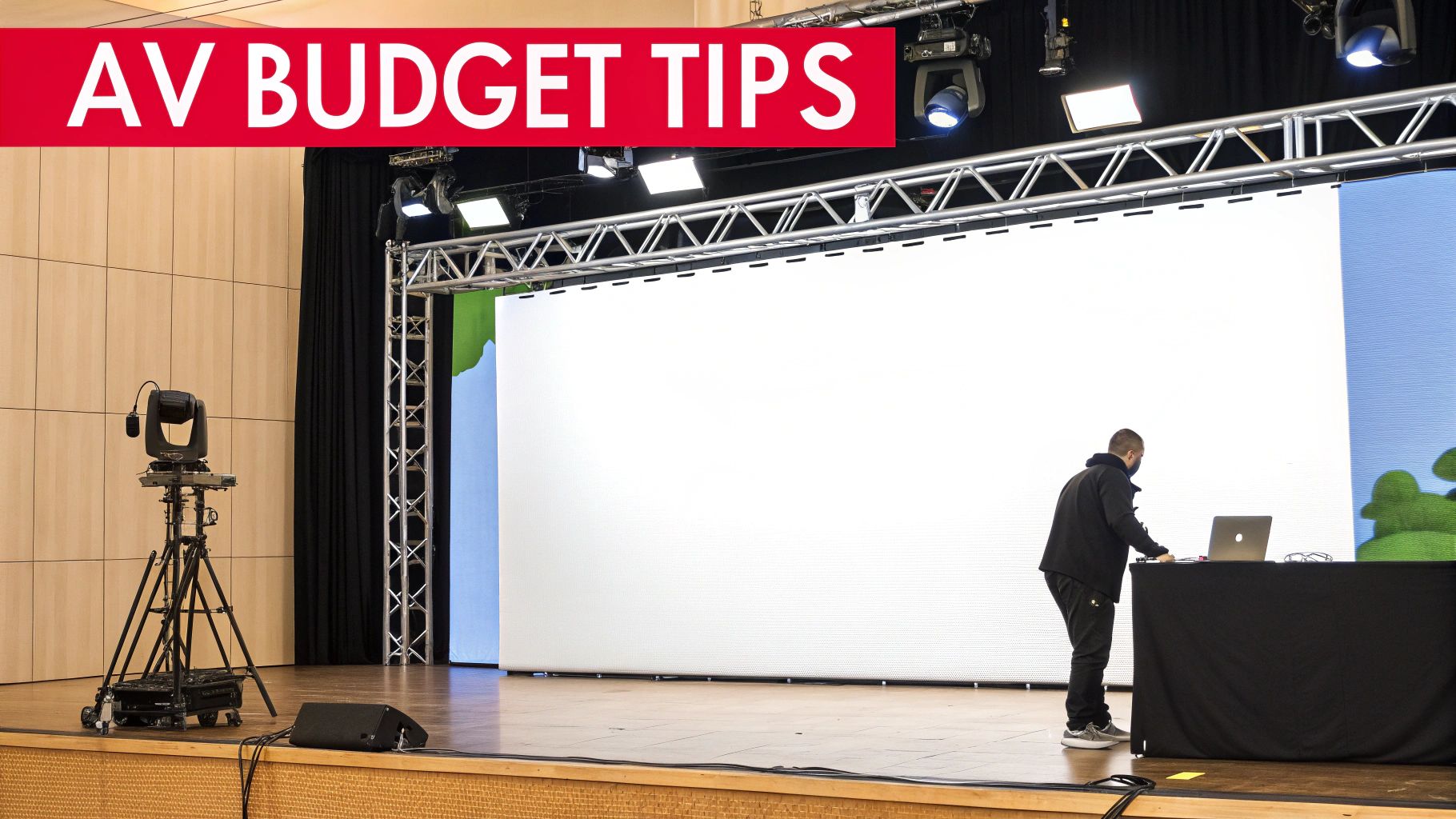
The biggest things that move the needle on AV and entertainment costs are your event size, the venue you choose, and how complex your technical needs are. A simple mic and speaker setup for a small nonprofit fundraiser is obviously going to be in a different league than a full-blown stage production for a corporate brand launch, complete with concert-grade sound and a dazzling light show.
Key Production Cost Factors in KC
Your venue choice is a huge piece of the puzzle. Does it have any AV built-in, or are we building your setup from the ground up? A beautiful ballroom with sketchy power access might mean we need to bring in a generator, which is an expense many people don't see coming.
Likewise, there’s a massive difference between adding some basic uplighting and programming a dynamic, custom light show. Both the price and the impact are worlds apart.
To make the right calls, you have to understand the nuances of audiovisual equipment for events and what each piece of gear actually does for your event's goals.
Your production budget should be a direct reflection of the atmosphere you want to create. It’s the sensory layer of your event—what guests see, hear, and feel. It’s what they’ll remember long after they head home.
It's no surprise that budget headaches are a top concern for planners. For the festival promoters and community groups we partner with right here in KC, having a solid event budget planning template is non-negotiable.
This is getting even more critical as 74% of Fortune 1000 companies plan to increase their event budgets. With over half of them now measuring ROI from live events and 22% of planners calling budget approval a top struggle, a detailed plan is your best tool to justify production as a core investment. You can find more on these event industry statistics at remo.co.
Ultimately, whether you're mapping out a wedding or a city-wide festival, smart production budgeting is all about maximizing your impact. Start with the vision—that unforgettable, high-energy atmosphere—and let's work backward to build a realistic budget that brings it to life.
Answering Your Biggest Event Budget Questions
Even with the perfect template, budgeting for an event can feel like navigating a maze. Questions always come up. Financial planning can get complicated fast, but believe me, untangling these common knots is easier than you think. Let's walk through some of the questions I hear most often from clients.
A huge one is always about saving money without making the event feel cheap. The secret isn't just axing entire categories from your spreadsheet. It's about making smarter, more strategic cuts. For instance, instead of springing for huge, elaborate floral centerpieces on every single table, why not mix it up with a combination of high and low arrangements? You could even repurpose flowers from the ceremony and bring them into the reception space.
Another great strategy is to just ask your vendors for their advice—they're the experts, after all. Ask your caterer if a buffet would be more cost-effective than a plated dinner for your guest count, or see if using in-season ingredients could bring that per-person cost down. These small tweaks really do add up to significant savings.
What Do You Do When a Quote Comes in Way Over Budget?
It happens to everyone. A quote lands in your inbox, and it’s way higher than you planned for. Don't panic. This is just a moment to pause and review, not to scrap the whole plan.
The very first thing you should do is go back to your list of priorities. Is that custom-branded dance floor an absolute "must-have," or is it more of a "nice-to-have"?
If a core, non-negotiable item like catering is the problem, see where you can trim the fat. Could you get away with fewer passed appetizers during cocktail hour? Or maybe switch from a full open bar to a more focused beer and wine package? And remember, that contingency fund is your built-in safety net for essential costs you simply can’t avoid.
Your budget is a living, breathing guide—not a set of rigid rules carved in stone. The real goal is to make smart trade-offs that protect the core vision for your event while keeping you on solid financial ground. It’s all about putting your money where it matters most.
What's the Best Way to Keep Track of Everything?
Spreadsheets are fantastic, but manually logging every single receipt and invoice can become a serious grind. I've found the most successful planners use a combination of their detailed budget template and a good financial tracking app.
- Receipt Scanning Apps: Tools like Expensify or FreshBooks are a lifesaver. You can just snap a photo of a receipt with your phone, and the app will automatically categorize the expense for you. No more manual data entry!
- A Dedicated Bank Account: For bigger events, this is a game-changer. Opening a separate bank account makes tracking income and expenses incredibly simple and clean.
- Regular Check-ins: This is key. Set a weekly reminder for yourself to sit down and update your budget with actual spending. Doing it in small, consistent chunks prevents that last-minute scramble trying to figure out where all the money went.
When you stay organized and on top of it, your budget stops being a source of stress and becomes your single most powerful planning tool.
Ready to get a real handle on your event finances? The experts at Showboss KC are here to help you build a production budget that truly maximizes your impact. Contact us today and let's start planning an unforgettable Kansas City event.