

So, what exactly is an event planning request for proposal (RFP)? Think of it as the strategic blueprint for your event. It’s the document you send out to potential vendors to get competitive bids, but it’s so much more than a simple request for a price tag. A solid RFP lays out your event’s vision, scope, and all the nitty-gritty technical details in one place.
This process is your secret weapon for making sure you can compare apples to apples and find a partner who genuinely gets what you’re trying to achieve.
Why a Great RFP Is Your Most Important Planning Tool
Let's be real—drafting a detailed Request for Proposal can feel like a mountain of work. But in today's event world, it’s the single most important document you’ll put together. A well-crafted RFP does a lot more than just collect quotes. It builds a solid foundation for a successful partnership and saves you from a world of headaches, budget blowouts, and mismatched expectations down the road.
Your RFP is a strategic filter. It’s designed to attract serious, professional vendors who have the chops to bring your vision to life, while politely showing the door to those who just aren’t the right fit. This isn't just about paperwork; it's about articulating your vision with absolute clarity, whether you're planning a massive corporate gala in Kansas City or an intimate backyard wedding.
Beyond a Simple Price Check
One of the biggest mistakes I see is planners treating the RFP like a basic price-shopping exercise. The real magic of a great RFP is its ability to communicate complexity and uncover a vendor's creative problem-solving skills. It pushes potential partners to move beyond their generic service packages and think critically about your specific needs.
This approach is more important than ever. While the total number of event inquiries has cooled off a bit, the value of events sourced through RFPs is actually on the rise. The total market value recently hit £666,721,431, a 2% increase from the previous year. This tells us one thing: clients are looking for more comprehensive, high-value event solutions, not just the cheapest option. You can learn more about what these event industry trends mean for planners.
Your RFP isn’t an administrative hurdle; it's the first step in building a collaborative relationship. It tells vendors you are a serious client with a clear vision, which in turn motivates them to deliver their most creative and competitive proposals.
Ultimately, the time you put in upfront pays off in a big way. It helps you:
- Establish Clear Expectations: Nail down every single requirement, from technical specs to creative must-haves.
- Ensure Fair Comparisons: Evaluate every vendor against the same detailed checklist, making your decision objective and defensible.
- Mitigate Risks: Spot potential roadblocks and tackle them head-on before any contracts are signed.
- Find a True Partner: Move past a transactional relationship and choose a vendor who truly aligns with your goals.
Building the Core of Your Event RFP
If you want proposals you can actually use—ones that are easy to compare and evaluate—you have to get the foundation of your RFP right. This isn’t just about listing a few needs; it’s about building a solid structure that gives vendors everything they need to deliver their sharpest, most accurate, and most creative ideas.
Think of it this way: you're providing the recipe. Without the core ingredients and clear instructions, you can't expect anyone to bake the cake you've been imagining. A well-built RFP eliminates the guesswork, ensuring every vendor is bidding on the exact same project. That makes your final decision a whole lot easier.
What Does Success Look Like? Defining Your Event Objectives
Before you get into the nitty-gritty of logistics, you have to nail down the "why." What does a win actually look like for this event? Vague goals like "increase brand awareness" just don't cut it. You need specific, measurable targets that a potential partner can sink their teeth into.
For a corporate product launch, a powerful objective sounds more like this: "Generate 150 qualified sales leads and land coverage in three key industry publications." For a non-profit gala, it might be: "Raise $75,000 through ticket sales and a live auction, while boosting donor engagement by 20%."
See the difference? These concrete goals give vendors the context they desperately need. It tells an AV company that the stage presentation better be flawless for the cameras, or it lets an entertainment booker know their act needs to complement the fundraising moments, not overshadow them.
Laying It All Out: Detailing the Scope of Services
This is your chance to outline exactly what you need a vendor to do. Trust me, ambiguity here is the number one reason for scope creep and blown budgets down the road. You have to be exhaustive.
Break it all down into clear categories. For a big corporate conference, that might look like:
- Audio/Visual Production: Main stage sound, projectors and mics for multiple breakout rooms, and live streaming capabilities.
- Lighting Design: Stage lighting for the keynotes, ambient uplighting for the reception hall, and custom gobos splashing the company logo on the walls.
- Entertainment: Booking the keynote speaker, a live band for the after-party, and a DJ to keep the energy up during networking breaks.
When you're juggling this many moving parts, you'll want to find event production companies near you that deliver comprehensive services. A full-service shop can be a lifesaver, streamlining communication and often finding cost savings by bundling services together.
A detailed scope of services is a vendor's best friend. It's a checklist that ensures they address every single one of your needs, forcing them to price their proposal accurately right from the start. No assumptions, no surprises.
Setting the Pace with a Realistic Event Timeline
A clear timeline is non-negotiable. It lets vendors immediately check their availability and figure out if they even have the bandwidth to pull off your event. And I'm not just talking about the event date itself. A truly useful RFP includes a master schedule with all the key milestones.
- Pre-Event Phase: Include deadlines for vendor selection, dates for initial planning meetings, and windows for site visits and technical walkthroughs.
- Event Day: Sketch out a draft run-of-show. Be sure to include vendor load-in times, setup deadlines, event start/end times, and the teardown schedule.
- Post-Event Phase: Note any deadlines for final invoicing or the return of rental gear.
This level of detail signals that you’re organized and you respect a vendor's operational needs. It lets them build a realistic production schedule and staff up accordingly, which ultimately leads to a much more accurate proposal for you.
To help you organize these crucial details, here’s a quick rundown of what every winning RFP should contain.
Essential Components of a Winning Event RFP
| Component | What to Include | Why It's Important |
|---|---|---|
| Event Objectives | Specific, measurable goals (e.g., generate 150 leads, raise $75,000). | Provides context and helps vendors align their creative solutions with your desired outcomes. |
| Scope of Services | A detailed, itemized list of all required services (AV, lighting, staging, etc.). | Prevents scope creep, eliminates guesswork, and ensures proposals are directly comparable. |
| Event Timeline | Key dates for pre-event, event day, and post-event phases. | Allows vendors to confirm availability, plan resources, and build an accurate production schedule. |
| Budget Range | A realistic budget or range (e.g., $40,000 – $50,000 for production). | Guides vendors to propose solutions that are financially viable and encourages creative problem-solving. |
| Submission Details | Deadline, contact person, and required proposal format. | Ensures you receive all information in a consistent format by your deadline, simplifying your review process. |
Getting these elements right from the start makes the entire process smoother for everyone involved.
Don't Be Shy About the Budget
I get it. A lot of planners hesitate to share their budget, afraid that vendors will just max it out. But holding that number close to your chest is one of the biggest mistakes you can make. Without a budget range, you’re guaranteed to get proposals that are all over the map—some way too high, others suspiciously low, and almost none that actually fit.
Be transparent. Give them a realistic range, like "$40,000 – $50,000 for all production elements." This empowers vendors to pitch solutions that deliver the absolute best value within your means. It sparks creativity, as they can suggest smart ways to make your money go further. As you build out these requirements, you can streamline data collection by using standardized event vendor application forms.
By clearly laying out your objectives, scope, timeline, and budget, you’re not just writing a document—you’re setting the stage for a successful partnership from day one.
How to Ask Questions That Reveal True Expertise
The quality of your RFP really boils down to the questions you ask. Let’s be honest, asking things like "Do you have experience with corporate events?" is a waste of everyone's time. You’ll just get a "yes," and you've learned nothing.
To find a true partner—someone who will elevate your event, not just service it—you have to ask questions that force them to think. You want to see their problem-solving skills, technical depth, and creative instincts in action. This is how you get past the polished sales pitch and see how they actually work.
Beyond the Basic Yes or No
Surface-level questions are the enemy of a great RFP. They give you nothing meaningful to compare vendors on, except for price, which is a race to the bottom. To get real insight, you need to frame questions that encourage a story, not just a one-word answer. The core idea is to write questions that get honest answers, and the same principles apply here.
Instead of asking if they can handle a large event, make them prove it. Try something like this:
"Describe the largest and most technically complex event you've produced in the last 18 months. What were the specific logistical hurdles you faced on-site, and how did your team work through them?"
A single question like that tells you so much more. It reveals their real-world experience, how they define "complex," and their approach to a crisis. That’s the kind of data you can actually use.
Probing Questions for Audio and Visual Vendors
AV is often the most technical—and most expensive—part of any event. It’s also where a small mistake can have a huge impact. Your questions need to dig deep into their gear, their know-how, and what they do when things inevitably go sideways.
Don't just ask for a gear list. Focus on a real scenario you’re facing.
- For Audio: "Our keynote speaker is famously soft-spoken, and the ballroom has terrible acoustics—high ceilings, lots of glass. What’s your specific plan to guarantee crisp, clear audio for all 500 guests in the room and for our global live stream?"
- For LED Video Walls: "We're planning a 30-foot LED wall for a dynamic backdrop. Walk me through your content management process. How do you help clients prep graphics for the best resolution, and who on your team is actually running the media cues during the show?"
- For Lighting Design: "We want to do more than just a basic stage wash. How would you use lighting to make a generic ballroom feel like an immersive brand experience using our navy and gold colors? Give me two different creative ideas and tell me what fixtures you'd use to pull them off."
These kinds of questions make vendors show their work. They have to design a solution for your problem, which gives you a fantastic preview of what it would be like to partner with them.
Uncovering Creativity in Entertainment and Staging
When you're hiring for entertainment or staging, you're looking for more than a band or a platform. You need a partner who understands mood, manages talent, and builds a safe, impressive environment.
Your questions should test both their creativity and their logistical chops.
- For Entertainment Management: "Our awards show has a jam-packed schedule. How do you manage talent—from pre-show communication to green room logistics and rehearsals—to ensure every single performer hits their mark on time?"
- For Staging and Rigging: "We need a multi-level stage with rigging points for aerialists. Tell me about your safety and engineering review process. What certifications do your riggers have, and can you share an example of a structural challenge you solved during a past event build?"
Why These Questions Work
This approach does three things incredibly well. First, it immediately weeds out the lazy vendors who just copy and paste their proposals. If they won't put in the effort to answer thoughtfully, they're not the partner you want.
Second, it gives you rich, qualitative information that makes your scoring matrix a whole lot more powerful. You can compare one vendor’s detailed audio plan against another’s, giving you a real sense of who truly knows their stuff.
Finally, it sets the stage for a collaborative relationship. Asking smart questions shows you’re a serious client who values real expertise. This attracts the best vendors—the ones who are looking for a true partnership, not just another gig.
Alright, the proposals are rolling in. Now the real fun begins. How do you sift through all the slick presentations and get to the heart of which vendor is actually the right one for your event? It's time to move past "gut feelings" and into a smart, structured decision-making process.
Setting up a formal evaluation process isn't just about being fair—it's about being smart. It ensures you're comparing apples to apples and that your final choice can be confidently explained to your team or stakeholders. Plus, it helps you spot the truly professional and responsive partners right from the get-go.
Establishing Your Scoring Criteria
Before you even glance at the first proposal, you and your team need to be on the same page about what really matters. This is where a scoring matrix is your best friend. Think of it as a simple spreadsheet that lists your non-negotiables and assigns a weight to each based on its importance to your event's success.
Your criteria should be a direct reflection of the goals you laid out in your RFP. I typically break it down into a few key areas:
- Portfolio and Experience (30%): Does their past work match the scale and style of your event? Have they handled similar technical or logistical headaches before? You need proof they can walk the walk.
- Creative and Technical Proposal (30%): How well did they actually answer your questions? Did they bring fresh ideas to the table, or just send a generic template? Their plan should feel like it was built just for you.
- Team and Communication (20%): Who is your point person going to be? Does their team have the right mix of expertise? Pay attention to how they communicated during the proposal process—it’s a preview of what’s to come.
- Budget and Value (20%): Notice I said value, not just price. Is their pricing transparent? Does the cost make sense for the quality and services they’re offering?
The lowest bid is rarely the best deal. A vendor might undercut everyone else, but if their technical plan is shaky and their experience doesn't line up, you're not getting good value—you're buying a future problem.
The Power of a Scoring Matrix in Action
Here’s how it works in the real world. For each criterion, you'll rate every vendor on a simple scale, maybe 1 to 5. Then, you multiply that score by the weight you assigned. Tally it all up, and the vendor with the highest score is your top contender, at least on paper.
For example, Vendor A might be a perfect 5 on budget but only a 2 on their creative ideas. Meanwhile, Vendor B is a bit pricier—let's say a 4 on budget—but they knock it out of the park with a 5 on their creative and technical solution. The weighted score will instantly show you that Vendor B is probably the stronger strategic partner for the long run.
This methodical approach takes a subjective choice and makes it objective. It forces you to look past the flash and focus on substance, ensuring your decision is based on capability, not just charisma.
It’s all about asking the right questions, analyzing the answers for real expertise, and finding a partner who can innovate with you.
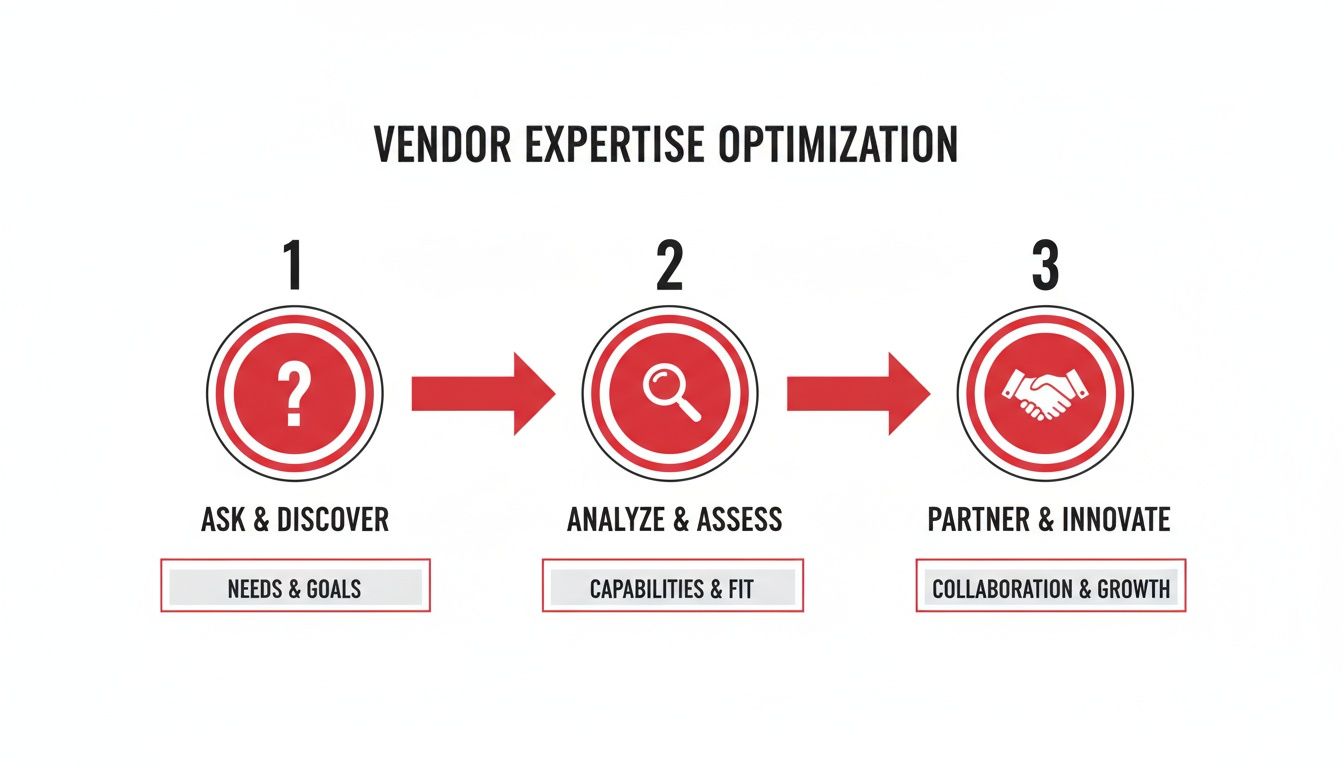
This simple flow—Ask, Analyze, Partner—is the backbone of a great vendor selection strategy. It turns your RFP from a simple document into a tool for building incredible partnerships.
Beyond the Numbers
The scoring matrix will get you 90% of the way there, but the final call often needs that human touch. I always recommend taking your top two or three vendors to a final round.
This is your chance to:
- Schedule Finalist Presentations: Invite them to present their proposal and let your team grill them with follow-up questions.
- Check Their References: Don't skip this! Talk to their past clients and ask pointed questions about their on-site problem-solving and post-event support.
- Do a Chemistry Check: A final call or in-person meeting is perfect for seeing if their team’s vibe actually clicks with yours. You'll be working closely together, after all.
A tight evaluation process is crucial, especially when you consider the stats. Data shows 42.6% of planners struggle to get timely venue proposals, and while 80% of us expect a response within four days, a whopping 39% of vendors miss that deadline. A rigorous process helps you weed out the disorganized ones from the start.
By mixing hard data from your matrix with these qualitative insights, you can pick a partner who won't just meet expectations but will help you knock your event out of the park. To make sure your evaluation criteria line up with your ultimate goals, check out our guide on how to measure event success.
Maximizing Your Budget and Finding Value
Let's talk about the elephant in the room: money. Discussing the budget in an RFP can feel like a high-stakes poker game. Many planners hold their cards close, worried that if they reveal their number, vendors will just inflate their prices to meet it.
But I’ve seen the opposite happen time and time again. Hiding your budget is the fastest way to get a stack of proposals that are all over the map, impossible to compare, and completely disconnected from what you can actually afford.
Being upfront about your budget isn't just helpful—it's a power move. It shows vendors you’re serious and have done your homework, allowing them to skip the guesswork and focus on pitching solutions that give you the most bang for your buck.
Frame Your Budget as a Creative Challenge
Don’t just drop a number and walk away. Frame your budget as the starting point for innovation. When you present a clear budget range, you challenge vendors to prove how they can deliver an incredible experience within your financial reality.
For example, instead of leaving that line item blank, try phrasing it like this:
"Our all-in production budget for this corporate gala is in the $50,000 – $60,000 range. We're looking for a partner who can pitch a full AV, lighting, and staging solution that creates a genuine 'wow' factor while showing us exactly where the value is."
This simple shift invites vendors to put on their consultant hats. They might suggest a killer LED wall instead of pricey custom-built sets, or propose a smart lighting design that does the heavy lifting, letting you scale back on other décor. You unlock their problem-solving skills and get a much clearer picture of who will be a true partner in the process.
The Power of Tiered Pricing and Bundled Services
One of the best tricks I've learned for finding value is to ask for tiered pricing options right in the RFP. This gives you an instant, clear-cut view of what’s possible at different investment levels.
It’s easy to structure this request:
- The Essentials: What does a successful event look like if we stick to the lower end of our budget?
- The Enhanced Experience: What cool extras (like advanced lighting or bigger video screens) can we add at the mid-range?
- The Ultimate Vision: If we can stretch to the top of our budget, what truly unforgettable moments can you create for us?
Suddenly, a simple quote becomes a collaborative roadmap. It also makes those internal conversations with your boss or stakeholders so much easier because you can point to the tangible benefits of a higher investment. If you need a hand organizing these numbers, our event budget planning template is a great place to start.
This strategy is more critical than ever. While 74% of event marketers are expecting budget increases, those budgets are only projected to rise by about 11%. Meanwhile, actual event costs are forecast to climb by 12%. That tiny gap puts a massive squeeze on planners.
This is where bundling services becomes your secret weapon. By consolidating audio, lighting, video, and entertainment with a single full-service provider, you gain major efficiencies. It simplifies your logistics and gives you more negotiating power, helping you close that budget gap and deliver more value for every dollar spent.
Got Questions About Event RFPs? We’ve Got Answers.
Jumping into the request for proposal process can feel like a maze, even for seasoned planners. No matter how buttoned-up your plan is, tricky situations always pop up and leave you second-guessing the next best move.
I’ve been there. So, I’ve pulled together some of the most common questions that cross a planner’s desk. Think of this as your go-to guide for those “what if?” moments. My goal is to clear up any confusion and give you the confidence to ace your vendor search.
How Far Out Should I Send My Event RFP?
This is a big one. Timing is everything, especially when you’re trying to lock in A-list vendors and services. Send your RFP too late, and your top choices will already be booked solid. Send it too early, and you might get proposals based on outdated pricing or capabilities.
The scale of your event is your best guide.
As a rule of thumb, here’s what I recommend:
- For large-scale events—think corporate conferences, music festivals, or those spectacular, once-in-a-lifetime weddings—get your RFP out the door 6 to 12 months in advance. This gives premier vendors the breathing room they need to check availability, huddle with their teams, and put together a proposal that’s truly thoughtful.
- For smaller, less complex events, like a single-day corporate meeting or an intimate private party, a lead time of 3 to 6 months usually works just fine.
No matter the size, always give vendors at least 2 to 4 weeks to respond. Rushing the deadline is a surefire way to scare off the best partners. The pros need time to craft a proposal that actually solves your problems, and they’ll pass on an opportunity that feels frantic from the start.
Should I Send My RFP to a Ton of Vendors or Just a Few?
It’s tempting to think that casting a super-wide net will land you the best fish, but with RFPs, the opposite is almost always true. Blasting your request to dozens of vendors just invites a tidal wave of generic, low-effort responses you’ll have to wade through. It's a waste of your time and theirs.
Instead, zero in on quality over quantity. The sweet spot is typically 3 to 5 well-researched vendors.
Seriously, taking the time to pre-qualify your vendor list is one of the smartest moves you can make. A targeted approach shows vendors you’re a serious client, and that’s what motivates them to put real time and creativity into their proposal for you.
Do your homework before you hit send. Dig into their portfolios, read every client testimonial you can find, and stalk their social media to get a feel for their style. This initial legwork ensures you’re only talking to companies whose work genuinely lines up with your vision.
What Are the Biggest Mistakes to Avoid in an Event RFP?
I've seen a few common missteps completely derail an otherwise solid RFP process. They lead to confusion, weak proposals, and a whole lot of frustration. Here are the top three to watch out for.
- Being Way Too Vague: Asking for "AV services" or "event entertainment" is going to get you a vague, copy-paste proposal that’s impossible to compare against another. Get specific. Do you need two wireless lavalier mics or ten? Are you looking for a 90s cover band or a string quartet? The details matter.
- Not Giving a Budget Range: We’ve talked about this, but it’s worth repeating—hiding your budget helps no one. It forces vendors to guess, leaving you with proposals that are either wildly expensive or disappointingly bare-bones. Being upfront leads to realistic, creative solutions that fit your world.
- Setting Crazy Deadlines: An impossible timeline for responses or for the event itself will send experienced pros running for the hills. They know what it takes to do a job right, and a rushed schedule is a massive red flag that signals chaos ahead.
Avoiding these is simple: be specific, be transparent with your budget, and be realistic with your timeline.
Should I Include My Evaluation Criteria in the RFP?
Yes, you absolutely should. Sharing how you’ll be scoring proposals right in the RFP document is a pro move. It signals that you’re organized and transparent, and trust me, vendors appreciate it.
When you tell them what you’re prioritizing—whether it’s creative ideas, technical chops, proven experience, or the best overall value—you give them a roadmap. It lets them shape their response to show off their strengths in the areas that matter most to you.
This one simple step helps you get sharper, more relevant proposals and sets a collaborative, fair tone from day one.
Ready to create an event experience people will be talking about for years? The team at Showboss KC is all about full-service production. We handle everything from immersive LED video walls and crystal-clear audio to high-energy DJs and custom lighting that will completely transform your space. Let's bring our expertise and creativity to your next wedding, corporate event, or festival. Learn more about our services at https://showbosskc.com.