

So, you’ve decided you need a pro to handle your event production. Great first step. But a quick search for "event production companies near me" probably just dumped a massive, generic list on you. It's overwhelming, and honestly, not that helpful.
Let's cut through the noise. The secret is knowing where to look and what to ask for. Instead of casting a wide, sloppy net, we’re going to be strategic and build a solid shortlist of real contenders.
Starting Your Search for the Right Local Partner
Forget the generic Google search for a minute. Your first move should be to look on platforms where the pros already are.
Planning a wedding? You’re going to have much better luck on sites like The Knot or WeddingWire. For a big corporate conference, industry-specific portals like Cvent are goldmines. These places have already done a lot of the initial filtering for you.
And don’t forget your own network. Seriously, a quick post on LinkedIn asking for local event production recommendations can work wonders. You’ll get honest feedback from people who’ve been in your shoes, which is way more valuable than a random online ad.
Refining Your Search Terms
Now, let’s talk about how you search. The words you use completely change the results you get. "Event production companies near me" is just too vague.
You need to tell the search engine exactly what you’re planning. Think about what makes your event unique—the type, the services, the location.
Try searches like these instead:
- "Corporate conference production in Kansas City"
- "Outdoor festival AV and staging services near me"
- "Non-profit gala lighting and sound design"
See the difference? A company that’s brilliant at producing rock concerts probably isn't the right vibe for an elegant fundraising gala. Getting specific from the get-go saves you a ton of time.
From a Long List to a Shortlist
Okay, you’ve gathered a few names. Now it's time to create a shortlist. This isn’t the deep-dive vetting process yet; think of it as a quick, gut-check filter.
Hop over to each company's website with two simple goals: check out their portfolio and scan their reviews.
First, the portfolio. Are they showcasing events that look and feel like yours? If you’re planning a sleek product launch, you want to see sharp, corporate work, not just a bunch of rustic barn weddings. Look at the quality of their lighting, their stage designs, and the overall atmosphere they create.
A strong portfolio is more than just pretty pictures. It’s a visual resume. It shows you what a company is capable of, how creative they are, and if they’ve handled an event like yours before.
Next, hit the reviews on Google, Yelp, or industry-specific sites. You’re looking for patterns. Are clients constantly talking about their great communication and on-the-fly problem-solving? Or are there consistent complaints about disorganization and technical glitches? A few bad reviews happen, but a pattern is a definite red flag.
This quick screening process is non-negotiable. The U.S. alone has over 12,000 event planning companies, so narrowing down your options is a must. (If you want to go down a rabbit hole on industry stats, GrandViewResearch.com has some interesting insights.) Once you’ve done this, you’ll have a manageable list of high-potential partners actually worth calling.
A Practical Vetting Checklist for Potential Partners
Once you have a shortlist of potential event production companies, the real work begins. It’s time to move beyond their polished portfolios and figure out if they're a true partner or just another vendor.
This is all about seeing how they handle pressure and confirming they have the right experience to manage an event of your specific scale and complexity.
This initial process—defining your needs, searching for partners, and creating that shortlist—is the foundation for everything that follows. The visual guide below breaks down these critical first steps before you start making calls.
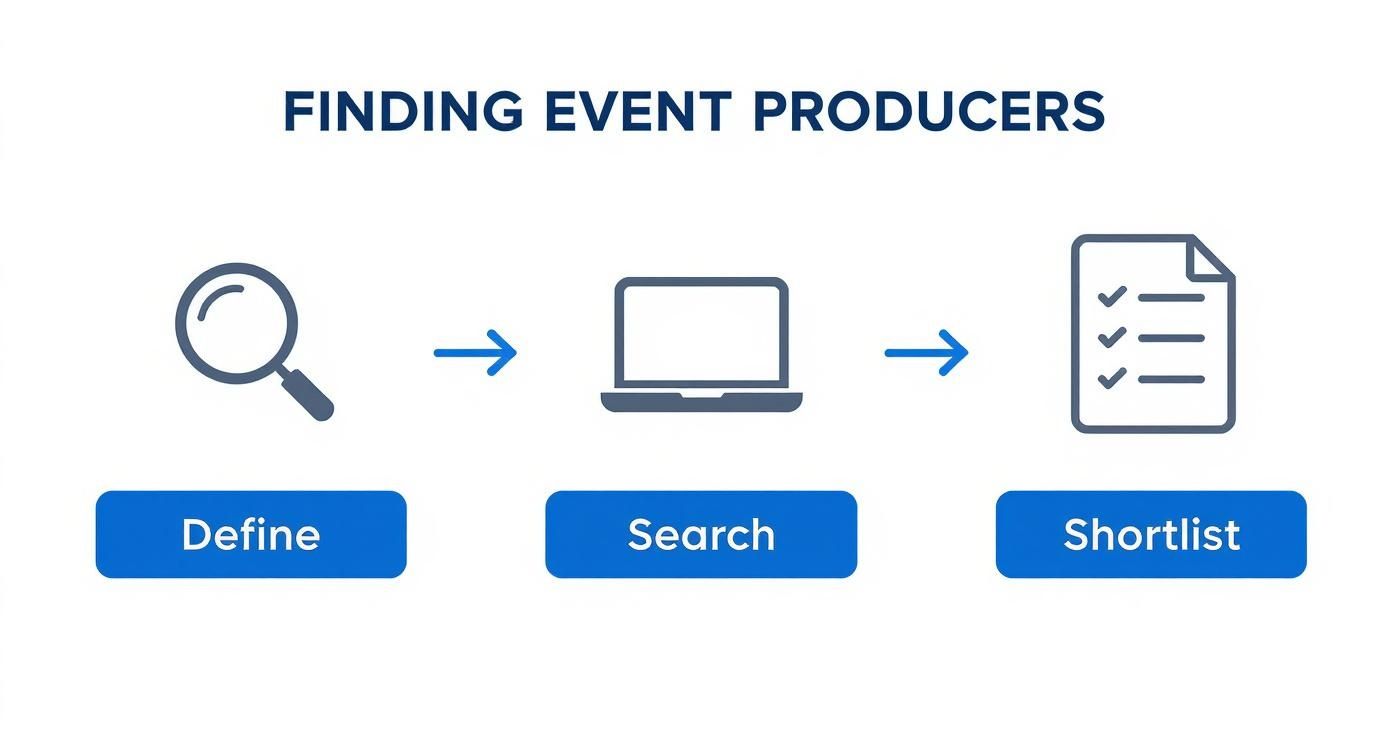
Following this simple flow—Define, Search, Shortlist—ensures you're not just picking names out of a hat. You're building a curated list of qualified candidates right from the start.
Analyzing Portfolios with a Critical Eye
A slick portfolio is standard these days, but you need to look closer. Don't just get wowed by flashy photos; analyze them for how they relate to your event. Are they showing off a massive outdoor festival when you're planning an intimate corporate retreat?
Look for proof of events that match your:
- Scale: Can they actually handle your expected guest count, venue size, and all the moving parts?
- Complexity: Do they have a track record with multi-day conferences, hybrid events, or tricky technical setups if that's what you need?
- Style: Does their vibe—whether it's buttoned-up corporate or wildly creative—align with your brand and vision?
An event producer whose portfolio is packed with huge concerts might not have the right touch for a high-end VIP brand activation. Their experience has to be directly applicable.
The goal is to find proof that they have successfully solved problems similar to the ones you anticipate. A beautiful portfolio is nice, but a relevant one is essential.
Key Questions to Ask During Initial Calls
That first phone call is your chance to get past the sales pitch. Your questions should be designed to uncover their real problem-solving skills, their communication style, and how deep their operational knowledge goes.
Go beyond the basic "What services do you offer?" and dig a little deeper.
Get ready with questions that probe their real-world experience:
- "Can you walk me through a time an event had an unexpected technical glitch, and how did your team fix it on the fly?" This tells you everything about their crisis management skills and how they perform under pressure.
- "Who would be my main point of contact, and who will physically be on-site running things on the event day?" It's critical to know if you'll be working with the senior person who sold you the package or a junior coordinator.
- "How do you handle coordinating all the different vendors in the weeks leading up to an event?" This question reveals their logistical process and how they make sure all the moving parts work together seamlessly.
Their answers should give you a clear picture of their hands-on approach. Vague responses are a huge red flag—it often means they lack direct experience or have a disorganized process.
Verifying the Essentials
Finally, before you get too far down the road with anyone, you have to verify the non-negotiables. This step protects you and ensures you're partnering with a legitimate, professional operation.
- Insurance: Ask for a certificate of insurance (COI). At a bare minimum, they need to have general liability insurance.
- Credentials and Reviews: Don't just take their word for it. Look up reviews and, if you can, ask for references from past clients who hosted events similar to yours.
- Team Structure: Get a clear understanding of what they do in-house versus what they subcontract. Do they own their audio-visual gear, or are they just renting it? This can seriously impact both your budget and the quality control on event day.
To help you keep track of these details, we've put together a quick-reference checklist. Use this table to compare your top contenders side-by-side and see who really measures up.
Event Production Company Vetting Checklist
| Vetting Criteria | What to Look For | Red Flags |
|---|---|---|
| Portfolio Relevance | Examples of events similar in size, style, and complexity to yours. | All examples are for a totally different type of event (e.g., concerts vs. corporate). |
| Problem-Solving Skills | Clear, specific stories of handling on-site issues with confidence. | Vague or generic answers about "being prepared for anything." |
| Communication & Team | A dedicated point of contact; clarity on who will be on-site. | Unclear who you'll be working with; high turnover in their team. |
| Vendor Management | An established process for coordinating with caterers, venues, etc. | No clear process; they seem to "wing it." |
| Insurance & Legitimacy | A valid Certificate of Insurance (COI) provided promptly upon request. | Hesitation or inability to provide proof of insurance. |
| Technical Capabilities | In-house gear and expertise, especially for key A/V needs. | They subcontract almost everything, limiting their control over quality. |
| Reviews & References | Positive, detailed reviews and a willingness to provide references. | No recent reviews, or they are unwilling to connect you with past clients. |
This kind of due diligence is what separates a stressful, chaotic event from a seamless, memorable one.
For those planning larger corporate gatherings, having a structured approach is key. You can find more detailed guidance in our complete corporate event planning checklist, which helps organize every one of these vetting steps.
Understanding Their Services and Pricing Structures
Getting a proposal from an event production company can sometimes feel like trying to translate a different language. To really know you're making the right choice, you've got to get a firm grasp on what they're offering and how they're charging for it.
First off, not all "event production companies near me" are built the same. Some are all-in, offering full-service production that covers every single detail from the very first brainstorm to the last bit of cleanup. This is the "don't worry, we've got this" approach. It's perfect if you want one point of contact to handle everything and ensure the entire event feels cohesive.
On the flip side, plenty of companies offer à la carte services. This lets you cherry-pick exactly what you need. Maybe you just need an expert audio engineer, some killer lighting design, or someone to manage the A/V for your keynote speaker. This model is a lifesaver when you have most of the event handled but need a specialist for the more technical pieces.
How They Bill: Decoding the Common Pricing Models
Once you know what services they offer, you'll see those reflected in a few common pricing setups. Each has its place, and the right one for you really depends on your event's complexity and how predictable your budget needs to be.
- Flat Project Fee: This is one all-in price for the whole shebang. It’s fantastic for events with a locked-in budget, like a corporate conference, because it eliminates surprises. You know the grand total from day one.
- Percentage-Based Cost: With this model, the company charges a percentage—usually around 15-20%—of your total event budget. You see this a lot with huge festivals or big-ticket galas where costs might shift as you bring on new vendors or add more elements.
- Hourly Rates: Some producers, especially freelancers, will charge by the hour for their time in planning, consulting, and managing on-site. This can be a great deal for smaller, specific tasks, but watch out—it can add up fast for big, complex events if there's no cap.
A good proposal should spell everything out. If you see a vague line item like "Production Management," don't be shy. Ask for a detailed breakdown of exactly what that covers, from pre-pro meetings to the number of on-site staff hours.
Reading Between the Lines of a Quote
The number on the proposal isn't always the final number. Hidden costs are notorious for blowing up a budget if you aren't looking for them. A true partner will be upfront about everything, but it's still on you to check. For a deeper look at all the moving parts, our guide on what is event production is a great resource.
Keep a sharp eye out for these potential budget-busters:
- Staffing: Does the quote clearly define standard hours versus overtime? Labor costs for late-night teardowns or early-morning setups can be way higher.
- Permits and Insurance: Who's handling the city permits, venue fees, or any special insurance policies needed? Make sure you know if that's on them or you.
- Contingency: Is there a contingency fund built into the budget for those "just in case" moments, or will you be billed extra when something unexpected pops up?
- Travel and Accommodation: For out-of-town staff or specialty gear, are travel costs laid out clearly, or are they hiding inside a generic "administrative fee"?
Asking these direct questions from the get-go is about more than just saving money; it’s about finding a partner who values transparency and respects your budget. That kind of clarity is what a great event—and a great partnership—is built on.
Why Hybrid and In-Person Event Expertise Matters
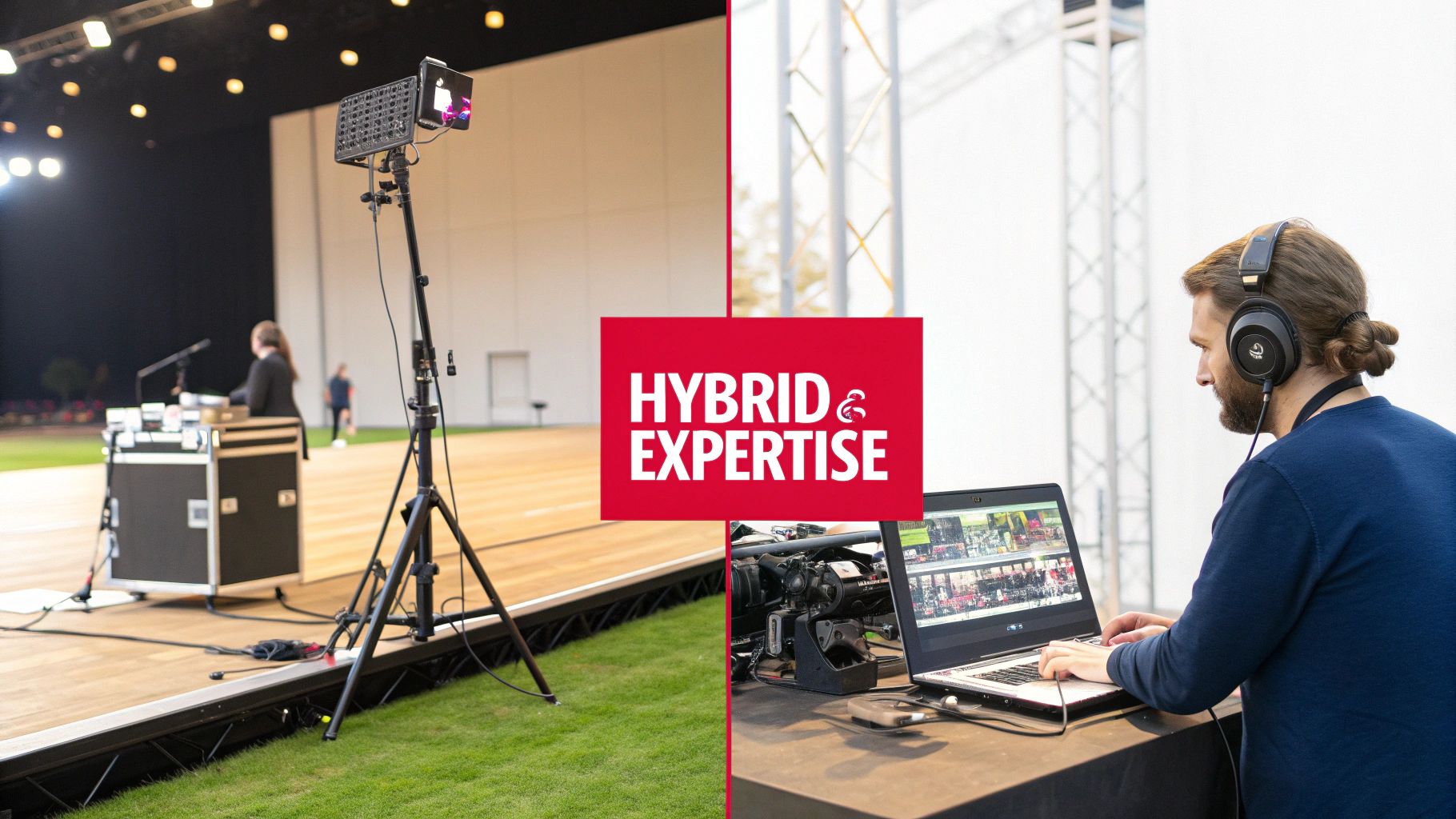
The event world simply isn't a one-size-fits-all game anymore. Your choice of a local production partner has to reflect that. A company that only knows how to run a traditional, in-person event might not have the technical chops for a flawless hybrid experience—and the same goes for the other way around.
You need a team that’s fluent in both languages.
Mastering the In-Person Experience
For purely in-person events, the expertise is tangible. It’s all about understanding the physical space, managing crowd flow, designing an immersive stage environment, and making sure the audio is perfect in every single corner of the room.
This kind of mastery only comes from hands-on experience with venue logistics, power distribution, and rigging. Success in a live setting really comes down to controlling the atmosphere. It's so much more than just setting up some speakers and lights; it's a sensory art form.
- Atmospheric Design: A truly skilled production team uses lighting, sound, and scenic elements to craft a specific mood that clicks with your brand and event goals.
- Logistical Precision: They’re the ones managing the complex dance of vendor load-ins, run-of-show schedules, and on-the-fly troubleshooting without your guests ever noticing a single hiccup.
- Audience Engagement: They build an environment where attendees feel connected and captivated, from crystal-clear keynote audio to dynamic visual backdrops.
When you search for "event production companies near me," you're looking for more than equipment renters. You're hunting for architects of experience who can transform an empty space into a moment people won't forget.
The Technical Demands of Hybrid and Virtual Events
The moment you bring in a remote audience, a totally different skill set becomes critical. This is where technical proficiency is completely non-negotiable. It’s no longer just about what’s happening in the room; it's about broadcasting a stable, high-quality stream to potentially thousands of people.
Your ideal partner gets the nuances of platform management, interactive tools like live polls and Q&A sessions, and ensuring remote speakers look and sound completely professional. For them, a successful hybrid event means the online audience feels just as valued as those attending in person. This blend of physical and digital know-how is essential for pulling off successful high-end corporate events today.
Even with the rise of digital formats, face-to-face gatherings are still incredibly powerful. The data backs this up: 60% of event revenue still comes from physical events, and 83% of planned meetings are expected to include an in-person component. People crave that connection. You can explore more on these event market trends to see how these dynamics are shaping the industry.
This is exactly why finding a local partner with rock-solid in-person production skills is still absolutely vital.
You've done the hard work. You've sorted through the proposals, asked all the right questions, and picked out the perfect local event production partner. Now comes the part that turns a handshake into a rock-solid plan: finalizing the partnership.
This isn't just about getting a signature on a piece of paper. It's about building a clear, shared vision so there are absolutely no surprises when showtime rolls around.
https://www.youtube.com/embed/AetnxYvd_LU
Think of your contract as the roadmap for your event. A vague agreement is a recipe for disaster, while a strong one protects everyone involved and keeps the project on track. Don't be shy about digging into the details here.
Before you sign anything, make sure the agreement includes a few key elements that transform it from a simple document into a powerful tool for collaboration.
The Anatomy of a Solid Contract
A good contract is way more than just a list of services. It should paint a crystal-clear picture of the entire partnership.
Make sure you see these sections spelled out:
- Detailed Scope of Work (SOW): This is where you get specific. The SOW should list every single deliverable—from the exact number of lighting fixtures and on-site techs to the precise dimensions of the stage and LED wall. No ambiguity.
- Clear Payment Milestones: The contract needs to define the complete payment schedule. How much is the deposit? When are the next payments due? When is the final balance settled? Getting this locked down now avoids awkward money conversations later.
- Cancellation Policies: Life happens. What if you need to postpone or cancel the event? A fair policy will outline the terms for both you and the production company, protecting everyone’s time and investment.
A great production partner will welcome a detailed contract. It shows they're professional, transparent, and committed to getting it right. If a company seems hesitant to define the scope or payment terms clearly, that’s a huge red flag.
Setting the Stage for Clear Communication
Beyond the legal paperwork, a successful event hinges on great communication. Kicking this off on the right foot is just as important as the contract itself. The goal here is to build a real collaborative team, not just a typical client-vendor relationship.
Once the ink is dry, schedule an official kickoff meeting. This is your chance to get all the key players from your team and theirs in the same room (or on the same video call). Use this time to establish a rhythm for how you'll talk and make decisions moving forward.
- Define Primary Contacts: Who’s your go-to person for day-to-day questions? And on the flip side, who has the final say on creative choices or budget approvals?
- Establish a Communication Cadence: Agree on a regular schedule for check-in calls. Early on, a bi-weekly meeting might be plenty, but as the event gets closer, you'll probably want to switch to weekly updates.
- Agree on an Approval Process: How will you handle changes? A simple email chain? A dedicated Asana board? Nailing this down prevents last-minute scrambles and miscommunications.
This kind of proactive planning ensures everyone is working from the same playbook, turning your chosen company into a true partner in your event’s success.
Got Questions? We've Got Answers
Even with the best game plan, a few questions always pop up when you're diving into the world of event production. It’s smart to get these sorted out from the start so you can find the right local partner with total confidence.
Let's clear up some of the most common things people ask when they start looking for an "event production company near me."
How Far in Advance Should I Book a Company?
This really comes down to the scale and date of your event. If you’re planning a massive conference or a wedding during peak season (think spring and fall), you’ll want to start your search 9-12 months out. This isn't just about getting on someone's calendar; it gives you the best pick of the top-tier companies and guarantees they have the crew and gear for your date.
For smaller corporate meetings or private parties, a 4-6 month lead time usually works just fine. But here’s a pro tip: if your event needs really specific tech or falls on a popular holiday, earlier is always better.
Don’t put this off. The best production companies book up fast, especially for prime dates. Starting early gives you more options, better leverage, and way less stress.
What’s the Difference Between an AV Company and a Production Company?
This is a big one, and the confusion is understandable. Here’s the simplest way I can break it down:
- An Audio-Visual (AV) Company: These are your tech specialists. They own and operate the gear—microphones, speakers, projectors, screens, you name it. You hire them when you primarily need the equipment and the technicians to make it work.
- An Event Production Company: We’re the big-picture architects. We handle the entire experience from design to execution. That means we’re involved in the creative direction, stage design, logistics, managing vendors, and yes, wrangling all the AV components, too.
Basically, an AV company provides the tools. A production company uses those tools (and a whole lot more) to create the entire experience.
Do I Really Need to Worry About Virtual or Hybrid Stuff?
One hundred percent, yes. Being able to engage a digital audience isn't a bonus skill anymore; it's a must-have. The global virtual events market was valued at an incredible $236.69 billion in 2025, and organizers are pouring more money into it every year. You can dig into more stats on this virtual boom over at Remo.co.
Even if your event is mostly in-person, having a partner who gets live streaming and remote engagement is a huge advantage. It gives you a solid backup plan and blows the doors wide open on your event's potential reach. Make sure you ask potential partners directly about their hybrid event chops.
Ready to partner with a team that brings creativity, technical expertise, and flawless execution to every event in Kansas City? Showboss KC provides full-service production, from immersive LED video walls to crystal-clear audio and professional staging. Let us help you create an unforgettable experience. https://showbosskc.com