

When you're planning a festival, it's easy to get lost in the big picture—the lineup, the marketing, the ticket sales. But who’s going to make sure the headliner's guitar solo can be heard perfectly from the back of the field? Who’s going to build a stage that can handle a ten-piece band and a torrential downpour? That’s where a festival production company comes in.
They're the architects behind the scenes, the technical wizards who turn an empty space into a fully immersive, completely unforgettable experience. The right partner isn't just renting you gear; they’re providing the expertise to make sure every single piece works together without a hitch.
What a Festival Production Company Actually Does
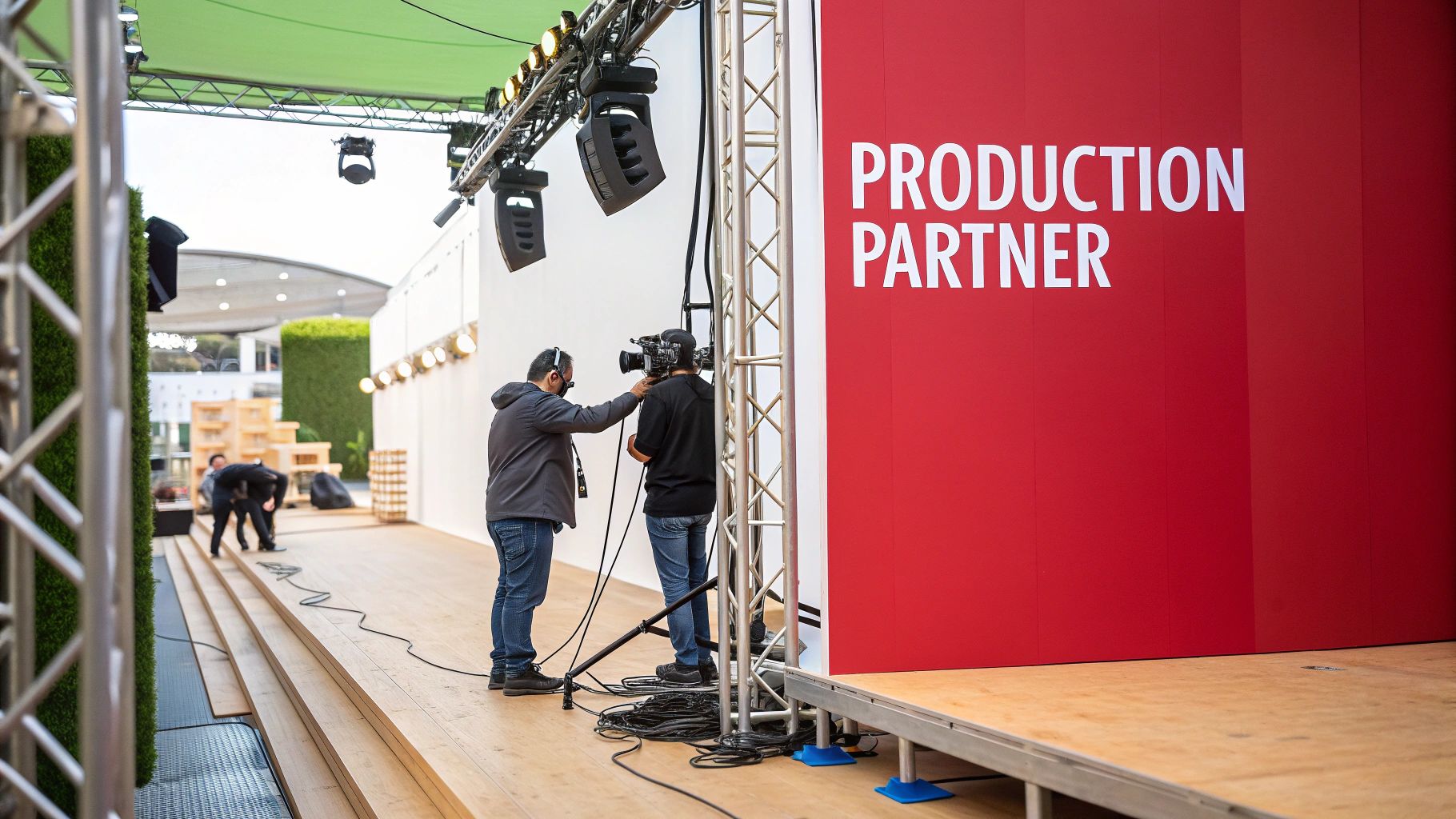
A common mistake is thinking of a production company as just a vendor—a place to pick up speakers, lights, and staging. While they absolutely provide the equipment, their real value is in the integrated management and technical direction they bring to the table.
Think of them less like a rental house and more like the general contractor for your festival's entire infrastructure.
They’re the problem-solvers. They make sure the lighting design amplifies the energy on stage, the sound is crisp and clear from every corner of the venue, and the power grid can handle the load from every stage, food truck, and sponsor activation without a single outage. It’s this holistic, big-picture view that separates a true production partner from someone who just drops off gear.
Beyond Equipment Rentals
This is a key distinction: it’s the difference between providing assets and delivering outcomes. An equipment rental company gives you what you ordered. A festival production company, on the other hand, starts by asking about your goals, your audience, and your creative vision to design a system that actually creates the experience you want.
Their role really breaks down into a few core functions:
- Creative & Technical Design: They’re the ones translating your vibe into a technical blueprint. This means everything from stage layouts and lighting plots to audio coverage maps and power distribution plans.
- Logistical Coordination: This is the nitty-gritty of managing load-in schedules, wrangling multiple vendors, handling freight, and overseeing the entire setup and teardown process. It's a massive puzzle, and they put the pieces together.
- On-Site Management: When the gates open, their team of technical directors, audio engineers, and lighting techs are on the ground running the show and ready to troubleshoot any issue in real-time.
- Safety & Compliance: A huge part of the job is ensuring all structures are safely rigged, electrical systems are up to code, and the entire event complies with local safety regulations.
The best production partners don’t just execute your plan; they enhance it. They bring years of experience from hundreds of events, allowing them to anticipate potential roadblocks and suggest creative solutions you might not have considered.
A Growing Industry of Experience Makers
The demand for these specialized skills is absolutely exploding. The global events industry, valued at around USD 1.5 trillion, is projected to soar past USD 5.1 trillion by 2035. This incredible growth is all about the rising demand for immersive, live experiences where people can connect with brands and artists in a meaningful way. You can check out more on this market expansion over at Market Research Future.
This boom just highlights how critical professional execution has become. The stakes are higher, and attendee expectations are through the roof—the margin for error is razor-thin. A skilled production partner is basically your insurance policy against the chaos that can derail an event. For a deeper dive into the specific tasks involved, you might be interested in our guide on what event production entails.
Ultimately, hiring a top festival production company is an investment in your own peace of mind. You aren't just paying for lights and sound; you're bringing on a team of experts dedicated to making your event run flawlessly so you can focus on what matters most: your guests, artists, and sponsors.
What to Look for in a Production Company’s Services
When you start digging into quotes from different festival production companies, the list of services can look like a foreign language. Staging, audio, lighting, LED walls… it's a lot. The real trick is learning to see past the line items and understand what separates a true pro from a company that just rents out gear.
This isn’t about just getting equipment; you're hiring expertise. A top-tier partner doesn’t just drop off a stage; they deliver a structurally sound, weather-rated platform with certified rigging points and engineering stamps. They don’t just set up speakers; they design an entire audio system that wraps every single attendee in clear, powerful sound.
Before we dive into the specifics, it's helpful to see how these pieces fit together. Here's a quick breakdown of the essential services and what you should be looking for in a vendor for each.
Essential Festival Production Services Breakdown
| Service Category | Core Function | Key Evaluation Point |
|---|---|---|
| Staging & Rigging | The physical platform for performances. | Ask for engineering reports, weight-load capacities, and experience with your specific venue type (e.g., grass vs. pavement). |
| Audio | Sound reinforcement for performers and announcements. | Inquire about their system design process, sound mapping software, and experience with artist riders and local noise ordinances. |
| Lighting | Stage illumination, visual effects, and site safety. | Look for a holistic approach that includes creative stage design and practical site lighting for paths, vendors, and exits. |
| LED/Video | Large-format screens for IMAG and visual backdrops. | Check the screen's pixel pitch (resolution), brightness (for daylight), and the experience of their live camera operators. |
| Power & Logistics | The electrical grid and operational infrastructure. | A professional plan must include redundant power sources, backup generators, and a solid site communication strategy. |
| Site Services | The "glue" holding the festival together. | This includes everything from fencing and sanitation to crew communication systems and waste management. |
Now, let's get into the nitty-gritty of what makes a company truly excel in each of these areas.
Staging and Rigging
The stage is the absolute heart of your festival, but its quality is about so much more than just square footage. When you're evaluating a company’s staging, your mind should be on safety, scalability, and logistics. A professional bid will always include detailed engineering plans, clearly stated weight capacities for hanging gear, and proof of compliance with local safety codes.
Drill down on their experience with your specific type of venue. A stage built on a flat, paved lot is a completely different beast than one going up on an uneven grass field. The best companies will insist on a thorough site survey to spot challenges like drainage issues or soft ground that could turn your stage into a disaster waiting to happen.
Audio Solutions That Resonate
Let’s be honest: bad sound can single-handedly kill a festival's vibe. It’s not about being the loudest; it’s about clarity, consistent coverage, and total control. An expert audio team uses specialized software to map your venue, predicting how sound will travel and pinpointing potential dead zones or spots where noise could bleed into the neighborhood.
This is the kind of proactive thinking that separates the pros. They’re thinking about:
- Venue Acoustics: How sound bounces off nearby buildings or gets soaked up by thousands of people.
- Artist Riders: The very specific, non-negotiable tech needs for each performer.
- Sound Ordinances: Keeping levels in check to avoid hefty fines or, even worse, a full shutdown.
This isn't just plugging in speakers; it's acoustic science that ensures every note hits exactly as the artist intended, from the front row to the food trucks.
Lighting Design and Visual Experience
Lighting is about so much more than just seeing the band. It’s the tool you use to create mood, command attention, and keep your guests safe. A truly skilled lighting designer builds an emotional arc for your entire event, using color, movement, and intensity to transform an ordinary field into an immersive world. This is a huge piece of the puzzle, and if you want to go deeper, we've put together a whole guide on what to look for in event lighting companies near you.
A truly great production company thinks about lighting holistically. This means they're just as concerned with functional lighting for pathways, exits, and vendor areas as they are with the spectacular effects on stage. A well-lit path to the restrooms can make or break the guest experience after dark.
And this industry is absolutely exploding. The global music festival market is on a rocket ship, projected to climb from USD 3.1 billion to an estimated USD 19.15 billion by 2032. That’s a compound annual growth rate of 22.5%—a clear signal that audiences are demanding bigger and better professional productions.
Video Walls and IMAG
Huge LED video walls and IMAG ("Image Magnification") have gone from a nice-to-have luxury to a must-have for most modern festivals. They give everyone a front-row seat and create incredible, dynamic backdrops that can be customized for every single act.
When you're evaluating a company's video department, look past the screen size. Ask them about the pixel pitch (the distance between LEDs, which dictates the resolution), the screen's brightness for daytime shows, and the software they use to manage content. A flawless show hinges on having a skilled video director and camera crew who know how to capture the magic as it happens.
Power Distribution and Site Logistics
This is the invisible hero of your event. A festival's power draw is massive, and one little hiccup can bring the whole show to a screeching halt. A professional production company will design a redundant power grid with backup generators locked and loaded, ensuring the show goes on no matter what.
Site logistics also cover the unglamorous but critical stuff. Smooth communication between your stage managers, security, and medical teams is non-negotiable, which is why understanding the benefits of two-way radios for event communication is so important. It’s this behind-the-scenes mastery that truly defines a world-class operation.
A Proven Framework for Vetting Your Production Partner
Picking the right festival production company is one of the biggest calls you'll make. This isn't just about renting gear. You're forging a partnership with the team that will literally build the physical reality of your event from the ground up.
A great partner can elevate your vision beyond what you thought possible. The wrong one? Well, that path leads to technical failures, safety nightmares, and a reputation hit you can't afford.
To find the right fit, you have to go deeper than a quick Google search and a glossy sales pitch. You need a real vetting process to compare your options, spot the red flags, and hire a team you can truly count on.
Go Beyond the Portfolio
Every production company has a slick highlight reel of their biggest and best shows. It's impressive, sure, but a portfolio doesn't tell you the whole story. Your job is to dig in and find out if they have experience that’s truly relevant to your event.
Look at their past projects with a critical eye. Are they showing off festivals similar to yours in size, genre, and venue? A company that crushes indoor corporate events might be completely out of its depth managing a multi-day music festival in a muddy field.
Look for depth and consistency. A company with a long, proven track record of successful festivals is a much safer bet than one with a single flashy event on their resume. It shows they have repeatable systems and can handle the unique chaos of festival production.
The Power of Real References
References are your single best source of unfiltered truth, but only if you ask the right questions. Don't just settle for, "So, how'd it go?"
Get specific. Prepare open-ended questions designed to see how the company acts when the pressure is on.
When you get a past client on the phone, try asking things like:
- "Can you tell me about a time something went wrong? How did their team handle it?"
- "What was their on-site communication like, both with your staff and the other vendors?"
- "Were there any surprise costs that weren't in the original proposal? How did they handle that?"
- "From your experience, what’s the one area they could improve on?"
These questions get you past a simple thumbs-up and give you real insight into their problem-solving skills, communication style, and financial transparency.
A great production company will have a long list of happy clients ready to sing their praises. If a potential partner gets hesitant about providing references or tries to steer you to just one or two specific people, that's a major red flag.
Critical Interview Questions to Ask
Once you’ve got it narrowed down to a few top contenders, the interview is your chance to see how they think on their feet. This isn’t about their sales pitch—it's about you assessing their real-world expertise and their approach to partnership.
Think about the core services they'll be managing and frame your questions around them.
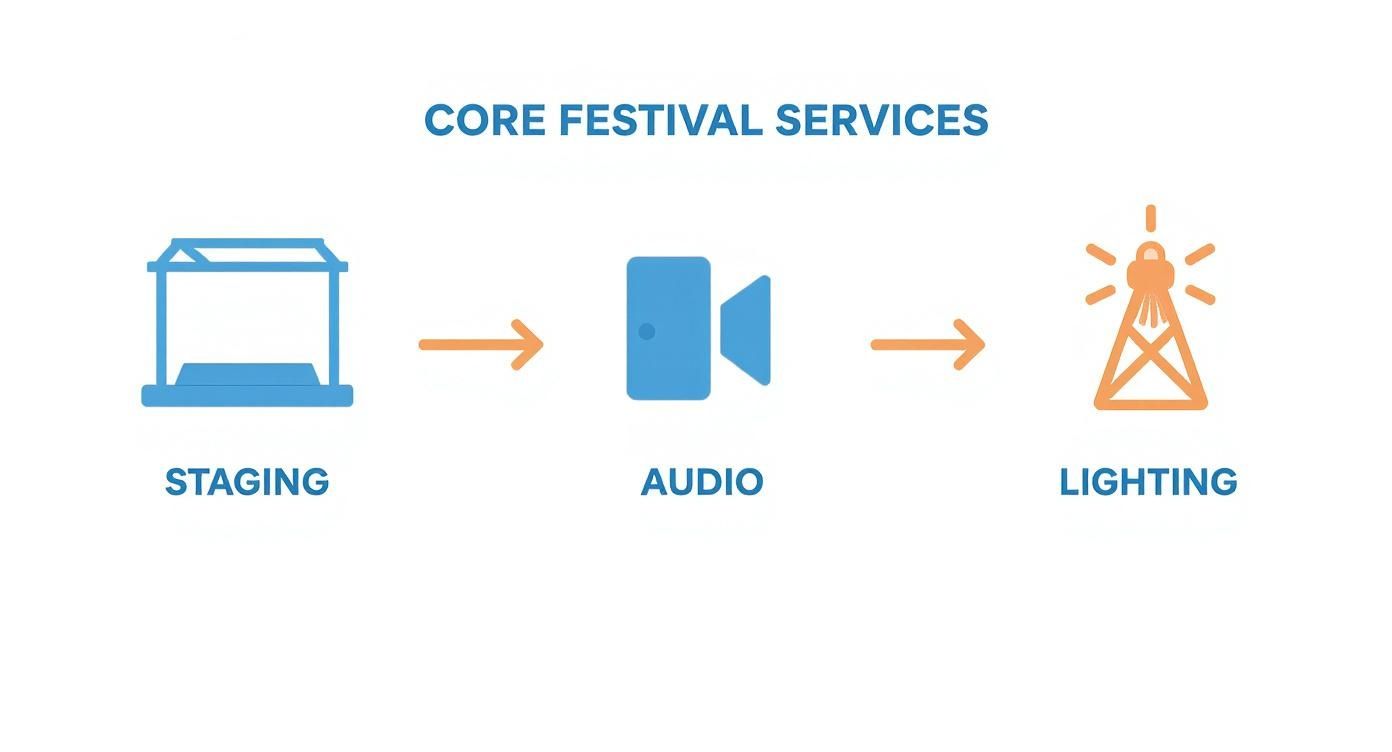
This process flow shows how foundational elements like staging, audio, and lighting all have to work together perfectly. Your interview should probe their expertise in each area.
Prepare questions that force them out of their canned responses:
- Safety & Contingency: "Walk me through your safety protocol for a stage build when it's windy. What's your plan B for a sudden thunderstorm?"
- Technical Problem-Solving: "The headliner's soundboard dies mid-set. What's your team's immediate response to fix it with minimal disruption?"
- Team & Leadership: "Who would be our dedicated on-site production manager? What's their specific experience with festivals our size?"
It's also essential to understand their approach to keeping everyone safe. Learning about the 5 types of event security and how to choose a provider can help you ask smarter questions about their crowd management strategies. Their answers will tell you if they're a proactive partner or just a reactive vendor.
Decoding Production Costs and Your Festival Budget

Alright, let's talk about the part of festival planning that can feel the most daunting: the money. Getting quotes packed with technical jargon and a dizzying number of line items makes it incredibly hard to compare your options. You're left wondering what you're actually paying for.
The real key is to cut through the noise and understand how production partners build their prices. Once you get a feel for it, you can build a realistic budget and negotiate a fair deal that actually matches your festival's vision. Without that clarity, you're flying blind and setting yourself up for surprise costs that can sink an otherwise great event.
Common Pricing Models Explained
Most production quotes will land in one of two buckets: a package deal or a line-item quote. Knowing the difference is your first step.
A package price is pretty common for smaller, more straightforward events. The company bundles the essentials—think a basic stage, a solid sound system, and a standard lighting rig—for one flat fee. This is fantastic for budget certainty, but it can be too rigid if you have a more complex or custom festival in mind.
On the other hand, a line-item quote breaks everything down piece by piece. You’ll see the cost for every speaker, every light, and every hour of labor for each technician. It’s a lot more to look at, but that transparency is gold. You see exactly where your money is going and can make smart decisions about where to add or cut.
Sample Festival Budget Ranges
To give you a starting point, let's look at some ballpark numbers. Remember, these are just rough estimates. Your final cost will swing based on your location, the quality of gear you choose, and local labor rates.
-
Small Community Festival (1 stage, <1,000 attendees)
- Estimated Cost: $15,000 – $40,000
- Typical Scope: A mobile stage, a compact line array sound system, a basic lighting package, and a small generator. Don't underestimate labor's chunk of this budget.
-
Mid-Sized Music Festival (2 stages, 5,000 attendees)
- Estimated Cost: $80,000 – $250,000
- Typical Scope: You're looking at larger stages with professional rigging, more powerful audio to cover bigger crowds, creative lighting design, and maybe a small LED wall. Power needs get much more serious here.
-
Large-Scale Festival (3+ stages, 15,000+ attendees)
- Estimated Cost: $500,000 – $2,000,000+
- Typical Scope: This is the big league—custom-built stages, massive audio and lighting rigs for headliners, huge LED walls, a robust power grid, and complex site logistics management.
Your budget is directly tied to the attendee experience you want to create. Every dollar spent on production should enhance that experience, whether through clearer sound, more dynamic visuals, or a safer, more comfortable environment.
This is all part of a huge and growing industry. The live entertainment market, where festival production companies are key players, was valued at USD 535.4 billion and is on track to hit USD 859 billion by 2034. That growth is all about people wanting incredible live experiences. You can discover more insights about this expanding market and its trends.
Uncovering the Hidden Costs
What's not in that first proposal is just as important as what is. A truly professional partner will be upfront about potential extras, but it's always your job to ask the tough questions.
Keep an eye out for these common "gotchas":
- Labor Overtime: What's the plan if the headliner's set runs an hour late? You need to know the overtime rate for the entire crew before you sign anything.
- Transportation & Freight: Fuel surcharges, trucking for heavy gear, and travel costs for specialized techs can add up fast.
- Contingency & Damage Waivers: Many companies will add a contingency fee (usually 5-10%) for last-minute needs or a waiver to cover potential equipment damage.
- Permits & Engineering Stamps: Who’s pulling the permits? Who’s paying for the certified structural plans for the stage? Make sure this is crystal clear from day one.
Getting ahead of these questions will help you build a budget that holds up and saves you from painful financial surprises when it's showtime.
Getting the Paperwork Right: Contracts, Permits, and Insurance
Let's be honest, the paperwork isn't the glamorous part of planning a festival. But it's just as critical as the gear on stage. Your contracts, insurance certificates, and city permits are the legal backbone that protects you, your event, and every single person who walks through the gates. Skimping on these details isn't just a risk—it's a recipe for disaster.
When you're hiring a production company, the contract is your single source of truth. It’s where all those verbal promises and handshake agreements become legally binding commitments. Don’t just give it a quick once-over; you need to dig into every clause to make sure there's zero ambiguity.
A solid production contract leaves nothing to chance. It should be a detailed roadmap for the entire project, so specific that there's no room for misinterpretation when the pressure is on.
Key Contract Clauses You Can't Ignore
Before you even think about signing, make sure the agreement clearly spells out a few non-negotiable points. Getting these right from the start protects everyone involved and keeps molehills from turning into mountains down the road.
Here's what you're looking for:
- A Detailed Scope of Work (SOW): This needs to list every single piece of equipment, every staff role, and every service being provided. Vague phrases like "standard lighting package" are a huge red flag. It should specify things like fixture counts, models, and where they'll be placed.
- A Clear Payment Schedule: No gray areas here. The contract has to define the deposit amount, any milestone payments, and the final due date for the balance.
- Cancellation Policies: What happens if the festival gets called off because of a thunderstorm, sluggish ticket sales, or something else completely out of your control? A fair policy outlines who is responsible for what.
- Liability and Indemnification: This is a big one. This clause clarifies who's on the hook for accidents, damages, or injuries. Make sure their liability coverage is more than enough for an event of your size.
A true pro will welcome a thorough contract review. If a company seems to be rushing you through the signing process or gets cagey when you ask about specific clauses, take that as a serious warning sign about how they do business.
Verifying Insurance and Permits
Never, ever just take a vendor’s word that they're "fully insured." You need to ask for and verify their Certificate of Insurance (COI). This is the document that proves they have the right coverage to operate legally and safely.
There are two policies you absolutely must check for:
- General Liability Insurance: This covers things like third-party bodily injury and property damage. A minimum of $1 million per occurrence is pretty standard, but for larger festivals, you'll often see requirements for $2 million to $5 million, or even more.
- Workers' Compensation: This is mandatory in most places and covers their own crew if they get hurt on the job. If they don't have it, you could be held liable for their medical bills.
Finally, you need to talk about the permitting process. This is where an experienced production company really shows its value. They know the ins and outs of local regulations for everything from noise ordinances to public assembly and fire safety inspections. They can guide you through that maze of applications and make sure your event is fully compliant, saving you from the nightmare of a last-minute shutdown by the city. That logistical expertise is a huge part of what you're paying for.
A Local Look at Kansas City Production Companies
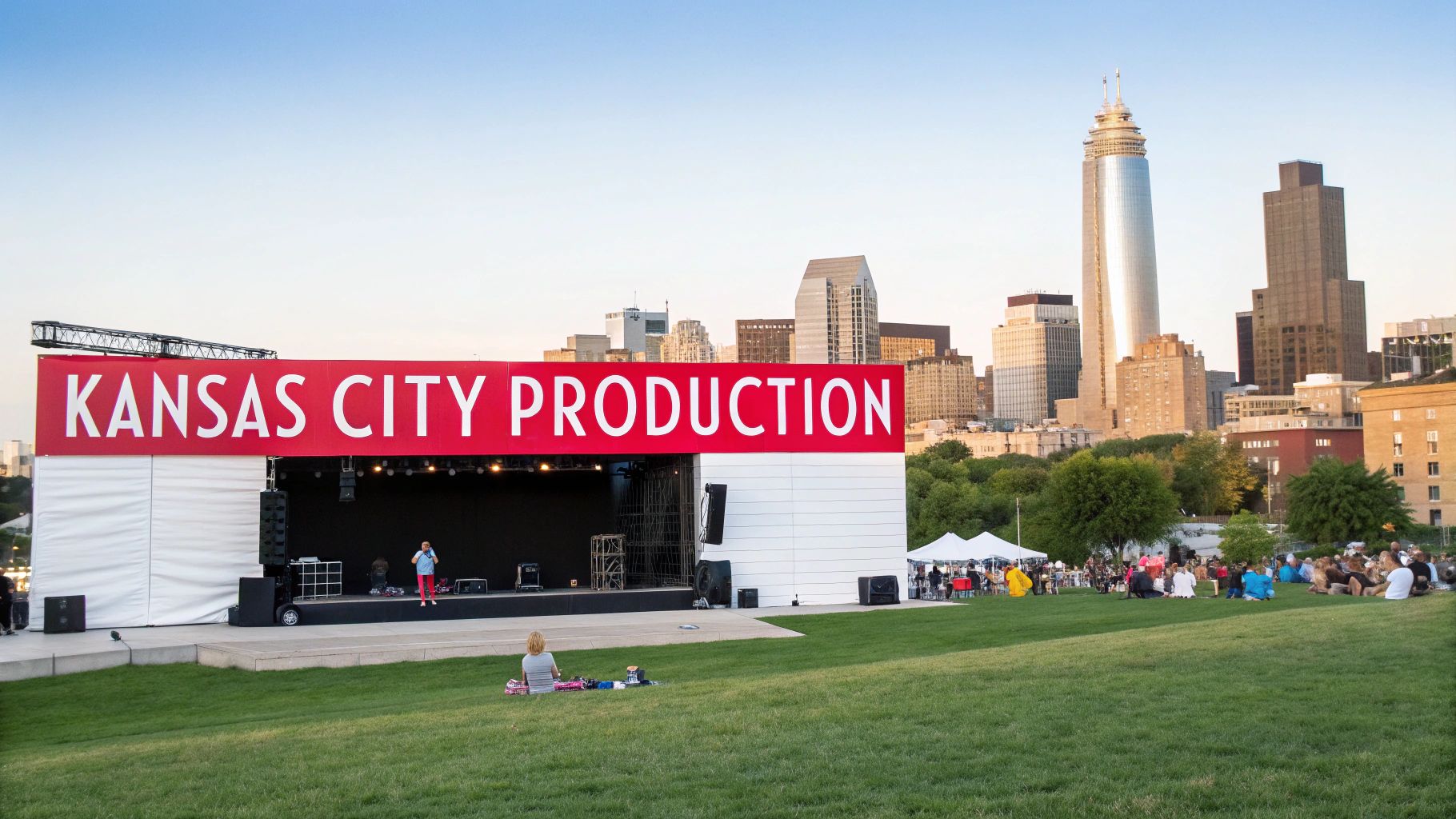
Okay, let's bring this all home. Theory is great, but what does it look like on the ground here in Kansas City? Our event scene is buzzing, and it comes with its own quirks and opportunities that only a local production company will truly get.
Think about it. Navigating the permitting process with KCMO Parks and Rec for a festival at Theis Park is a completely different beast than coordinating load-in at the T-Mobile Center. A seasoned local partner already knows the ins and outs, from union labor rules to the city’s specific noise ordinances that can shut you down fast.
Profiles of KC Production Experts
The Kansas City market has some seriously talented festival production companies, each with a different flavor. To give you a real-world feel for what's out there, here are a few anonymous profiles based on the kind of specialists you'll find around town.
-
The Concert Audio Powerhouse: You’ll find at least one crew in KC that is legendary for their mastery of large-scale concert sound. They’re the ones the big music festivals call first because they can handle complex artist riders in their sleep and design audio systems that cover massive fields at places like the Kansas Speedway without a single dead spot. Their portfolio is basically a who's-who of national touring acts.
-
The Corporate & Non-Profit Specialist: Then you have the pros who live and breathe the high-stakes world of corporate events and non-profit galas. While they can absolutely handle a festival, their real magic is in flawless execution where brand image is everything. Think crisp video presentations, intricate stage designs for awards shows, and seamless logistics for fundraisers at venues like the Kauffman Center.
Choosing a local partner means you're not just getting gear; you're gaining an ally with deep community ties and invaluable institutional knowledge. They know which city officials to call and which local vendors are the most reliable under pressure.
Making the Right Choice in the Metro
When you start vetting companies, look closely at their past work. Does it line up with what you’re trying to do? If you’re planning a community street festival in the Crossroads, a company that specializes in massive arena tours is probably overkill (and way over budget). On the flip side, a smaller AV team might not have the inventory or crew to pull off a multi-stage music fest.
The goal is to match their proven expertise to your vision. To get a better sense of the options available, exploring a list of event production companies near you is a fantastic way to start shortlisting potential partners right here in Kansas City.
Got Questions? We've Got Answers
Even the most seasoned festival planners run into the same few questions when it's time to bring a production partner on board. Nailing these down early saves a ton of stress and makes sure you find a team that's actually the right fit for your vision and scale. Let's clear up some of the most common ones.
How Far Out Should I Be Booking?
If you're planning a large-scale festival, you need to start the conversation 10-12 months out. Seriously. This isn't just about making sure they have the gear available; it gives your production partner the runway they need for proper site surveys, thoughtful design work, and wading through the inevitable permitting process.
For smaller community festivals or one-off events, a 4-6 month lead time can sometimes work. But a word of advice: the best crews book up fast. Don't wait.
What's the Difference Between a Production Manager and a Technical Director?
It's easy to get these two mixed up, but their roles are distinct and equally critical. Here’s a simple way to think about it:
- A Production Manager (PM) is the master strategist. They are the logistical brain of the operation, managing the overall production budget, coordinating all the different vendors, and keeping the master timeline on track. They see the whole forest.
- A Technical Director (TD) is the expert on the ground who makes the technical plan a reality. They're the one managing the audio, lighting, and video crews and are the go-to problem-solver for any and all gear-related hiccups. They know every tree.
Your production company will provide both, but the PM is usually your main point of contact during the planning stages. Once it's time for load-in and the show is on its feet, the TD becomes your right hand on site.
Who Handles On-Site Emergencies?
While you, the festival organizer, are ultimately responsible for everything, your production company is your first line of defense. Any professional crew worth their salt will have detailed contingency plans for everything from a sudden downpour to a generator failure.
Their on-site manager takes the lead in executing these plans, directing their crew, and securing the stage and all technical areas to ensure everyone stays safe. This is a non-negotiable—make sure your contract clearly spells out their duties in an emergency.
At Showboss KC, we don't just show up; we build proactive partnerships. We bring the expertise and equipment to make your festival a seamless success from day one.
Explore our full-service production solutions and let's start planning your event today!