

When we talk about high-end corporate events, we're talking about much more than just a lavish party. These are strategic investments—meticulously crafted experiences designed to deliver real, measurable business results. They go far beyond surface-level luxury, focusing on flawless execution and a powerful story that connects with your most important stakeholders, whether they're C-suite execs, top-tier clients, or crucial investors.
What Really Defines a High-End Corporate Event?
Let's ditch the old cliché of extravagant parties with bottomless budgets. A truly high-end corporate event is a strategic move for your brand, built to cultivate key relationships and produce tangible returns. It's the critical difference between a gathering that's simply expensive and an experience that's genuinely memorable—one that resonates long after the last guest has gone home.
This isn’t just about securing a premium venue or serving five-star cuisine. It's about creating a cohesive journey with a crystal-clear purpose. Every single detail, from the first touchpoint of the invitation to the final follow-up email, is intentionally designed to reflect your brand's prestige and drive home its core message. It's about crafting moments that feel exclusive, personal, and incredibly valuable to the people in the room.
The Core Pillars of a High-End Event
To understand what makes these events tick, we need to look at their foundational elements. These pillars distinguish a truly strategic experience from just another big-budget affair.
| Pillar | Core Focus | Example Tactic |
|---|---|---|
| Strategic Intent | Every decision is driven by a clear business goal. | Designing a product launch around an immersive demo that directly addresses key investor questions. |
| Bespoke Experiences | The event is unique and personalized, not a cookie-cutter affair. | Arranging a private Q&A session with a Nobel laureate for a select group of C-level attendees. |
| Flawless Execution | The behind-the-scenes logistics are invisible and seamless. | Using RFID wristbands for frictionless check-in and personalized content triggers throughout the venue. |
| Measurable ROI | The event's success is tied back to specific, quantifiable business outcomes. | Tracking post-event sales conversions from a unique code given only to attendees. |
These pillars ensure that the event isn't just impressive, but also purposeful.
This simple process illustrates how a successful event is really a continuous cycle—where the initial idea, the on-the-ground execution, and the final analysis all feed into one another.
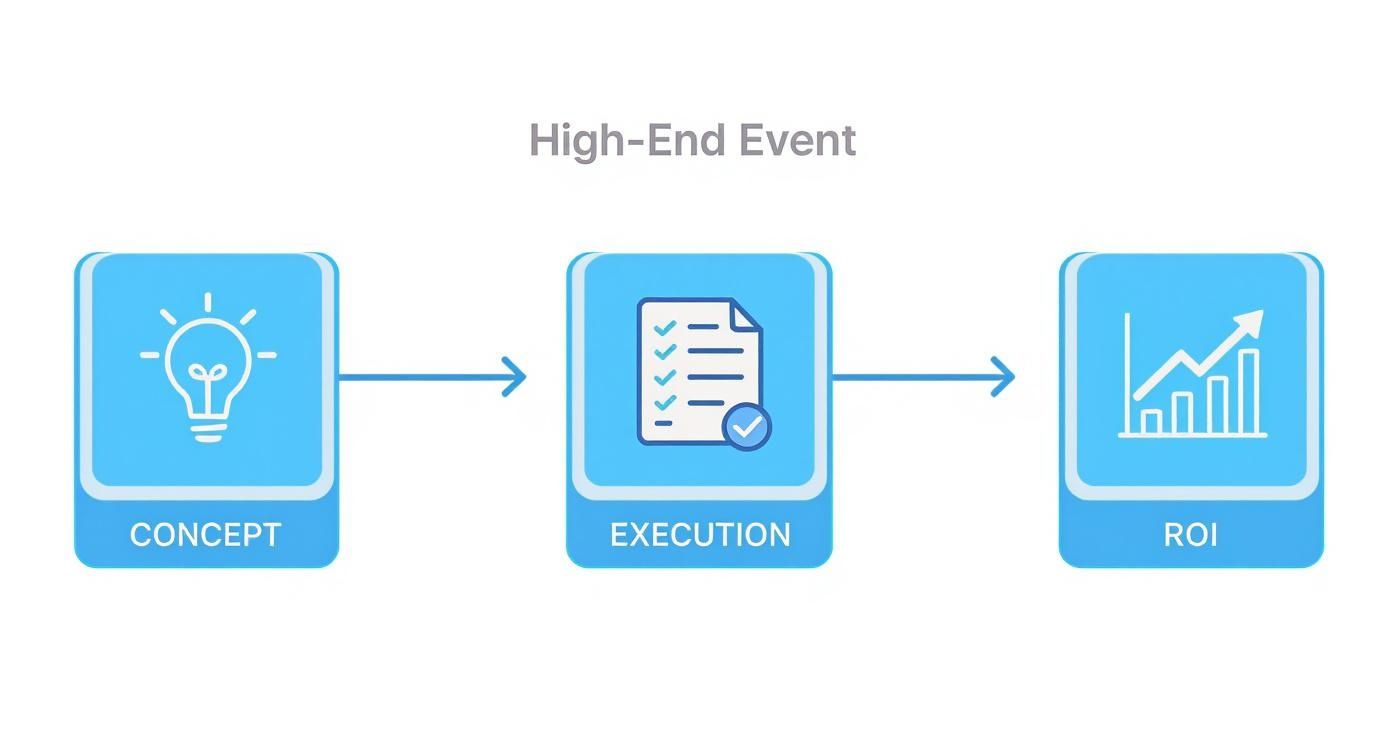
This loop—from concept to execution to ROI—is what turns a great idea into a profitable reality.
More Than a Party, It's an Investment
The numbers back this up. With the rise of experiential marketing, companies are doubling down on high-impact events. The global market for corporate luxury events hit a staggering $152,508.6 million in 2020 and is on track to explode to $526,165.5 million by 2030. That's a compound annual growth rate of 14.5%, which proves one thing: businesses see these experiences as essential drivers of growth, not just discretionary spending.
A high-end corporate event isn't just a line item on the marketing budget; it's a powerful tool for brand activation and relationship building. The goal is to make your most important audiences feel valued and connected to your mission.
Ultimately, these events are about creating an environment where business relationships can thrive. They're a powerful, physical expression of a company's brand, its confidence, and its vision for the future. By using unique brand activation ideas to forge genuine connections, you can leave a lasting impression that drives both loyalty and business forward.
Building Your Event Strategy and Defining Success
Before you even think about touring venues or calling vendors, you need to nail down the single most important part of any high-end corporate event: the strategy. This is your blueprint. It’s the document that guides every single decision and makes sure the final product isn’t just impressive, but that it actually does something for your business.
A solid strategy is what turns a massive expense into a smart, calculated investment with a clear return.
Aligning Your Event with Business Goals
First things first: why are you even doing this? A fuzzy goal like "brand awareness" isn't going to cut it. You have to go deeper and tie the event directly to a real business outcome.
Is the whole point to smooth over some fragile C-suite relationships that need a white-glove, exclusive setting? Or are you trying to generate a flood of qualified leads for a new flagship product launch? The approach for those two goals couldn't be more different.
Think about what you're really trying to achieve. Most high-end events fall into one of these buckets:
- Deepen Client Relationships: Crafting an unforgettable experience for your top 10% of clients to lock in loyalty and keep them coming back.
- Launch a Flagship Product: Generating serious buzz and landing pre-orders from key industry players and the media.
- Secure Investor Confidence: Putting on a powerful, immersive show of company stability and future growth for current and potential investors.
- Reward Top Performers: Recognizing your absolute best employees with an exclusive trip that makes them feel truly valued.
Getting crystal clear on this is non-negotiable. It determines your guest list, your messaging, your venue, and the entire feel of the event. For a deeper dive, our detailed guide on how to plan corporate events from the ground up can give you a more detailed checklist for these early stages.
Defining What Success Looks Like
Once you know your "why," you have to define what a win actually looks like in real numbers. This means setting Key Performance Indicators (KPIs) that go way beyond counting heads or tracking social media mentions. Your KPIs need to be a direct reflection of your main business goal.
For example, if you're trying to boost investor confidence, success isn't just getting them to show up. Success is measured by the number of follow-up meetings you book, a measurable jump in positive feedback on post-event surveys, or even direct capital commitments that roll in during the weeks after.
Success isn't about throwing a great party; it's about moving the needle on a specific business metric. The event is the vehicle, not the destination.
This is the data-driven thinking that separates professional event production from simple party planning. The right KPIs give you a clear benchmark to prove the event worked and justify the serious cash it takes to pull off a high-end experience.
Understanding Your Audience and Crafting a Theme
With your goals and KPIs locked in, it's time to shift focus to the most important people in the room: your guests. Who are they? What makes them tick? A theme that works for a crowd of 30-something tech entrepreneurs will completely miss the mark for a room of established financial execs in their 60s.
Steer clear of cheesy, generic themes. Instead, develop a concept that feels authentic to your brand and speaks directly to what your audience cares about. A theme like "Pioneering the Future" for a tech investor summit can be woven into everything—from holographic speakers and interactive data walls to futuristic food and drink experiences.
When you get this right, you create an atmosphere where your guests feel seen and understood, which is absolutely critical for building real connections. After all, research shows that two-thirds of attendees feel more positive about a brand after an engaging event. That positive feeling is the direct result of a smart, audience-first strategy.
Assembling Your Elite Team of Venues and Vendors
Your event strategy is only as good as the team you hire to bring it to life. A high-end corporate event absolutely lives or dies by the partners you choose. This isn't just about hiring help; it's about building a specialized crew—from the venue manager to the AV techs—who get what's at stake and can execute flawlessly when the pressure is on.
An extraordinary event is built by an extraordinary team. Finding these people requires a vetting process that goes way beyond a quick look at a portfolio. You're basically creating a temporary company built for a single, high-stakes mission.
Choosing a Venue That Embodies Your Brand
The venue isn’t just a room; it’s the physical embodiment of your event's entire vibe and your company’s prestige. And while looks are important, the things that really matter for a luxury corporate event are often hidden beneath the surface. Forget the standard ballroom and start thinking about what the space communicates.
Here are a few less-obvious things I always look for:
- Exclusivity and Privacy: Can you guarantee a secure, private experience for your guests? For high-profile attendees, this is non-negotiable. A complete buyout of a wing or even a standalone property is often what it takes to control the environment and avoid interruptions.
- Technical Infrastructure: Does the venue have the backbone to support your vision? This means rock-solid, high-speed Wi-Fi that can handle hundreds of devices at once, enough power for complex lighting and AV rigs, and easy load-in access for the production crew.
- Service Reputation: This is huge. Look past the sales pitch and find out what the in-house staff is really like. A venue with a proactive, problem-solving team is a million times more valuable than a beautiful space run by rigid, unhelpful management.
Big players like Marriott International, Hilton Worldwide, Accor, and Four Seasons Hotels and Resorts really set the bar for this level of service. They provide a solid benchmark for quality, and you can learn a lot by studying the corporate luxury event market dynamics they influence.
Vetting Vendors Like a Pro
Your vendors are your creative partners in crime. For an event at this level, you need specialists who are used to demanding clients and technically complex productions. A standard wedding DJ or your average catering company just won't have the experience or equipment to deliver.
Your vetting process has to be surgical. Start with their portfolio, but that's just the beginning.
- Demand Specific Case Studies: Ask for examples of events they've produced that are similar in scope, budget, and audience to yours.
- Check Unlisted References: This is my favorite trick. Ask for the contact info of a client from a past event that didn't go perfectly. How a vendor handled a crisis tells you more about their professionalism than a hundred glowing reviews.
- Gauge Their Creative Input: On your first call, are they just nodding along and saying "yes" to everything? Or are they offering suggestions to make your concept even better? You want a partner, not an order-taker.
Putting in this work upfront helps you build a team that isn’t just skilled, but also resilient and truly collaborative.
To make this process a bit more concrete, I use a simple scorecard system. It helps me stay objective when comparing great options.
Vendor Vetting Checklist
| Vetting Criteria | Vendor A Score (1-5) | Vendor B Score (1-5) | Key Notes |
|---|---|---|---|
| Portfolio Alignment | 4 | 5 | Vendor B has direct experience with our industry. |
| Client References (Positive) | 5 | 5 | Both have stellar reviews. |
| Client References (Problem-Solving) | 5 | 3 | Vendor A's story about a power outage was impressive. |
| Creative Input & Proactiveness | 5 | 4 | Vendor A offered several budget-saving ideas. |
| Technical Capabilities & Gear | 4 | 5 | Vendor B has newer, more advanced equipment. |
| Team Professionalism & Responsiveness | 5 | 4 | Vendor A's team is incredibly quick to respond. |
| Overall Score | 28 | 26 |
This simple tool prevents you from getting swayed by a slick presentation and forces you to focus on who is genuinely the best fit for the job.
The real magic happens when your vendors stop being just suppliers and become true creative collaborators. They should challenge your ideas, offer better solutions, and share your commitment to creating an unforgettable experience.
Negotiating Contracts That Protect Your Investment
Once you've picked your dream team, it's time to talk contracts. This is your chance to protect your budget and your vision. A contract for a high-end event needs to be incredibly detailed and written to protect your interests.
Don't get fixated on just the price. Smart negotiation is about locking in value and getting ahead of potential risks.
Key Clauses I Never Skip:
- Detailed Scope of Work: The contract must spell out every single deliverable. The number of lighting fixtures, the specific menu items, the staffing levels—get it all in writing. Ambiguity is your enemy.
- Cancellation and Force Majeure: Define the terms for cancellation from either side, including penalties. A rock-solid force majeure clause is essential for protecting you from things you can't control, like a freak snowstorm or a public health crisis.
- Payment Schedule: I always tie payments to specific milestones, not arbitrary dates. This ensures you only pay for work that's been completed to your satisfaction.
- On-Site Change Orders: Things change on event day. Your contract needs a clear process for how additions or changes will be handled, including who has the authority to approve extra costs.
When you treat vendor selection and negotiation with the same strategic focus you gave your initial planning, you end up with a team that isn't just capable of pulling off your vision—they're fully invested in its success.
Designing an Unforgettable Attendee Experience
This is where the rubber meets the road—where your big-picture strategy becomes a real, tangible experience for your guests. The attendee experience is the absolute heart of any high-end corporate event. It covers every single interaction someone has with your brand, from the moment they see the invitation to the final thank-you note.
It's all about crafting a seamless journey that makes every single guest feel like a VIP.
A truly premium experience doesn't start at the door. It begins with that very first touchpoint. Forget the generic email blasts. We're talking about bespoke, high-quality printed invitations or personalized digital experiences that build genuine excitement. This first communication sets the tone immediately, signaling that this isn't just another corporate function; it's an exclusive event worth clearing their schedule for.
Make your pre-event communication thoughtful and genuinely helpful. Give them clear details on travel, attire, and what to expect. Little touches, like sending personalized itineraries to key guests or a pre-event welcome package to their office, are what elevate an event from standard to exceptional. Every detail communicates care.
Crafting Pinnacle Moments
The best high-end events I've ever produced were all built around what I call "pinnacle moments." These are the deliberately designed, highly shareable experiences that get people talking and forge a real emotional connection to your brand. They are the Instagrammable highlights that keep the memory of the event alive long after it’s over.
A pinnacle moment doesn’t have to be a massive pyrotechnics display. It can be a surprisingly intimate performance from a well-known artist, an exclusive Q&A with an industry legend, or a beautifully crafted, multi-sensory dining experience. The key is that it feels unique, unexpected, and perfectly in sync with your event's core message.
Here are a few ways we’ve engineered these powerful moments:
- Surprise and Delight Entertainment: Instead of a predictable cover band, think bigger. Consider a world-renowned mentalist who customizes their act around your company's mission, or a "silent disco" that gets even the most buttoned-up executives on the dance floor.
- Immersive Brand Activations: Create interactive installations that let guests engage with your product or brand story in a physical, memorable way. Let them touch it, feel it, play with it.
- Personalized Gifting: Ditch the generic swag bag. Instead, offer a curated gifting suite where guests can choose their own high-end takeaways. It’s a small change that makes a huge impact.
These moments become your event’s signature. They transform attendees from passive observers into active participants in a story you’ve built just for them.
The goal is to design an experience so seamless and engaging that the intricate logistics behind it become completely invisible to the guest. They should only feel the magic, not see the machinery.
The Run-of-Show Is Your Script
A detailed run-of-show is the literal script for your event's success. This is a minute-by-minute document that choreographs every single element, from the second the doors open to the final truck loading out. It’s so much more than a schedule; it’s the production blueprint that syncs every single vendor—lighting, audio, catering, entertainment—into one cohesive performance.
For a high-end financial summit in Kansas City, for instance, the run-of-show wouldn't just say, "Keynote Speaker at 10 AM." It would detail the precise lighting cues as they walk on stage, the exact audio track that plays, and the signal for the catering team to start prepping the post-session networking break. That level of detail is what ensures a flawless, high-production-value feel.
Leveraging Technology to Enhance Luxury
Technology should be your silent partner in creating a luxury experience. The best tech integrations are frictionless and simply make the guest's journey smoother, not more complicated.
Consider a few practical applications:
- Seamless Check-In: Use RFID wristbands or simple QR code scans to kill long lines and make a welcoming first impression right away.
- Interactive Installations: Projection mapping can turn a boring wall into a dynamic canvas for storytelling, while interactive touchscreens can deliver personalized content on demand.
- Ambient Enhancements: Sophisticated lighting and sound design are non-negotiable. Use lighting to sculpt the space, guide attention, and create different moods throughout the night. Crisp, high-quality audio ensures every word is heard clearly, reinforcing the event's professionalism.
Kansas City Example: An Authentic Financial Summit
Let's imagine you're hosting a high-end financial summit in Kansas City for executives flying in from all over the country. Instead of some generic, played-out theme, you lean into the city's rich heritage.
The experience starts with invitations styled like vintage jazz club tickets. When guests arrive, they aren't greeted by standard hotel lobby music, but by a live, sophisticated jazz trio. The catering features upscale twists on Kansas City barbecue, paired with cocktails from local craft distilleries. The pinnacle moment? A private tasting and history lesson with a renowned local pitmaster.
This approach weaves local culture into the fabric of the event, creating an authentic, memorable experience that feels rooted in a real place—not just another conference in another city.
Mastering Logistics and Proactive Risk Management
Behind every incredible, high-end corporate event is a whole lot of unglamorous, behind-the-scenes work. It's the logistics and risk management that truly make an event feel effortless. When a thousand moving parts sync up perfectly, it’s not luck—it’s the result of meticulous, proactive planning.
This is the stuff that allows the creative vision to take center stage without getting tripped up by preventable problems. The real goal is to solve issues before your guests even have a chance to notice them.
Executing Flawless On-Site Logistics
For high-end events, "logistics" means so much more than just having a schedule. It’s about choreographing a complex dance between people, equipment, and services, especially when you’re dealing with VIPs who expect everything to be seamless.
Take VIP transportation, for instance. It’s not just about booking a few black cars. It’s about coordinating precise arrival times with the run-of-show, having a dedicated transport manager on standby for flight delays, and making sure every driver has a direct line to on-site staff. Security is another huge layer. For events with C-suite execs or public figures, this involves everything from venue sweeps and managed access points to having a security team that's present but discreet.
And then there's permitting. Here in Kansas City, you can need permits for almost anything—street closures, noise variances, temporary tents, you name it. Tackling those municipal requirements early is the only way to avoid a last-minute phone call that could shut the whole thing down.
Building a Proactive Risk Assessment Framework
"Hope for the best" is not an event strategy. The best producers in the business plan for the worst by running a thorough risk assessment way before the event day even gets close. It’s a process of identifying what could go wrong and, crucially, building out clear, actionable contingency plans for every single scenario.
What’s the move if the keynote speaker’s flight gets canceled? What's the protocol for a medical emergency? Is there a backup generator ready to go if a classic KC summer storm knocks out the power?
A great event producer doesn't just solve problems—they anticipate them. Having a plan B, C, and D for your most critical elements is what separates the amateurs from the pros.
Your risk assessment needs to cover all the bases, broken down into clear categories.
Common Risk Categories:
- Technical Failures: This could be anything from a mic cutting out to a total AV system meltdown. Your plan must include redundant equipment and a tech on standby who can jump in immediately.
- Medical Emergencies: You need a crystal-clear plan. That means on-site medics or a designated emergency contact, first-aid kits within easy reach, and clear paths for emergency services to get in and out.
- Weather Events: If any part of your event is outdoors, you absolutely need a rock-solid rain plan. This might be an alternate indoor space on hold or high-end tents ready to be deployed at a moment's notice.
- Guest-Related Issues: From a lost wallet to an unruly guest, your staff has to be trained to handle these situations with professionalism and discretion.
Synchronizing Vendors for Perfect Execution
Your vendors are all experts in their own right, but on event day, they need to act like a single, unified team. That kind of synchronization doesn’t just happen. It’s the direct result of deliberate, constant communication led by the production manager.
The master production schedule is the brain of the whole operation. This document goes way beyond the guest-facing run-of-show. It maps out every single behind-the-scenes detail: vendor load-in times, tech rehearsals, catering prep, and teardown timelines.
A mandatory pre-event briefing with all your key vendor leads is non-negotiable. This is where you walk through the entire schedule, make sure everyone understands their role, and smooth out any last-minute questions. It ensures the lighting team knows their cue is triggered by an audio track, and the catering staff knows exactly when to clear tables before the next speaker goes on.
Finally, get your core team on-site for a comprehensive walk-through a day or two before the event. This is your last chance to spot any overlooked details. Check every outlet, walk the exact path a guest will take, and triple-check your list. It’s that final layer of diligence that guarantees a smooth, impressive, and truly high end corporate event.
Measuring ROI and Proving Your Event's Value
The last truck has rolled away, the house lights are up, and the quiet hum of an empty venue has replaced the buzz of the crowd. It’s a great feeling, but the job’s not quite done. Now comes the part that separates a good event from a strategic win: proving its value.
This is where we turn those unforgettable moments and incredible experiences into cold, hard data. It’s how you justify the budget, prove the event was more than just a party, and get the green light for next year's even bigger idea.
Reconnecting with Your Initial KPIs
Remember way back in the strategy phase when you set your Key Performance Indicators (KPIs)? It’s time to pull that document out again. Those aren't just buzzwords; they're the yardstick you’ll use to measure success.
Success isn't just a vibe—it's a set of numbers that tells a story. If your goal was to nurture key client relationships, your data points could be the number of post-event meetings your sales team booked or a noticeable uptick in contract renewals from companies that attended.
Collecting the Right Post-Event Data
To get real answers, you need to ask the right questions. A generic "Did you have fun?" survey just won't cut it for a high-end experience. Your data collection needs to be as sophisticated as the event itself.
- Targeted Post-Event Surveys: Get specific. Instead of asking if guests enjoyed themselves, ask things like, "How has your perception of our new product line changed after seeing the live demonstration?" This ties feedback directly to a business goal.
- Social Media Listening: Keep an eye on your event hashtags and brand mentions. Tools for social listening can track the reach and engagement of posts from attendees, helping you gauge sentiment and identify key influencers who loved the experience.
- Sales and CRM Tracking: This is where you find the most direct ROI. By using unique tracking links, special offer codes, or dedicated CRM tags for attendees, you can trace new leads, sales, and pipeline growth directly back to the event.
Your goal is to build a post-event report that tells a compelling story. You need to blend the hard numbers with the powerful, intangible value that comes from a perfectly executed high-end corporate event.
Articulating Intangible Value
Not everything valuable can be plugged into a spreadsheet. A huge part of the ROI from a high-end event is intangible, and you have to know how to talk about it.
Think about the C-suite relationships that were built in a relaxed, exclusive setting. Or the way your brand’s prestige gets a boost from being associated with a top-tier experience. These outcomes are often the real reason for the event, even if they aren't easily measured. You can show this value by including glowing testimonials from VIPs or noting specific conversations that opened doors to new partnerships.
A thorough post-event analysis doesn't just put a bow on a successful event; it gives you a roadmap for the next one. For a little help structuring your process, our corporate event planning checklist offers a great framework for organizing your post-event reporting. When you can methodically prove your event's worth, you turn a one-time expense into a strategic investment that leadership will be excited to back again and again.
Ready to create a corporate event that delivers both unforgettable moments and measurable results? The team at Showboss KC specializes in designing and executing high-impact experiences with flawless production. Let's build something extraordinary together. Learn more at https://showbosskc.com.