

Alright, let's get into the first, most crucial step in finding your perfect wedding DJ: figuring out what you actually want and what you can realistically spend. Before you even think about Googling "Kansas City wedding DJs," you need to get on the same page with your partner.
Defining Your Wedding Vibe and DJ Budget
Seriously, before you dive into portfolios and reviews, take a moment to look inward. What do you want your wedding to feel like? Your DJ is so much more than a person with a playlist—they are the architect of your reception's entire atmosphere.
Think about it. Do you picture a wild, high-energy dance party? A sophisticated, black-tie affair? Or maybe something more laid-back and intimate? The right DJ uses their music selection and microphone presence to shape the whole experience for you and every single one of your guests.
Consider the key moments. What’s playing during cocktail hour? Are you two making your grand entrance to a massive anthem that gets everyone on their feet, or something more classic and romantic? Answering these questions now will help you build a clear picture of the professional you need.
Turning a Vibe Into a Vetting Tool
Once you’ve got the general feel down, it's time to connect it to specific music and MC styles. This turns a vague idea ("we want it to be fun!") into a concrete checklist you can use to interview potential DJs.
- For a High-Energy Party: You’re looking for a DJ who can truly mix. They need to be skilled at beat-matching and creating seamless transitions between genres like Top 40, hip-hop, and EDM to keep that dance floor packed all night. Their MC style should be energetic and engaging, but never cheesy.
- For a Sophisticated and Elegant Affair: This calls for a DJ with deep experience in genres like jazz, soul, and classic R&B. Their presence on the mic should be polished, articulate, and understated—guiding the evening's events with total grace.
- For a Relaxed, Indie Vibe: This requires a DJ with a real passion for music beyond the mainstream. They should be comfortable curating amazing playlists with alternative, folk, and classic rock. Their MC style is usually more conversational and personal.
Key Takeaway: Your wedding "vibe" is the emotional blueprint for your celebration. Defining it clearly is the only way to find a DJ who can build the perfect atmosphere, not just play songs from a list.
Establishing Your DJ Budget
With your vision clear, it's time to ground it in financial reality. The cost of a wedding DJ varies—a lot—based on their experience, demand, and the services they offer.
Industry data gives us a solid baseline. According to The Knot’s most recent Real Weddings Study, the average amount couples spent on a wedding DJ was $1,689. Just a decade ago, that number was closer to $1,200, which shows how much couples are prioritizing high-quality entertainment.
This is a great starting point, but let’s break down what you actually get for your money.
What to Expect at Different DJ Budget Tiers
| Budget Tier | Typical Price Range | What You Can Expect to Receive |
|---|---|---|
| Entry-Level | $800 – $1,200 | A newer DJ, basic sound system, limited lighting, often works from pre-made playlists. Good for smaller, more casual weddings. |
| Professional | $1,200 – $2,500 | An experienced DJ/MC, professional-grade sound, dance floor lighting, custom playlists, and timeline coordination. This is the sweet spot for most couples. |
| Premium | $2,500+ | A top-tier, in-demand entertainer, advanced sound & lighting, and often includes add-ons like a photo booth, special effects, or live music elements. |
This table should help you match your budget to your expectations. Several key factors will influence where a DJ falls in that range:
- Experience: A seasoned pro with hundreds of weddings under their belt will naturally command a higher fee than someone just starting out.
- Equipment: You’re paying for reliability. Professional-grade sound systems, lighting, and wireless mics for toasts are standard for any top-tier DJ.
- Hours: Most wedding packages cover 4-6 hours of performance time. Need them longer? Overtime will add to the final cost.
- Add-Ons: Many DJs offer cool enhancements to elevate the experience. For anyone wondering what is a photo booth, it’s one of the most popular add-ons for a reason—it gets guests mingling and creates amazing, candid memories. Other options can include uplighting, custom monograms, or even cold spark effects.
By defining your vibe first, you can put your budget where it matters most, ensuring you invest in a professional who can deliver the exact experience you’ve been dreaming of.
Alright, you’ve got your wedding vision and a budget. Now for the fun part: finding the DJ who’s actually going to bring your party to life. Going beyond a quick Google search is the secret to finding a real pro who just gets it. A little strategy here will save you a ton of headaches later.
The absolute best place to start? The people you already trust. Your venue coordinator and photographer have seen it all. They know who shows up on time, who’s a pro on the mic, and who can pack a dance floor. Ask for their shortlist—they’re not going to recommend anyone who might make them look bad.
And don't forget your recently married friends. They’ll give you the real, unfiltered story of what it was like to work with their DJ, from the first planning call to the last song of the night. That kind of insight is pure gold.
Where to Look for Wedding DJs
Once you have a few names from people you trust, it’s time to cast a wider net. A few key places are perfect for finding and comparing local talent.
- Wedding Vendor Sites: Your go-to spots are platforms like The Knot and WeddingWire. They're the industry standard for a reason, with tons of profiles, verified reviews, and often photo and video galleries from real weddings.
- Local Blogs and Mags: Kansas City has some fantastic local wedding publications and blogs that feature real couples. If you see a wedding gallery with a vibe you love, scroll down to the vendor credits and see who the DJ was.
- Social Media Deep Dive: Instagram and TikTok are your best friends here. Search hashtags like #KansasCityWeddingDJ or #KCDJ to see DJs in their natural habitat. Watch how they talk in their captions and engage with comments—it tells you a lot about their personality.
Pro Tip: Don't get mesmerized by perfectly edited highlight reels. The real magic is in the unedited stuff. Check out their Instagram Stories or raw video clips to see what they’re really like behind the decks. It gives you a much better feel for their energy and how they connect with a crowd.
How to Properly Vet Your Shortlist
Okay, you've got a list of names. Now it's time to do a little homework to make sure they’re the real deal. This is where you separate the pros from the hobbyists.
First, check out their website. It should look professional, be easy to get around, and tell you exactly what they offer. A slick website is a good sign they take their business seriously.
Look for a deep portfolio. A great DJ will be proud to show off a ton of different weddings, not just one or two. Pay extra close attention to any video clips. Are the music transitions smooth? Is their MC style confident but not cheesy? Most importantly, do the people on the dance floor look like they’re having the time of their lives?
Experience is non-negotiable here. A new DJ might have a lower price tag, but a seasoned pro brings a level of calm and expertise that is priceless on a wedding day. Industry data shows that DJs with five or more years of experience have client satisfaction rates that are 30% higher than newcomers. In fact, 85% of couples who hire experienced DJs feel more relaxed about the reception's flow, even if they pay 15–25% more for that peace of mind.
Finally, read the reviews—and I mean really read them. Look for detailed testimonials that talk about specific skills, like how they read the room, handled guest requests, or worked with the other vendors. A couple of less-than-perfect reviews isn’t a dealbreaker, but watch for patterns. If you see consistent complaints about professionalism, equipment problems, or a bad music selection, that’s a major red flag.
Many DJs are also offering cool, creative add-ons these days. If you're looking for a unique late-night vibe for your guests, you could learn more about what is a silent disco and see if any of your top contenders offer it. Unique touches like that can make your celebration totally unforgettable.
Conducting the DJ Interview
Alright, you’ve done your homework and narrowed down your list to a few top contenders. This is where the real work begins: the interview. It's your opportunity to see what’s behind the slick website and perfectly curated Instagram feed. Is there a genuine connection?
This conversation is as much about personality as it is about their technical skills. You're going to be working closely with this person, and they'll essentially be the voice of your reception. You need to feel comfortable with them, trust their judgment, and be absolutely sure they get the atmosphere you want to create.
Think of it less like a job interview and more like a first date. You're feeling out the chemistry. Do your visions for the big day align? Are your communication styles a match? Going in prepared with the right questions will give you the clarity you need to make a confident choice.
Going Beyond Basic Questions
Every DJ is ready for "What's your price?" and "Are you free on my date?" To really get a feel for who you're talking to, you have to dig deeper. Your questions should focus on their philosophy, their process, and how they’ve handled real-world wedding scenarios.
A great place to start is their approach to music. Instead of just asking what genres they play, ask them how they build a playlist that gets your grandma, your parents, and your college friends all on the same dance floor. Their answer tells you a ton about their experience and their ability to read a room.
Another huge piece of the puzzle is their role as the MC, or Master of Ceremonies. This isn't just about making a few announcements; it’s about setting the entire tone for the evening.
- Ask about their MC style: Are they high-energy and super interactive, or are they more laid-back and sophisticated?
- Talk about guest interaction: How do they get a shy crowd onto the dance floor without being cheesy or intrusive?
- Clarify their role: Will they be the one making all the key announcements, from introducing the wedding party to letting everyone know it's time for cake?
A pro’s answers will be specific and confident. If you hear vague responses like, "I just go with the flow," that can be a red flag. It might suggest they don't have a solid strategy for managing a wedding reception.
You aren't just hiring someone to play music. You're hiring an entertainer, a timeline coordinator, and a problem-solver all in one. The interview is your best chance to see how they stack up in all three areas.
Talking Through the Logistics
Once you've got a good rapport going, it's time to get into the nitty-gritty of how they operate. These questions are all about uncovering their level of professionalism and preparedness. A seasoned DJ will have clear, immediate answers for every single one.
How they handle music requests, for example, says a lot. Do they take requests from guests during the reception? If so, how do they make sure those requests fit the vibe and don't conflict with your "do-not-play" list? It’s a delicate balance, and their process really matters.
Next, get into their planning process. What happens after you sign the contract?
- Do they have an online planning portal you can use?
- How many planning meetings are included in their package?
- What’s the deadline for finalizing your "must-play" and "do-not-play" lists?
This infographic gives a great overview of the different ways couples find DJs, but you’ll notice every path leads to the same place: this crucial interview stage.
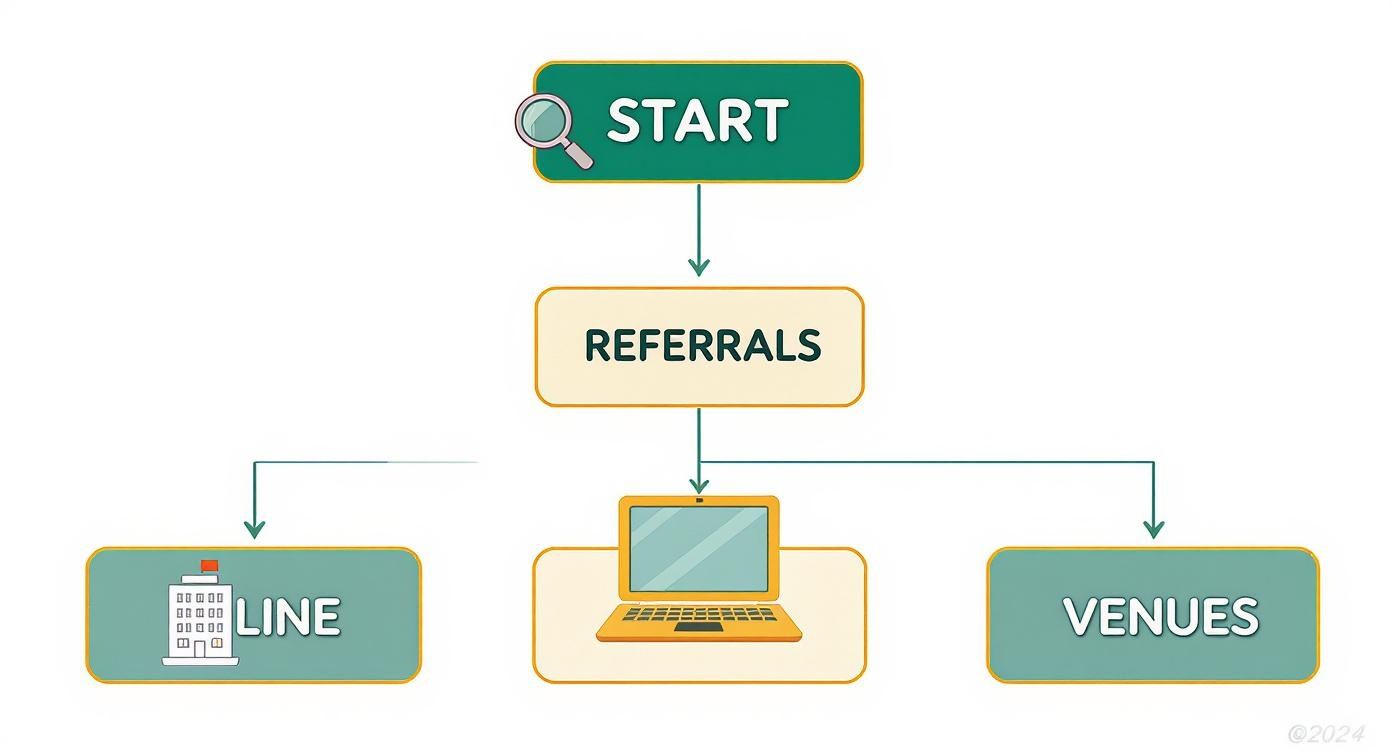
Whether you got their name from a friend, a planner, or a Google search, vetting them properly is what makes all the difference.
Finally, you absolutely must ask about their backup plan. This is non-negotiable. What’s the plan if they get sick or have a family emergency? Do they have a network of trusted DJs who can step in? And what about equipment failure? A true professional will have a backup for everything—speakers, laptop, mixer—ready to go at a moment's notice. Their answer here tells you everything you need to know about their reliability.
DJ Interview Comparison Scorecard
Keeping track of your conversations can get tricky, especially when details start to blur. A simple scorecard helps you objectively compare candidates side-by-side after the interviews are done. Use this to rate each DJ on a scale of 1 to 5 across the most important categories.
| Category | Attribute to Evaluate | DJ A Score (1-5) | DJ B Score (1-5) | Comments and Red Flags |
|---|---|---|---|---|
| Professionalism | Responsiveness, Punctuality, Website/Materials | |||
| Experience | Years in Business, Number of Weddings, Venue Familiarity | |||
| Personality/Vibe | MC Style, Energy Level, Connection with You | |||
| Music Knowledge | Genre Versatility, Ability to Read a Crowd | |||
| Logistics | Planning Process, Request Policy, Backup Plans | |||
| Equipment | Quality of Gear, Backup Equipment, Lighting Options | |||
| Overall Gut Feeling | Would you trust them with your big day? |
Once you've filled it out, take a step back and look at the scores. Sometimes the right choice is obvious, but often it comes down to who you felt the strongest connection with. This tool just helps make sure you haven’t overlooked any critical details in the process.
Evaluating Their Technical Skills and Gear
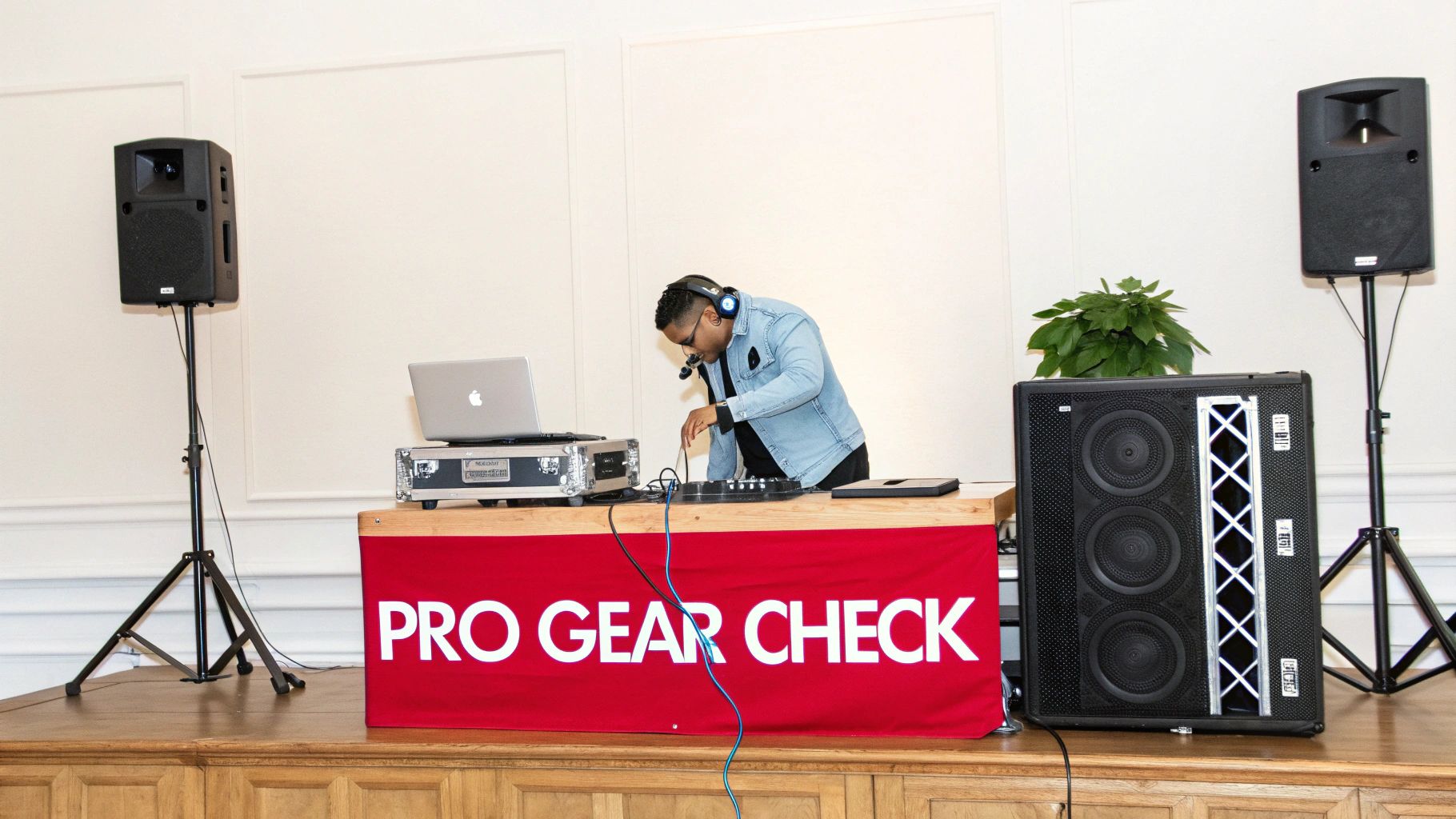
A fantastic personality and an incredible music library are crucial, but they’re useless if the sound system crackles or the mic cuts out during the maid of honor’s toast. The technical side of things is the foundation of your reception's entire vibe, and it’s a detail that couples often overlook.
A pro’s setup is way more than a couple of speakers on stands. It’s a whole ecosystem of equipment chosen for reliability and crystal-clear sound. Their gear isn't just playing background music; it’s delivering the emotion of your first dance and every heartfelt word spoken.
You don't need to become an audio engineer to figure this out, but you absolutely need to ask the right questions to make sure they’re bringing professional-grade equipment that fits your venue.
What Professional Gear Actually Looks Like
When a DJ starts talking about their setup, they should be able to describe it confidently. If you get vague answers, that’s a red flag. Here’s what a truly professional rig usually includes:
- High-Quality Speakers: We're talking reputable brands known for crisp, clean audio that can fill a room without sounding distorted or tinny. They should also have subwoofers—that's what provides the rich, full bass that actually makes people want to get up and dance.
- Reliable Microphones: At a bare minimum, they need professional-grade wireless handheld mics for toasts. A lapel mic for your officiant during the ceremony is also a key piece of gear for a seamless experience.
- Professional Mixer and Controller: This is the DJ's command center. It’s what lets them mix songs together smoothly, control the volume, and manage audio from different sources without any awkward pauses.
- Dance Floor Lighting: This is more than just a disco ball. Pro DJs often have a lighting package with effects that sync to the music’s tempo, creating an energetic atmosphere that pulls people onto the dance floor.
The Backup Plan Is Non-Negotiable
The single most important technical question to ask is: "What’s your backup plan if a piece of equipment fails?" A real professional will have an immediate, detailed answer. This should include having a backup laptop, mixer, speakers, and all the necessary cables right there on-site. If they don't have a backup plan, it's an immediate deal-breaker.
It's About the Mix, Not Just the Playlist
Beyond the physical gear is the DJ's actual skill behind the decks. A great wedding DJ isn’t just hitting "play" on a Spotify playlist. They are actively mixing, beat-matching, and creating a continuous flow of energy that keeps the dance floor packed.
This skill is often called "reading the room." It’s the ability to see that a certain song is a hit and then seamlessly transition into another track with a similar vibe to build momentum. On the flip side, it's also knowing when to switch genres or slow things down to get grandma and grandpa out on the floor.
Understanding how audio and lighting work together is a huge part of this. If you want a deeper look at how all these technical pieces fit together, learning the basics of what is event production can give you a new appreciation for the complexity involved.
Understanding the Contract Before You Sign

Okay, you found your DJ! After all the research, interviews, and vibe-checks, you’re confident you’ve got the right pro to make your reception unforgettable. Before you celebrate, there’s one final, absolutely critical step: the contract.
This isn't just a piece of paper. Think of it as the official blueprint for your party. A professional, detailed contract is the hallmark of a legitimate business and it’s designed to protect both of you, ensuring there are zero surprises when the big day arrives.
It’s the tool that turns all those great conversations and verbal promises into a solid, written commitment. Let’s break down exactly what you should be looking for.
Key Components of a Solid DJ Contract
A truly thorough contract leaves no room for guessing games. As you read it over, make sure every single aspect of the service is spelled out. My rule of thumb? If it's not in writing, it's not guaranteed.
Here's a quick checklist of the non-negotiables:
- Contact Information: This seems obvious, but you’d be surprised. Double-check that the full names, addresses, and phone numbers for you and the DJ company are 100% correct.
- The Specifics: The contract needs to list the exact date, the precise start and end times, and the full, formal address of your venue.
- Your DJ's Name: If you’re hiring a company with multiple DJs, the contract must name the specific DJ you connected with. You don’t want a stranger showing up on your wedding day.
- A Detailed List of Services: It should itemize everything in your package—ceremony audio, cocktail hour music, reception performance, all MC duties, and any fun add-ons like special lighting or a photo booth.
- Total Cost and Payment Schedule: The contract must clearly state the total fee, the amount of the non-refundable retainer, and the due dates for every payment.
A professional DJ contract is your peace of mind in writing. It’s the difference between hoping for the best and knowing you're covered, ensuring every detail you planned is executed flawlessly.
Spotting Potential Red Flags
Unfortunately, not all contracts are created equal. Some are frustratingly vague, while others might be missing crucial protections. Knowing what to watch out for can save you a world of hurt later.
A massive warning sign is the lack of an insurance clause. Every single professional wedding vendor should carry liability insurance, period. Ask them for a certificate of insurance—most venues require it anyway. This protects you, your guests, and the DJ in case of any accidents.
Another red flag is vague or wishy-washy language. Phrases like "standard lighting package" or "appropriate music" are way too open to interpretation. The contract should specify the exact type and number of lights and clearly outline how the music selection process will work.
Finally, be very wary of anyone who pressures you to sign on the spot. A true professional will want you to feel comfortable and will encourage you to take your time and read it through. High-pressure sales tactics are usually a sign of a business that isn't confident in its own service.
Critical Clauses You Cannot Overlook
Beyond the basics, a few specific clauses offer vital protection and should be non-negotiable. These are the details that handle all the "what ifs" that come with a live event.
First is the cancellation and postponement policy. Life happens. The contract must clearly define the terms for both you and the DJ if the wedding has to be canceled or moved. What happens to your retainer? Are there fees for rescheduling?
Next, look for an illness or emergency clause that covers the DJ. What is their specific backup plan if they are physically unable to perform? A professional's contract will state that they will provide a substitute DJ of equal or greater skill at no additional cost to you.
Finally, make sure the contract includes any on-site needs for the DJ, sometimes called a "rider." This usually covers simple things like access to a power outlet within a certain distance and, often, a vendor meal. Getting this clarified upfront prevents any awkwardness or logistical hiccups on the day itself. When you see these points covered, you can book with total confidence.
A Few Final Questions Before You Book
You've done the interviews, you've checked the reviews, and you're this close to locking in your DJ. Before you sign on the dotted line, a few common questions always seem to pop up. Let's tackle them head-on, so you can feel 100% confident you've found the right pro for your big day.
Think of this as your final gut check—clearing up those last-minute details that separate a good choice from the perfect one.
How Far in Advance Should I Book a Wedding DJ?
If you take away one thing, let it be this: book your DJ way sooner than you think you need to. In a city like Kansas City, the best talent gets snapped up fast.
For the best selection, you really want to lock in your wedding DJ 9 to 12 months in advance. This is non-negotiable if your wedding is on a Saturday during peak season (think spring through fall). The most sought-after, experienced DJs often see their calendars fill up more than a year out.
Booking early doesn’t just guarantee you get your first choice—it also locks in their current pricing. Wait too long, and you might not only miss out but also face next year's rates. If you're on a tighter timeline, don't panic! You can often find fantastic DJs with availability for Friday or Sunday weddings, but you’ll need to move quickly.
Pro Tip: Don't put this off. As soon as you have your date and your venue, start the DJ search. Your DJ is a huge part of your reception's success, so give this decision the time it deserves.
Should I Give My DJ a Complete Playlist?
This is a classic question, and the answer is a hard no. It might feel like you're being helpful, but handing over a rigid, multi-hour playlist actually ties your DJ's hands. A huge part of their job—and what separates the pros from the amateurs—is reading the room and adjusting the music on the fly to keep the energy high.
Instead, give them a little guidance. It works best when you provide two simple lists:
- A "Must-Play" List: Think 15-20 of your absolute, can't-live-without-them jams. These are the songs that define you as a couple.
- A "Do-Not-Play" List: This is just as critical. Make sure they know about any songs, artists, or genres that would totally kill the vibe for you.
This approach gives your DJ the perfect road map. They get a real feel for your taste but still have the creative freedom to work their magic, mix in other crowd-pleasers, and build a set that keeps everyone—from your college friends to your grandma—on the dance floor.
What’s the Difference Between a DJ and an MC?
This is a big one. While many professional DJs are also fantastic Masters of Ceremonies (MCs), they are two different jobs. You need to be crystal clear on what your package includes.
A DJ is the music expert. They’re in charge of curating the perfect soundtrack, mixing tracks, managing the sound system, and creating the whole sonic vibe of your party.
An MC is the host. They’re the voice of the evening—making announcements, introducing the wedding party, guiding guests from the toasts to the cake cutting, and keeping the whole event flowing smoothly.
A great DJ isn't automatically a great MC. Some are incredible on the mic, while others prefer to let the music do the talking. Make sure you ask about their MC style during the interview to ensure it matches the tone you're going for, whether that's high-energy and interactive or more polished and understated.
Is It Customary to Tip My Wedding DJ?
While a tip is never required, it’s definitely a welcome and appreciated gesture for a job well done. If your DJ knocked it out of the park, kept the dance floor packed all night, and made your reception run flawlessly, a gratuity is a fantastic way to say thank you.
So, what’s the standard? Think 10-20% of their total fee. Another common approach is a flat amount, somewhere between $100 and $250. It’s best to hand this off in cash inside a thank-you card at the end of the night. If the DJ owns the company, a tip is still a wonderful gesture, though it’s generally less expected than if they’re an employee of a larger agency.
Planning the perfect wedding celebration starts with the right team. At Showboss KC, we combine top-tier DJ talent with full-scale event production to create unforgettable experiences. From custom lighting designs to crystal-clear audio, we handle every detail so you can focus on making memories. Discover how we can bring your vision to life.