

The success of a corporate event is locked in long before the first guest walks through the door. This is the foundational stage—where you get brutally honest about what you want to achieve and map out exactly how you'll get there. It’s about moving past vague ideas and defining what a “win” actually looks like, whether that’s a flood of new leads, a tangible boost in team morale, or successfully launching a new product.
Every single decision from this point forward needs to be intentional.
Build Your Foundation for a Flawless Event
Before you even think about tasting menus or venue walkthroughs, you have to answer the most important question of all: Why are we doing this? The answer is the bedrock of your entire strategy. Without it, you're just throwing an expensive party. With it, you're executing a strategic business move.
Define Your Event Goals and Objectives
Your goals can't be fluffy. "Improving company culture" or "making a splash" are nice thoughts, but they're impossible to measure. You need concrete, specific targets that tie directly back to a business outcome.
Get specific. Think in numbers.
- Lead Generation: Instead of "get new leads," aim to generate 75 qualified sales leads from your product launch.
- Employee Engagement: Don't just "boost morale." Strive to achieve a 90% satisfaction score on post-event surveys after a team-building retreat.
- Brand Awareness: "Get press" is too vague. Your goal should be to secure 10 media placements following a press conference.
- Client Retention: Instead of "show client appreciation," try to increase client renewal rates by 15% among attendees of an exclusive dinner.
When your goals are measurable, you can walk back into your boss's office with a clear ROI. That's how you prove your event was a strategic investment, not just a line item on the marketing budget.
To get you started, here's a simple framework for locking down these core components.
Core Event Planning Framework
| Planning Component | Key Questions to Answer | Example Outcome |
|---|---|---|
| Primary Goal | What is the single most important outcome we need to achieve? | Generate 50 new MQLs for our new software. |
| Target Audience | Who, specifically, are we trying to reach? (Job titles, industries, etc.) | VPs of Marketing at mid-size tech companies. |
| Key Message | What is the one thing we want every attendee to remember? | Our new software solves their biggest workflow bottleneck. |
| Success Metric | How will we know, with data, that we succeeded? | 50 MQLs generated and a 20% meeting booking rate post-event. |
This table forces you to be specific from the get-go, which makes every subsequent decision infinitely easier.
Develop a Realistic Event Budget
Your budget is your reality check. It’s the financial roadmap that dictates what’s possible and forces you to be smart about where you spend your money. A well-planned budget isn't about being cheap; it's about allocating funds where they’ll make the biggest impact on your goals.
Start by listing every single potential cost—don't forget the little things that sneak up on you. A solid budget needs to account for everything:
- Venue Rental & Insurance
- Food & Beverage (catering, staffing, permits)
- Audio-Visual Production (this is a big one: sound, lighting, video, staging)
- Speaker & Entertainment Fees
- Marketing & Promotion (ads, invitations, content)
- On-site Staffing & Security
- Signage & Branded Swag
- Contingency Fund (always add 10-15% for the unexpected—it will happen)
A smart budget isn't about spending less; it's about spending smarter. If your primary goal is networking, allocate more funds to a high-quality cocktail reception and less on elaborate stage decorations. Align every dollar with your objectives.
The good news? Companies are recognizing the value of live events. A recent study shows that 74% of event marketers expect their budgets to increase in 2025, with only 5% seeing a decrease. This tells us that well-run events are seen as powerful business drivers, so treat your budget as a strategic investment.
Create Your Master Event Timeline
With your "why" defined and your budget set, it's time to build your timeline. This is your master plan, your single source of truth that maps out every task and deadline from today until the last thank-you email is sent.
Think of it as your event's GPS. It breaks the entire overwhelming process into small, manageable steps.
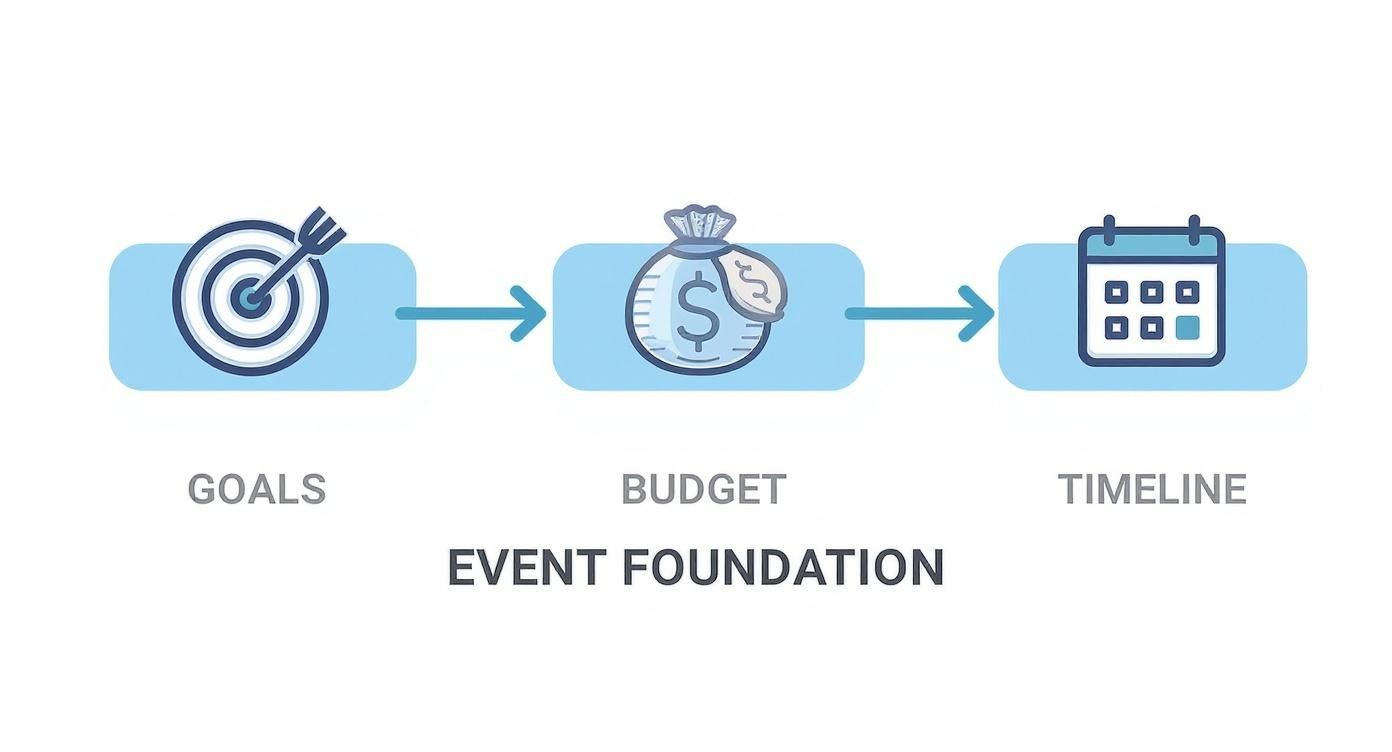
The best approach is to work backward from your event date. Plug in the big deadlines first—venue contract signed, catering confirmed, invitations sent—and then fill in all the smaller tasks that lead up to them. A detailed timeline is your best defense against last-minute chaos.
For a really deep dive into every single item you'll need to track, our comprehensive corporate event planning checklist breaks it all down for you.
Lock in Your Venue and Build Your A-Team
Okay, you've got your goals, a solid budget, and a timeline. Now for the fun part—bringing the vision to life by picking the partners who will make it all happen. This is where your event starts to feel real.
The venue you choose and the vendors you hire aren't just expenses; they're the co-creators of your entire attendee experience. A killer venue sets the mood instantly, and a top-notch vendor team ensures everything runs so smoothly you actually get to enjoy yourself.
Finding the Right Walls for Your Vision
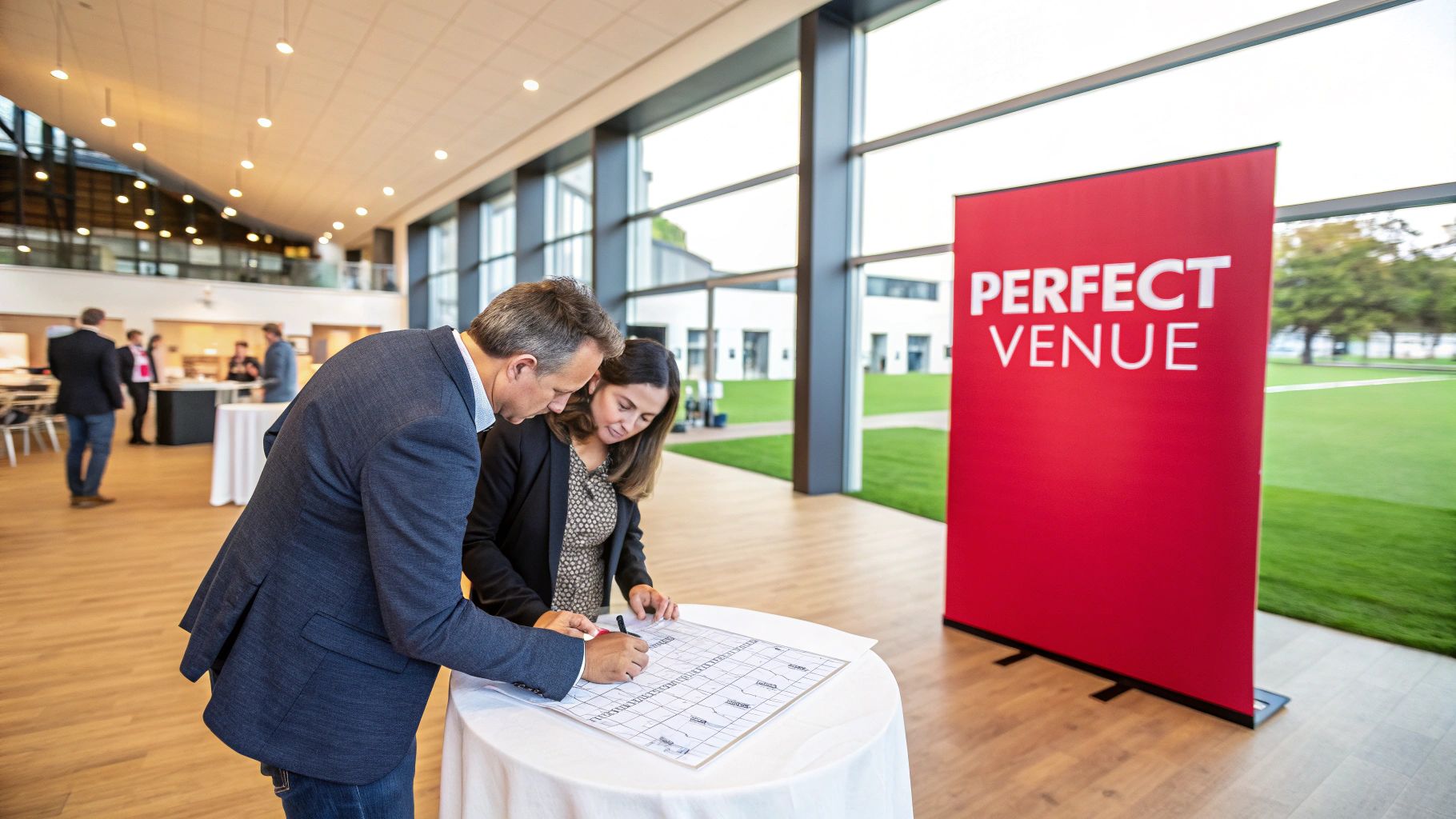
Picking a venue is so much more than finding a room that fits your headcount. The space itself is a massive part of your event's story and a direct reflection of your brand. Skimping here with a cheap, hard-to-reach location can sabotage even the most brilliant program.
You have to think bigger. When you're touring potential spots, look at it from every angle:
- Does It Vibe with Your Brand? Seriously, does the space feel like your company? A sleek tech startup probably shouldn't book a rustic ballroom, just like a black-tie gala would feel pretty strange in a minimalist industrial loft.
- Location, Location, Accessibility. How easy is it for people to get there? Think about airport access, public transit, and nearby hotels. And never, ever underestimate the power of good, free parking. It's one of those small details that leaves a big impression.
- The Tech Check. Don't just tick the "has Wi-Fi" box. Ask about the bandwidth. Can it handle 500 people all logging on at once? What about built-in AV, power capacity for your production crew, and rigging points for lights and sound? Getting these answers now saves massive headaches later.
A great venue doesn't just hold people—it amplifies your message. Before you even think about signing a contract, do a full walkthrough. Imagine the entire event flow, from the check-in desk to the main stage and the breakout rooms.
Once you've got a shortlist, it's time to get forensic with the contracts. Hunt for those pesky hidden fees—things like mandatory security, surprise cleaning charges, or being locked into using their overpriced in-house vendors. And don't be afraid to negotiate! Asking for a better rate, a few included amenities, or flexibility on dates can make a huge difference to your bottom line.
Assembling Your Vendor Dream Team
Your vendors are your boots on the ground. From the caterer to the AV techs running the show, their expertise is what turns your plan into reality. Finding pros you can trust is absolutely essential.
It all starts with a crystal-clear Request for Proposal (RFP). A sharp, detailed RFP is your best friend—it immediately weeds out vendors who aren't the right fit, saving everyone a ton of time.
Your RFP should nail these points:
- The Quick Pitch: A simple summary of the event, including your goals, date, time, and how many people you're expecting.
- The Specifics: Get detailed. For a caterer, list meal types and any dietary restrictions. For an AV company, specify the exact gear you need, like wireless mics, projectors, or specific lighting setups.
- The Money Talk: Give them a realistic budget range. This allows them to propose solutions you can actually afford.
- The Deadline: Make it clear when you need their proposal.
Vetting and Signing Your Partners
Getting proposals in your inbox is just the first step. Now you need to figure out who’s the real deal. Whatever you do, don't skip this part.
- Call Their References. Ask for at least three recent clients and actually call them. A few simple questions about communication, on-site problem-solving, and overall performance will tell you everything you need to know.
- Look at Their Work. Scour their portfolio. Do their past events have the look and feel you're going for? Have they handled events of your size and complexity before?
- Get Face Time. Hop on a video call or meet in person. You need to know if you can work with these people under pressure. You’re not just hiring a service; you’re building a temporary team.
Once you’ve found your people, read the contracts. Then read them again. Make sure every single service, cost, and deadline you discussed is spelled out clearly. Pay special attention to cancellation policies and liability insurance.
Building a solid relationship with your vendors from day one gets everyone invested in the same goal: pulling off an incredible event. This is the team that will make it all happen.
Design an Unforgettable Attendee Experience
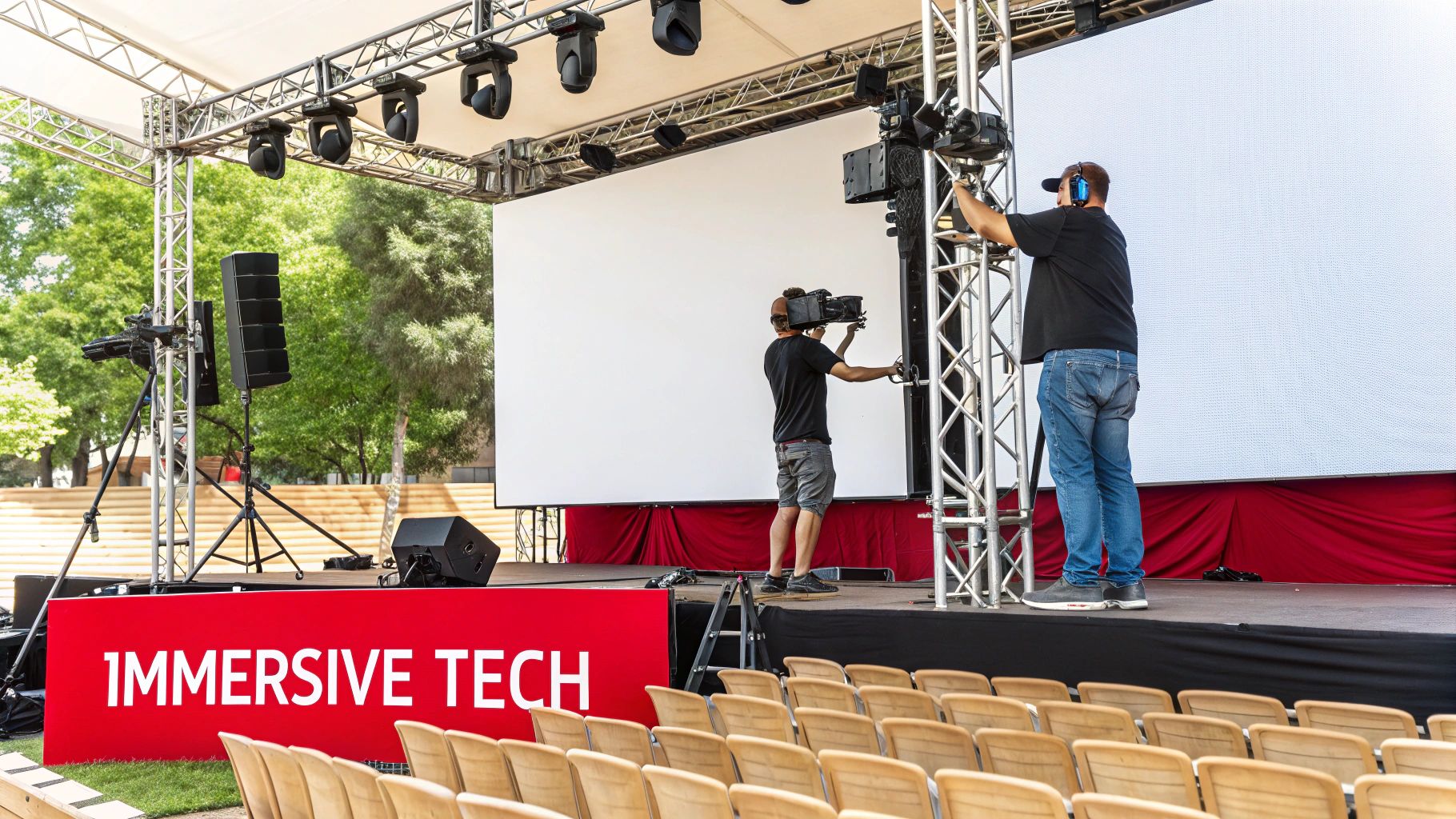
Let's be honest, the days of a wobbly podium and a microphone that screeches are long gone. Today, corporate events are all about the experience, and the engine driving that experience is professional audio-visual (AV) production.
This is what turns a forgettable meeting into an immersive brand moment that people are still talking about weeks later.
Great production isn’t just about making things louder or brighter. It's about shaping the atmosphere and making sure your message lands with clarity and real impact. From the second your attendees walk in, the lighting, sound, and visuals need to work together to support your goals and transform a standard conference room into a dynamic environment.
Breaking Down Your AV and Production Needs
Thinking about all the technical gear can feel like a lot, but it really just boils down to a few key pieces. Each one has a specific job in crafting the attendee journey, whether your audience is in the room, joining online, or both.
The event world has changed. Now, 74.5% of planners are running hybrid formats, and 63% are putting more money into their virtual events. While live events still bring in the most revenue, you need a rock-solid tech plan no matter what format you choose.
Here’s what you absolutely have to get right for a seamless production:
- Crystal-Clear Audio: This one is non-negotiable. If your audience can't hear the keynote speaker or the background music sounds like a blown speaker, the whole experience is shot. You'll need to think about how many speakers you have, whether you need wireless lapel mics or handhelds, and how to get even sound coverage across the entire space.
- Dynamic Lighting: Lighting is so much more than just flipping a switch. It sets the entire mood. Use branded uplighting to splash your company colors on the walls, spotlights to draw everyone's focus to the stage, and intelligent lighting to create some serious energy for a band or DJ.
- High-Impact Video: An LED video wall is the modern centerpiece for a reason. It can display everything from presenter slides and branded motion graphics to sponsor loops and live camera feeds. It’s a stunning backdrop that keeps the audience completely locked in.
- Staging and Set Design: Your stage is the focal point. It has to look professional and match the scale of your event. Think about branded podiums, custom backdrops, and even stage furniture that completes the look and feels polished.
Matching Technology to Your Event Format
The tech you need for an in-person gala is completely different from what you’d use for a global hybrid summit. Nailing down the unique demands of your format is critical for your budget and for pulling it off without a hitch.
For an in-person conference, you’re focused on creating an incredible in-room experience. That means a powerful sound system that reaches the back row, massive video screens so everyone can see, and stage lighting that makes presenters pop.
A fully virtual event shifts the entire game to broadcast quality. The priority here is high-definition cameras, slick switching between speakers and slides, and a super stable streaming platform. Your "venue" is the viewer's screen, so the production value has to be top-notch to hold their attention.
Hybrid events are easily the most complex. You're basically running two shows at once—one for the live audience and one for the virtual one. This means you need a dedicated production team handling the live AV while a separate broadcast crew manages the stream, cameras, and online audience engagement.
Collaborating with Your Production Partner
Choosing the right production company is just as crucial as picking your venue. These folks aren't just vendors; they're your creative and technical partners in crime. A great team will listen to your vision and then figure out how to bring it to life inside your budget.
When you start those conversations, come prepared with a few key details:
- Your Vision and Goals: Explain the feeling you want to create. Is this a high-energy awards show? A serious educational seminar? A massive product launch party?
- Venue Details: Have the venue name, room dimensions, and any known tech limitations ready to go. Your production partner needs this to build an accurate plan.
- The Agenda: Share a draft of your run-of-show. Knowing how many presenters, panel discussions, and entertainment segments you have will tell them exactly what kind of AV support you’ll need.
When you treat production as a core part of your event design from day one, every technical element has a purpose. That strategic thinking is what elevates an event from just another gathering to a powerful, memorable experience. To really spice things up, you could even explore some unique corporate event entertainment ideas that a great production team can take to the next level.
Master Your Event Day Execution
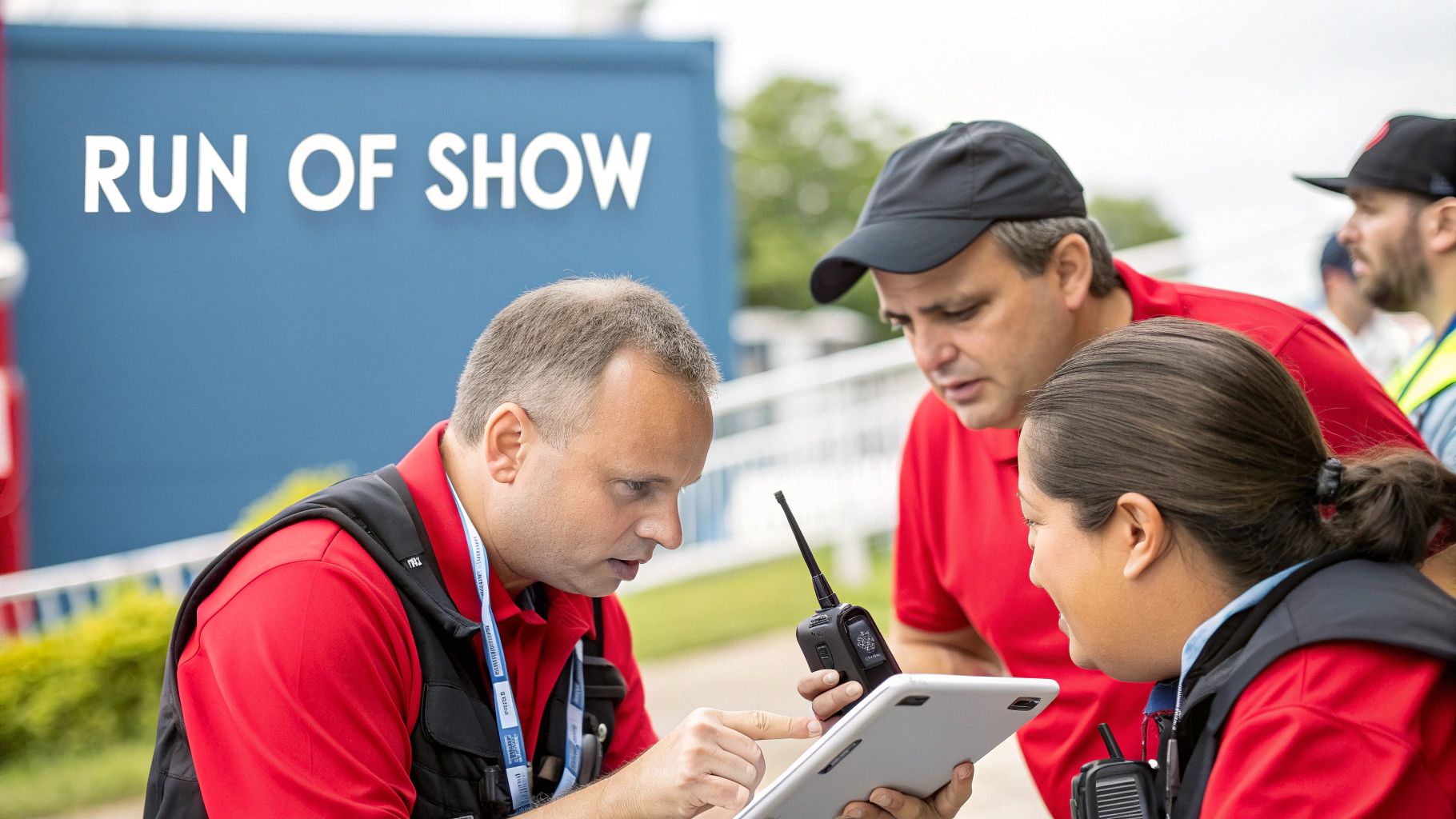
After months of planning, event day is finally here. This is where the magic happens, where your vision comes to life. Your role officially shifts from architect to orchestra conductor.
Success on the big day boils down to two things: a hyper-detailed run-of-show and a team that knows exactly what to do. Every moving part—from the caterers and production crew to your speakers and attendees—needs to move in perfect harmony. Flawless execution isn't about luck; it's about having a bulletproof plan.
Crafting the Ultimate Run-of-Show
Forget a simple agenda. A professional run-of-show is your event’s minute-by-minute playbook. It’s the single source of truth shared with every key player—venue managers, the AV crew, internal staff—so everyone is on the same page.
A basic schedule might just say "9:00 AM – Keynote Speaker." A true run-of-show gets granular.
Here’s what a detailed segment looks like:
- 8:55 AM: House lights dim to 50%. Walk-in music fades.
- 8:57 AM: Pre-recorded video intro rolls on the main LED screen.
- 8:59 AM: Stage manager cues keynote speaker into position backstage.
- 9:00 AM: Video concludes. Stage lights up to full. Speaker’s walk-on music plays for exactly 15 seconds.
- 9:01 AM: Speaker hits the stage. Presentation clicker and confidence monitor are live.
This level of detail leaves no room for error and creates the seamless transitions that separate amateur events from professional productions. To get a better handle on how all these technical pieces fit together, it’s worth understanding the broader scope of what is event production and the role it plays on-site.
Building Your On-Site Dream Team
On event day, your staff is your greatest asset. No matter how meticulously you've planned, you simply can't be everywhere at once. You need a team that gets the mission, owns their specific role, and feels empowered to solve problems on the fly.
Before the first guest even thinks about arriving, get everyone together for a pre-event briefing. This is more than a quick huddle; it's a critical alignment session.
During this meeting, you need to:
- Walk Through the Run-of-Show: Go over the entire schedule, pointing out critical transition points and potential hiccups.
- Define Clear Roles: Make sure everyone knows their "zone." Who’s managing speaker check-in? Who’s the point person for the catering captain? Who is keeping an eye on the live stream chat?
- Establish Communication Channels: Ditch the scattered texts and calls. Set up a dedicated channel like a WhatsApp group or Slack for instant updates.
A well-informed team is a confident team. When your staff knows the plan inside and out, they can anticipate needs and handle minor issues without needing to escalate every little thing. That frees you up to manage the bigger picture.
Empowering Your Team to Succeed
Once roles are crystal clear, you have to give your team the autonomy to act. An empowered team makes smart decisions under pressure.
For example, if the registration line suddenly gets long, a team lead shouldn't have to hunt you down for permission to open another check-in station—they should feel empowered to make that call right then and there.
You build this trust by setting clear guidelines beforehand. Let your team know the parameters they can operate within. This could mean giving your volunteer coordinator a small budget for unforeseen needs or trusting your technical director to make real-time audio adjustments without getting your approval for every little change.
This approach doesn't just make your event run smoother. It builds a more positive, responsible team environment—a non-negotiable for pulling off a truly great event.
Prepare for the Unexpected with Contingency Planning
Here's a hard truth of live events: something will go wrong. No matter how meticulously you plan, no matter how perfect your run-of-show looks on paper, the unexpected will happen. A seasoned pro knows the real test isn't in preventing every single problem—it's having a calm, smart response locked and loaded.
This is the whole game of contingency planning. It’s not just about stashing a few extra power strips in a road case. It’s a deliberate approach to risk management that transforms potential catastrophes into manageable hiccups.
When you think through the "what-ifs" ahead of time, you're building resilience right into the foundation of your event. You get to lead with confidence, not react with panic.
Identify Your Primary Risks
First things first: get your team in a room and start brainstorming every single thing that could plausibly go sideways. I mean everything. Walk through the event day in your minds, from the first truck hitting the loading dock to the last guest heading home. This isn't about being negative; it's about being prepared.
To keep it from getting overwhelming, start bucketing the risks into categories. Your list will likely include:
- Tech Failures: This is a huge one. What’s the plan if the presentation laptop gives up the ghost? What if the venue's Wi-Fi crumbles or a CEO’s lapel mic dies mid-sentence?
- People Problems: The human element is always a wildcard. What happens if your keynote speaker’s flight gets canceled? What if your lead AV tech calls in sick, or the registration desk is suddenly short-staffed during the morning rush?
- Venue & Environmental Glitches: These are the things you often can't control. Think about a sudden power outage, a fire alarm getting pulled (it happens!), or a freak thunderstorm rolling in during your outdoor reception.
Once you have a solid list, rank each risk by how likely it is to happen and how badly it would mess things up. A typo on a slide is a low-impact blip. A total power failure is a showstopper. Focus your energy on the high-impact stuff first.
Contingency planning isn't about having a crystal ball. It's about building a flexible framework so that no single failure can torpedo your entire event. The goal is to have a Plan B so seamless that the audience never even knows you had to use it.
Develop Actionable Backup Plans
For every high-priority risk on your list, you need a clear, step-by-step backup plan. "We'll figure it out" is not a plan—it’s a recipe for chaos. Your backup strategy has to be so specific that any member of your team can pick it up and run with it.
Let's take a classic nightmare scenario: your main speaker cancels on the morning of the event.
Your contingency plan can't just be "find a replacement." It needs to be a detailed sequence. For example, maybe you have a talented executive from your own company on standby, complete with a pre-built presentation on their laptop. The plan would also detail who is responsible for communicating the change to the audience and exactly what the emcee will say from the stage.
A few more examples of solid backup plans:
- For Internet Failure: Have a dedicated mobile hotspot—on a different cellular carrier than your primary—ready to go for mission-critical systems like check-in or the livestream.
- For Power Outages: Get written confirmation from the venue on their backup generator. Know exactly what it powers (HVAC? Stage lighting? Kitchen?) and what it doesn't. Keep pre-printed directional signs handy in case digital screens go dark.
- For Medical Emergencies: Make sure every single staff member knows where the first-aid station is, who the designated first-responders are, and the exact protocol for calling for help. No hesitation.
Establish an Emergency Communication Strategy
When things go wrong, clear communication is your single most powerful tool. Panic and confusion feed on bad information. Your contingency plan absolutely must include a communication protocol that defines who says what, to whom, and how.
Designate one person as the official source of information for your internal team. This prevents conflicting orders from flying around in a high-stress moment. Use a dedicated channel—like a private Slack channel or WhatsApp group—to push out real-time updates so everyone is on the same page.
By planning for the unexpected, you're not just managing risk. You're fiercely protecting the attendee experience and your organization's reputation.
Measure Success and Prove Your Event's ROI
The lights have dimmed and the last guest has walked out the door, but if you think your job is done, you're missing the most important part. The post-event wrap-up is where you transform a great experience into solid business value. This is your moment to prove the event was a strategic investment—not just a line item on a budget—and to mine for gold that will make your next one even better.
Let's be real: without a smart way to measure success, you’re just guessing. Proving the return on investment (ROI) is everything when it comes to securing budgets for next year and showing leadership why your work matters. And it all starts by listening to the people who were actually there.
Get Real Feedback From Your Attendees
The single best way to know if you hit the mark is to ask. A well-designed post-event survey is your direct line into the minds of your audience, but you have to be fast and focused to get the goods.
You absolutely have to get that survey out within 24 hours of the event. If you wait any longer, the specific details and the immediate emotional impact start to fade. Response rates will plummet, and the feedback you do get will be vague.
Keep it short and sweet. Nobody wants to fill out a 20-minute questionnaire. Aim for something that takes 3-5 minutes, tops. A good mix of question types will give you the richest data:
- Net Promoter Score (NPS): The classic "On a scale of 0-10, how likely are you to recommend this event to a colleague?" is a powerful, standardized benchmark for overall satisfaction.
- Rating Scales: Use simple 1-5 scales for people to rate specific things like the venue, the speakers, the food, and the session topics. It’s quick and gives you clear data points.
- Open-Ended Questions: Always include one or two questions like, "What was the most valuable part of the event for you?" or "What could we improve for next time?" This is where you’ll find the unfiltered, honest feedback you never would have thought to ask for.
Tie Everything Back to Your Original Goals
Okay, now it’s time to connect the dots. All the data you've gathered is useless unless you tie it directly back to the specific, measurable goals you set way back at the beginning. This is how you stop talking about feelings and start talking about results.
Every KPI you track should be a direct answer to the question, "Did we achieve our goal?" This simple shift turns a pile of numbers into a powerful story of success.
An event without clear metrics is just a party. An event with data-driven reporting is a business asset. You have to show how the investment in staging, catering, and speakers translated into tangible results that the C-suite actually cares about.
To make this crystal clear, I always build a simple table that puts the initial goals right next to the final outcomes. It’s impossible to misunderstand.
Linking Objectives to Outcomes
| Initial Objective | Key Performance Indicator (KPI) | Where the Data Came From |
|---|---|---|
| Generate 75 qualified sales leads. | Number of MQLs from event registration. | CRM Data |
| Increase client renewal rates by 15%. | Renewal rate of attending clients. | Sales Team Reports |
| Achieve a 90% employee satisfaction score. | Average satisfaction score from surveys. | Post-Event Survey |
Put It All Together in a Killer Post-Event Report
The final play is to package all your findings into a comprehensive post-event report. This document is your proof. It’s your showcase. And it’s the roadmap for making the next event even more of a home run. Think of it less like a dry summary and more like a strategic analysis.
Your report needs to be clean, visually engaging, and easy for a busy executive to skim.
A strong post-event report always includes these five things:
- An Executive Summary: Start right at the top with the big wins. Briefly state the event's goals, what you achieved, and the final ROI calculation.
- Performance Against KPIs: Don't just list numbers. Use simple charts and graphs to show how you did against each goal. Visuals are your best friend here.
- Attendee Feedback Analysis: Summarize the key takeaways from your survey. Include your NPS score and pull a few powerful, positive quotes that bring the success to life.
- Budget Breakdown: Show the final numbers—projected expenses vs. actual costs. Transparency builds trust.
- Actionable Recommendations: This is critical. End with what you learned and exactly how you’ll apply those insights next time. Suggest specific, concrete improvements.
This final report closes the loop on all your hard work. It validates your strategy, proves your value, and solidifies your role as an essential partner in the company's success.
Common Questions We Get About Planning Corporate Events
Even with the perfect plan laid out, questions are going to pop up. It happens to everyone. Here are some of the most common ones we hear from clients just getting their feet wet, with straightforward answers to get you past those hurdles.
How Far in Advance Should I Start Planning?
This is a big one, and the answer really depends on the scale of your event.
For the heavy hitters—think annual conferences, formal galas, or major product launches—you’ll want to give yourself a long runway. Start the process 6-12 months out. This isn't just about being organized; it's a strategic move to lock in the best venues and in-demand speakers before their calendars fill up.
On the other hand, for smaller gatherings like an internal workshop, a team-building off-site, or an intimate client dinner, you can work with a much shorter timeline. A lead time of 2-3 months is usually plenty. The key is giving yourself enough breathing room to make smart decisions without feeling the pressure of a ticking clock.
What's the Single Biggest Mistake I Can Make?
If there's one pitfall to avoid at all costs, it’s diving in without establishing clear, measurable goals from day one. Without a defined purpose, your event has no direction, and you have no way to prove its value later.
An event without a goal is just a party. A goal like "generate 100 qualified sales leads" or "achieve a 90% employee satisfaction score" transforms it into a strategic business initiative. Every decision should directly support your primary objectives.
How Do I Create a Budget That's Actually Realistic?
First, get granular. Make a list of every single potential expense you can think of. Don't just jot down the big stuff like the venue, catering, and A/V production. Remember all the smaller costs that add up, like marketing materials, name badges, staff meals, and insurance.
Once you have your list, do some research on the going rates for each item in your city. This grounds your estimates in reality, not wishful thinking.
Most importantly, always add a 10-15% contingency fund to your grand total. Trust me, unexpected costs will come up—it’s just the nature of the beast. That buffer will be your best friend. From there, you can prioritize spending based on your main goals. If networking is the top priority, for instance, you’ll want to invest more in a great reception space and catering.
At Showboss KC, we transform your vision into an unforgettable experience with professional production and entertainment. Let's start planning your next corporate event.