

In today's competitive landscape, relying on the same old fundraising tactics can lead to donor fatigue and missed opportunities. To truly thrive, nonprofits need a diverse portfolio of engaging, high-impact events that connect with supporters on every level, from major donors to grassroots advocates. This comprehensive guide moves beyond the basics to provide a strategic look at 10 proven nonprofit fundraiser event ideas designed to drive results.
We will break down each concept, from high-touch galas to scalable digital campaigns, equipping you with the actionable details needed for successful execution. This is not just a list; it is a blueprint for building a more dynamic and sustainable fundraising strategy.
Inside this guide, you will find:
- Actionable Blueprints: Each idea includes a clear concept description, target donor profile, and realistic budget considerations.
- Strategic Insights: We explore the revenue and engagement potential for every event type, helping you align your efforts with your organizational goals.
- Practical Checklists: Key logistical, production, and AV needs are outlined to simplify your planning process from start to finish.
- Creative Twists: Discover unique angles to increase participation, boost donations, and make your event unforgettable for attendees.
Whether you're a corporate event planner organizing a charity activation, a nonprofit director looking to refresh an annual campaign, or a community group planning your first fundraiser, these ideas provide the detailed framework needed for a record-breaking year. Let's explore the events that will unlock your organization's full fundraising potential.
1. The High-impact Gala: A Night of Elegance and Philanthropy
The classic fundraising gala remains one of the most powerful nonprofit fundraiser event ideas for a reason. This formal event combines a sophisticated multi-course dinner, premium entertainment, and high-stakes auctions into an unforgettable evening. Galas are designed to attract and honor major donors, corporate sponsors, and community leaders, creating a powerful environment for philanthropy.
The high production value and ticket price create an atmosphere of exclusivity and importance, which in turn elevates the perceived value of your mission. This format excels at building deep, lasting relationships with key supporters who have the capacity for significant giving.
Key Details & Strategy
- Target Donor: Major individual donors, high-net-worth individuals, corporate executives, and foundation representatives. This event is tailored for supporters who appreciate formal recognition and networking opportunities.
- Budget Range: High ($50,000 – $250,000+). Costs include venue rental, catering, high-profile entertainment, decor, and extensive marketing.
- Revenue/Engagement Potential: Very High. A well-executed gala can raise six to seven figures through a combination of ticket sales, corporate sponsorships, live and silent auctions, and a direct "Fund-A-Need" appeal.
Production & Logistics Checklist
- Production/AV Needs: Professional staging, lighting, sound systems for speakers and entertainers, large screens or video walls for presentations and sponsor recognition, and seamless live-streaming capabilities for a hybrid component.
- Logistics Checklist:
- Secure a prestigious venue and high-end caterer 9-12 months in advance.
- Form a host committee of influential community members to leverage their networks.
- Develop tiered corporate sponsorship packages with clear benefits.
- Procure unique, high-value items for live and silent auctions.
- Create a compelling program with a powerful keynote speaker or mission-focused story.
Creative Twist: Introduce a "theme" that ties directly to your cause. For an environmental nonprofit, a "Verdant Oasis" theme could feature locally sourced food and nature-inspired decor. For a children's literacy organization, a "Storybook Ball" theme could bring beloved literary characters to life, making the mission tangible and memorable for guests. This turns a standard dinner into an immersive brand experience.
2. The Community 5K: Mobilizing Supporters for a Cause
The 5K Run/Walk is a dynamic and accessible nonprofit fundraiser event idea that leverages community participation and peer-to-peer fundraising. This format invites supporters of all ages and fitness levels to get active for a good cause. Participants pay a registration fee and are encouraged to gather pledges from their personal networks, exponentially expanding the event's fundraising reach.
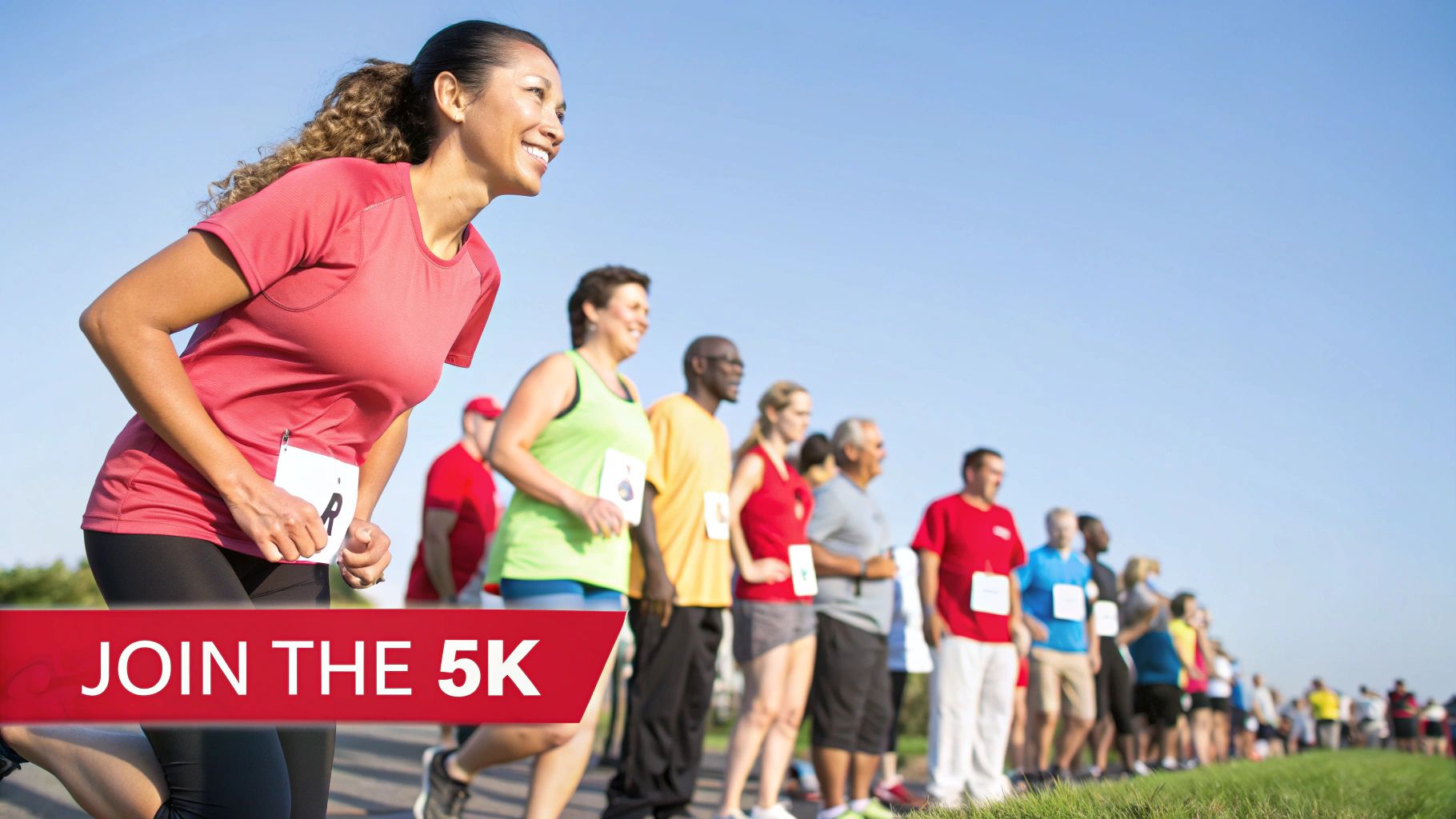
Unlike exclusive galas, the 5K is built on inclusivity and high-volume participation. It's an excellent way to raise brand awareness, foster a sense of community, and engage a broad demographic. The energy of the event, combined with a clear fundraising goal, creates a powerful and motivating experience for everyone involved.
Key Details & Strategy
- Target Donor: A wide audience, including families, young professionals, students, corporate wellness teams, and grassroots community members. It's ideal for acquiring new, entry-level donors and engaging existing supporters in a new way.
- Budget Range: Low to Medium ($5,000 – $40,000+). Major costs include permits, race timing technology, participant t-shirts, insurance, and marketing. Sponsorships can significantly offset these expenses.
- Revenue/Engagement Potential: High. Success is driven by the volume of participants and the effectiveness of their peer-to-peer fundraising. Events can raise five to six figures through registration fees, sponsorships, and participant-led fundraising campaigns.
Production & Logistics Checklist
- Production/AV Needs: A starting and finish line arch, a sound system for announcements and music, portable stages for pre-race warm-ups and post-race awards, and clear signage throughout the course.
- Logistics Checklist:
- Secure all necessary city permits, insurance, and police/EMT support 6-8 months out.
- Map out a safe, accessible, and well-marked route for participants.
- Partner with local running clubs and fitness centers to boost promotion.
- Implement an online registration platform that includes peer-to-peer fundraising tools.
- Secure in-kind sponsors for water, post-race snacks, and prizes.
Creative Twist: Gamify the experience by introducing a "Color Run" or "Zombie Run" theme. In a Color Run, volunteers douse participants with colored powder at different stations, creating a vibrant, photo-worthy finish. For a Zombie Run, volunteers dressed as zombies "chase" runners, adding a thrilling element of fun and excitement that can attract a younger, more adventurous demographic and generate significant social media buzz.
3. The Online Auction: Bidding for Good from Anywhere
An online auction is one of the most versatile and scalable nonprofit fundraiser event ideas available. It leverages a digital platform to allow supporters to bid on a curated selection of items, experiences, and services directly from their computers or mobile devices. This format can operate as a completely standalone virtual event or as a powerful complement to an in-person gala, extending bidding access to those who cannot attend.

The primary advantage of an online auction is its ability to demolish geographical barriers, engaging a worldwide audience and significantly expanding your potential donor base. The convenience of timed bidding windows, automated notifications, and instant checkout creates a low-friction giving experience that appeals to a broad demographic.
Key Details & Strategy
- Target Donor: A wide range of supporters, from new, younger donors comfortable with digital platforms to established supporters who appreciate the convenience. It's ideal for engaging remote followers and community members.
- Budget Range: Low to Moderate ($500 – $10,000+). Costs are primarily driven by the auction software subscription, payment processing fees, and marketing. The budget is significantly lower than in-person events as venue and catering costs are eliminated.
- Revenue/Engagement Potential: Moderate to Very High. Success is tied directly to the quality and appeal of the auction items procured. Revenue comes from winning bids, "Buy It Now" options, and direct donations made through the platform.
Production & Logistics Checklist
- Production/AV Needs: High-quality photography and videography for all auction items is critical. A reliable internet connection and a central command station for managing the auction platform during its final hours are also necessary.
- Logistics Checklist:
- Select an intuitive online auction platform (e.g., 32auctions, Givebutter, BiddingForGood) that fits your budget and feature needs.
- Procure a diverse catalog of items, including physical goods, unique experiences, and gift certificates from local business partners.
- Write compelling, detailed item descriptions that tell a story and highlight value.
- Develop a multi-channel marketing plan (email, social media, website) to promote the auction before and during the event.
- Establish a clear plan for item fulfillment, including shipping and local pickup options.
Creative Twist: Create "Themed Baskets" or "Experience Bundles" that tell a story connected to your mission. For a humane society, bundle a pet photography session, a basket of premium toys, and a gift certificate to a pet-friendly cafe. This strategy increases the perceived value of smaller donated items and makes bidding more exciting than just offering standalone gift cards.
4. Peer-to-Peer Fundraising Campaign
A peer-to-peer (P2P) fundraising campaign is a powerful, decentralized model that transforms your most passionate supporters into active fundraisers. Instead of your organization making every ask, you empower individuals to create personal fundraising pages and solicit donations from their own social and professional networks. This approach exponentially expands your reach far beyond your existing donor base.
This model leverages social proof and personal connections, as a request from a friend or family member is often more compelling than one from an organization. P2P is highly effective when tied to a specific goal or event, like a 5K run, a month-long awareness challenge (e.g., Movember), or a giving day, creating a sense of collective effort and urgency.
Key Details & Strategy
- Target Donor: Broad and diverse. This engages your existing grassroots supporters, volunteers, and board members, who in turn reach their own networks of small-to-mid-level donors. It's ideal for activating a large volume of new, first-time givers.
- Budget Range: Low to Medium ($500 – $15,000+). The primary costs are the P2P software platform subscription and marketing materials. Since participants do the fundraising, it's one of the most cost-effective nonprofit fundraiser event ideas.
- Revenue/Engagement Potential: High. Campaigns can range from a few thousand dollars to millions, depending on the size and engagement of your supporter base. It excels at donor acquisition and building a strong sense of community.
Production & Logistics Checklist
- Production/AV Needs: Minimal for the campaign itself. Requires high-quality digital assets like branded graphics, email templates, and compelling video content that fundraisers can easily share on social media.
- Logistics Checklist:
- Select a user-friendly P2P fundraising platform (e.g., JustGiving, Classy) that integrates with your CRM.
- Develop a comprehensive "Fundraiser Toolkit" with sample emails, social media posts, and talking points.
- Create a clear communication plan with regular updates, encouragement, and success stories for participants.
- Plan and implement a system of incentives and recognition, such as leaderboards, badges, and prizes for top fundraisers.
- Host a kickoff webinar to train fundraisers and build excitement.
Creative Twist: Introduce gamification with a team-based competition. Encourage corporate partners, departments, or groups of friends to form teams and compete to raise the most funds. Create separate leaderboards for individuals and teams, and offer a unique prize for the winning team, such as a catered lunch or a special recognition plaque. This fosters friendly competition and boosts overall participation and results.
5. Benefit Concert or Live Entertainment Event
Harnessing the power of performance, a benefit concert or live entertainment event is a dynamic nonprofit fundraiser event idea that captivates audiences and builds strong community connections. This event model centers on a ticketed performance, whether it's live music from a local band, a stand-up comedy show, or a theatrical production. The energy of a live show creates a memorable, emotionally resonant experience that associates your cause with excitement and joy.
Revenue streams are diverse, coming from ticket sales, corporate sponsorships, merchandise, and concession sales. By leveraging an artist's or performer's existing fan base, you can extend your reach to a new audience, raising both critical funds and widespread awareness for your mission.
Key Details & Strategy
- Target Donor: General public, community members, music/arts lovers, and younger demographics. It's also attractive to corporate sponsors looking for brand visibility with a culturally engaged audience.
- Budget Range: Varies widely ($5,000 – $100,000+). Costs depend heavily on artist fees, venue rental, and production scale. Partnering with local artists and existing venues can significantly reduce expenses.
- Revenue/Engagement Potential: High. Success is tied to the performer's draw and ticket pricing. A well-promoted event with strong sponsorship can generate substantial revenue while creating high levels of audience engagement and social media buzz. For inspiration on finding the right talent, you can explore various corporate event entertainment ideas that can be adapted for a nonprofit setting.
Production & Logistics Checklist
- Production/AV Needs: Professional-grade stage, sound system, and lighting rig appropriate for the performance. Video screens for sponsor logos and mission-focused content are highly effective. For larger concerts, consider full backline equipment and an experienced sound engineer.
- Logistics Checklist:
- Book artists and secure a suitable venue 6-9 months out.
- Negotiate artist fees (or donated performances) and contracts clearly.
- Develop sponsorship packages that offer visibility on marketing materials and at the event.
- Set up a reliable ticketing platform and promotion plan, leveraging the artist's social media channels.
- Plan for merchandise sales, concessions, and potential VIP package fulfillment (e.g., meet-and-greets).
Creative Twist: Instead of a single headliner, host a "Battle of the Bands" or a "Local Artist Showcase" where performers compete for a prize. This fosters a sense of community ownership and can generate excitement through audience voting (which can be an additional donation opportunity). For a theater group, produce a series of short, 10-minute plays written by local playwrights, all centered around a theme related to your mission. This approach diversifies the appeal and engages multiple creative communities at once.
6. Corporate Sponsorship Package Program
While not a singular event, a structured corporate sponsorship program is the financial engine that powers many nonprofit fundraiser event ideas. This strategic approach involves creating tiered packages that offer businesses tangible benefits like logo placement, event recognition, and media exposure in exchange for financial support. This transforms the fundraising relationship from a one-time ask into a mutually beneficial partnership.
Developing a formal program allows your organization to secure predictable, recurring revenue from the corporate sector. It professionalizes your fundraising efforts, demonstrating to potential partners like Microsoft or local businesses that you have a clear plan for recognizing their contribution and delivering a return on their community investment.
Key Details & Strategy
- Target Donor: Corporations with established corporate social responsibility (CSR) programs, local businesses looking for community engagement, and companies whose brand values align with your mission.
- Budget Range: Low ($500 – $5,000). Costs are primarily for creating professional marketing materials (sponsorship decks, one-pagers) and staff time dedicated to outreach and relationship management.
- Revenue/Engagement Potential: Very High. A well-managed program can secure five to seven figures annually from multiple corporate partners, providing a stable funding base for your events and general operations.
Production & Logistics Checklist
- Production/AV Needs: High-quality graphic design for sponsorship proposals and marketing collateral. A dedicated section on your website to showcase sponsors is essential.
- Logistics Checklist:
- Develop tiered sponsorship levels (e.g., Platinum, Gold, Silver) with clear, incremental benefits.
- Research and identify potential corporate partners whose giving priorities align with your cause.
- Create a compelling, professional sponsorship deck that outlines the impact and ROI for partners.
- Designate a staff member or committee to manage corporate relationships and fulfillment.
- Establish a system for tracking deliverables and reporting impact back to sponsors.
Creative Twist: Instead of just offering logo placement, create "experiential sponsorships." A tech company sponsoring a youth coding program could host an exclusive "Day at the Office" for participants. A local bank sponsoring a community festival could host a "Financial Literacy Tent" for families. This approach integrates the sponsor's brand directly into your mission-driven activities, creating a more powerful and memorable partnership.
7. The Digital Crowdfunding Campaign: Mobilizing the Masses
A crowdfunding campaign is a powerful, time-limited online fundraising initiative that leverages the power of community to raise funds. This approach relies on collecting many small donations from a broad audience, democratizing philanthropy and allowing supporters at every level to contribute to a specific, tangible goal. It’s one of the most accessible nonprofit fundraiser event ideas for urgent needs or project-specific goals.
These campaigns use compelling storytelling, often through video and regular updates, to create a sense of urgency and shared purpose. By harnessing the virality of social media and the reach of email marketing, nonprofits can engage new audiences and mobilize existing supporters around a focused objective, turning passive followers into active donors.
Key Details & Strategy
- Target Donor: The general public, social media followers, email subscribers, and grassroots supporters. This model is ideal for engaging younger donors and those who prefer to give smaller, impact-focused amounts online.
- Budget Range: Low to Moderate ($500 – $10,000+). Costs are primarily for creating high-quality video content, platform fees (if applicable), and digital advertising to expand reach.
- Revenue/Engagement Potential: Moderate to High. Success is highly dependent on the strength of your existing digital community and the emotional appeal of the campaign. Campaigns can raise anything from a few thousand dollars to six-figure sums for compelling causes.
Production & Logistics Checklist
- Production/AV Needs: A high-quality, emotionally resonant video (60-90 seconds) is essential. This is your primary storytelling tool and requires professional or near-professional-level production, including clear audio, compelling visuals, and concise messaging.
- Logistics Checklist:
- Choose the right platform (e.g., GoFundMe, Indiegogo, or a self-hosted solution).
- Set a realistic, specific, and transparent funding goal.
- Develop a multi-channel promotion plan for email, social media, and partners.
- Prepare a launch strategy to gain initial momentum from your core supporters.
- Plan regular progress updates to keep donors engaged throughout the campaign.
Creative Twist: Gamify the campaign by introducing tiered giving levels with non-monetary rewards. For example, a $25 donation might get a social media shout-out, $100 could unlock an exclusive behind-the-scenes video update, and $500 could earn a personal thank-you video from the program director. This incentivizes higher donation amounts and makes the act of giving more interactive and rewarding.
8. Volunteer-Led Community Event (Bake Sale, Car Wash, Garage Sale)
Grassroots, volunteer-led events are the heart of community-based fundraising. These accessible, low-cost activities like bake sales, car washes, and garage sales empower your most dedicated supporters to take an active role in your mission. They turn everyday interactions into opportunities for contribution and conversation.
This approach is powerful because it prioritizes participation and local awareness over high-dollar donations. It's a fantastic way to engage families, youth groups, and new volunteers, building a strong community foundation and creating a visible presence in your neighborhood. These events prove that even small, collective efforts can make a significant impact.
Key Details & Strategy
- Target Donor: Community members, families, neighbors, and casual supporters. This format is designed for broad accessibility, attracting people who want to contribute small amounts of money or their time.
- Budget Range: Very Low ($50 – $500). Costs are minimal, typically covering supplies like soap and sponges for a car wash, signage, or basic ingredients that aren't donated for a bake sale.
- Revenue/Engagement Potential: Low to Moderate. While a single event might raise a few hundred to a few thousand dollars, the primary value is high volunteer engagement and increased brand visibility within the local community.
Production & Logistics Checklist
- Production/AV Needs: Minimal. A simple point-of-sale system (like a Square reader on a phone), a cash box, good signage, and perhaps a portable speaker for music to create a fun atmosphere.
- Logistics Checklist:
- Secure a high-traffic, visible location with permission (e.g., a local business parking lot, community center).
- Recruit and organize volunteers using a simple online sign-up tool.
- Coordinate the collection of donated goods in advance (baked goods, garage sale items).
- Promote heavily on local social media groups, community calendars, and with physical flyers.
- Create a simple "kit" for volunteers with clear instructions, pricing, and talking points about your mission.
Creative Twist: Supercharge the concept by creating a "Community Give-Back Day." Instead of just one activity, combine several. Host a car wash in one part of the parking lot, a bake sale near the entrance, and a garage sale in another section. This multi-activity approach creates a bigger draw, extends visitor stay time, and provides multiple ways for supporters to contribute, maximizing revenue and energy on a single day.
9. Grant Writing and Foundation Fundraising Program
While not a traditional "event," a structured grant writing program is one of the most powerful and sustainable nonprofit fundraiser event ideas for securing large-scale funding. This strategic initiative focuses on identifying and applying for grants from private, corporate, and community foundations whose missions align with your own. It transforms fundraising from a singular event into an ongoing, strategic process that builds organizational capacity.
This approach provides a stable, often multi-year funding stream that can support core operations, new programs, or capital campaigns. Success in grant writing elevates your nonprofit's credibility and proves your ability to manage significant projects, attracting further investment from major donors and institutional partners.
Key Details & Strategy
- Target Donor: Program officers and board members at private foundations (e.g., Ford Foundation), corporate foundations (e.g., Google.org), and local community foundations. This strategy targets institutional funders looking for scalable, high-impact projects with measurable outcomes.
- Budget Range: Low to Medium ($2,000 – $25,000+). Costs are primarily for grant writing software or databases (like Foundation Directory Online), staff time for research and writing, or fees for hiring a professional grant writer or consultant.
- Revenue/Engagement Potential: Very High. A single successful grant can yield five to seven figures in funding, often with the potential for renewal. This method builds long-term institutional relationships rather than one-time event-based engagement.
Production & Logistics Checklist
- Production/AV Needs: None. The "production" is a well-researched, professionally written, and compelling grant proposal document, complete with a detailed budget, logic model, and evaluation plan.
- Logistics Checklist:
- Invest in a grant database subscription to research and identify aligned funders.
- Develop a master proposal template that can be customized for specific applications.
- Build relationships with foundation program officers before applying.
- Create a grant calendar to meticulously track deadlines and reporting requirements.
- Develop a robust system for tracking metrics and outcomes to report back to funders.
Creative Twist: Frame your grant proposals around a specific, time-bound "campaign" or "initiative." Instead of just asking for general operating support, package your need as "The Digital Literacy for Seniors Initiative" or "The Clean Water Project: Phase One." This creates a more compelling, project-based narrative that is easier for foundation boards to understand, approve, and fund. It turns a standard application into a visionary investment opportunity.
10. Monthly Giving/Donor Retention Program
While not a one-time "event" in the traditional sense, a Monthly Giving Program is one of the most powerful and sustainable nonprofit fundraiser event ideas an organization can implement. This model establishes a recurring, subscription-style donation system where supporters commit to automatic monthly contributions. It transforms sporadic, one-off donors into a reliable and engaged community of sustaining partners.
This strategy shifts the fundraising focus from transactional events to long-term relationship building. By providing predictable revenue, it allows for more accurate budgeting and planning. For donors, it offers a convenient and impactful way to support a cause they care about without the need for a large one-time gift, making philanthropy accessible to a broader audience.
Key Details & Strategy
- Target Donor: Mid-level and grassroots donors, young professionals, and existing one-time givers who have shown consistent interest. This is ideal for supporters who want to make a sustained impact but may not have the capacity for a major gift.
- Budget Range: Low to Medium ($500 – $10,000+). Initial costs involve setting up the payment processing technology, marketing materials, and ongoing staff time for stewardship. The investment is significantly lower than a physical event.
- Revenue/Engagement Potential: Very High (Long-Term). While individual gifts are smaller, the cumulative effect and high retention rate can generate substantial, predictable annual revenue. It dramatically increases the lifetime value of each donor.
Production & Logistics Checklist
- Production/AV Needs: A robust and user-friendly online donation platform with recurring payment capabilities, a secure CRM to manage donor data, and email marketing software for automated communication and impact reporting.
- Logistics Checklist:
- Integrate a simple, one-click recurring donation option on your website's main giving page.
- Create a branded name for your program (e.g., "The Hope Builders," "Pawsitive Partners") to foster a sense of community.
- Develop a marketing campaign to convert existing one-time donors into monthly givers.
- Automate welcome emails and tax receipts.
- Plan a content calendar of exclusive updates, stories, and impact reports specifically for this group.
Creative Twist: Launch your monthly giving program with a dedicated virtual "launch event" or a time-bound campaign. Set a goal to recruit a specific number of new monthly donors in a month (e.g., "100 new members in 30 days"). Offer a small, tangible incentive for signing up during the launch, such as branded merchandise or a special mention in your next annual report. This creates urgency and turns the program launch into an engaging, community-driven event.
Top 10 Nonprofit Fundraiser Ideas Comparison
| Event / Strategy | Implementation complexity | Resource requirements | Expected outcomes | Ideal use cases | Key advantages |
|---|---|---|---|---|---|
| Charity Gala Dinner | High — detailed planning, staging, program flow | High — upscale venue, catering, AV, auction items, volunteers | High revenue per event ($10,000–$100,000+); strong donor cultivation | Major donor cultivation, high-profile fundraising, sponsor activation | High per-attendee revenue; strong relationship-building; media appeal |
| 5K Run/Walk Event | Medium — course logistics, permits, safety planning | Medium — permits, timing system, shirts, volunteers, first aid | Moderate revenue ($5,000–$50,000); strong community engagement | Health-focused nonprofits, broad-participation fundraising | Inclusive and repeatable; participants can solicit pledges |
| Online Auction | Low–Medium — platform setup, item curation and listing | Low–Medium — platform fees, item photography, shipping logistics | Low–Moderate revenue ($3,000–$30,000); extended geographic reach | Organizations seeking remote participation or event complements | Global reach; lower venue costs; flexible timing |
| Peer-to-Peer Fundraising Campaign | Medium — platform, training, campaign coordination | Medium — platform fees, supporter toolkits, staff support | Moderate–High revenue ($10,000–$100,000+); exponential reach via networks | Large-scale mobilization, walk/run hybrids, awareness campaigns | Scalable outreach; leverages personal networks; low barrier per participant |
| Benefit Concert / Live Entertainment | High — production, talent booking, technical production | High — artist fees or in-kind talent, stage, sound, production crew | Moderate–High revenue ($5,000–$75,000+); audience and publicity boost | Arts-oriented causes, mass-awareness events, celebrity-driven fundraisers | High energy engagement; multiple income streams (tickets, concessions) |
| Corporate Sponsorship Package Program | High — strategic sales, package customization, stewardship | Medium–High — BD staff, marketing collateral, fulfillment capacity | High predictable funding ($50,000–$500,000+ annually) | Organizations seeking sustainable, large-scale corporate support | Predictable multi-year revenue; strengthens B2B relationships; sponsor benefits |
| Crowdfunding Campaign | Low–Medium — campaign setup, storytelling, promotion | Low — video/content creation, social media, platform fees | Low–Moderate revenue ($1,000–$50,000); fast, time-limited results | Specific projects, emergency relief, pilot programs | Accessible to many donors; viral/shareable; low startup cost |
| Volunteer-Led Community Event | Low — simple operations, volunteer coordination | Low — donated goods, volunteer time, basic supplies | Low revenue ($500–$5,000); strong local engagement | Small grassroots groups, volunteer recruitment, local awareness | Minimal overhead; high volunteer ownership; easy to replicate |
| Grant Writing & Foundation Fundraising | High — research, proposal development, reporting | Medium–High — grant writers, databases, evaluation systems | High funding per award ($10,000–$500,000+); multi-year potential | Organizations with scalable programs seeking large unrestricted/restricted grants | Large sums possible; validates credibility; sustainable funding |
| Monthly Giving / Donor Retention Program | Medium — systems, communications, retention workflows | Medium — CRM, payment processing, donor communications | High long-term revenue per donor ($500–$5,000+ annually); predictable income | Organizations seeking stable recurring revenue and donor retention | Predictable monthly income; higher lifetime donor value; scalable |
Choosing the Right Idea and Bringing It to Life
We have explored a comprehensive spectrum of nonprofit fundraiser event ideas, from the high-touch elegance of a Charity Gala to the broad community appeal of a 5K Run, and the digital reach of an Online Auction or Crowdfunding Campaign. Each concept presented offers a unique pathway to connect with donors, raise critical funds, and amplify your mission. The key takeaway is that there is no single "best" idea; the most effective fundraising strategy is a diversified one, tailored specifically to your organization's unique DNA.
The perfect event is born from the intersection of three core elements: your organization’s mission, your operational capacity, and your community’s interests. A peer-to-peer campaign might resonate deeply with a younger, socially-connected audience, while a structured Grant Writing Program is essential for securing large-scale institutional funding. The most successful nonprofits understand this and build a balanced calendar that leverages different event types to engage distinct donor segments. This approach creates a robust and resilient fundraising ecosystem.
Synthesizing Strategy into Action
As you move from inspiration to implementation, the central challenge becomes execution. A brilliant concept can easily fall flat without meticulous planning and flawless delivery. This is where the practical checklists and creative twists provided for each idea become invaluable tools.
To select the right mix of nonprofit fundraiser event ideas for your calendar, consider these strategic steps:
- Audit Your Audience: Who are your current supporters? Who do you want to reach? Map the event ideas from this list to specific donor profiles. A benefit concert attracts a different crowd than a corporate sponsorship drive.
- Assess Your Resources: Be realistic about your team's bandwidth, budget, and volunteer base. A volunteer-led bake sale is low-cost and high-touch, while a large-scale gala requires significant investment in time and capital. Start with what is manageable and scale up as you grow.
- Define Your Goals: Is your primary objective revenue, community engagement, brand awareness, or all three? A 5K might excel at engagement, while an online auction is laser-focused on revenue. Clarity on your goals will narrow your choices significantly.
- Create a Balanced Calendar: Avoid putting all your eggs in one basket. A successful annual strategy might include one major "tentpole" event (like a gala), a broad community-facing event (like a 5K), and ongoing passive income streams (like a Monthly Giving Program).
The Power of Professional Execution
Remember, the event experience itself is a direct reflection of your organization's brand and capability. A poorly managed event, plagued by technical glitches or logistical chaos, can do more harm than good, eroding donor confidence. For your most ambitious and visible events, especially those involving stages, lighting, and sound, professional production is not a luxury; it is an essential investment in your mission’s success.
Flawless audio-visual execution ensures your message is heard clearly, your guest speakers are seen perfectly, and your brand is presented with the polish and professionalism it deserves. When attendees are immersed in a seamless, engaging experience, they are more inspired to connect with your cause and give generously. Investing in professional event production frees your team to focus on what you do best: building relationships with supporters and sharing the powerful story of your work. As you plan your next major fundraiser, consider how a partnership with production experts can elevate your event from simply good to truly unforgettable, maximizing both your impact and your return on investment.
Ready to bring your most ambitious nonprofit fundraiser event ideas to life with flawless execution? For galas, concerts, 5Ks, and any event needing professional staging, sound, and visual support in the Kansas City area, the team at Showboss KC has the expertise to make your vision a reality. Let us handle the technical production so you can focus on your mission. Contact Showboss KC today to start planning your next impactful event.