

Picture this: you’re at the best concert or conference you’ve ever attended. Where is all the energy coming from? All eyes are on one place: the stage.
A stage is so much more than a platform. It’s the command center of your event, the single spot that captures everyone's attention and sets the entire tone.
Your Stage Is the Heart of Your Event
Honestly, an event without a proper stage feels like a movie without a screen. There's no focal point, no designated space for the magic to happen. The stage is the engine that drives your whole production, making sure every speech, performance, and presentation lands with impact.
It literally elevates your speakers, frames your performers, and creates a professional atmosphere that tells your audience, "This matters."
This guide isn't just about defining what a stage is. We’re going to dig into how the right stage can turn a simple get-together into a production people will be talking about for weeks. We'll cover everything from the basic types of stages to the nitty-gritty details like sizing, safety, and tech integration. Whether you're planning a wedding, a corporate gala, or a massive outdoor festival, getting your staging right is the first step toward a flawless event.
Why Your Stage Is a Smart Investment
Choosing the right platform isn't just a box to check on your to-do list; it’s a strategic move that directly impacts how your audience connects with your event. A well-built stage guarantees great sightlines for every single guest, supports all the A/V and lighting you need, and gives your talent a safe, professional space to shine.
This is especially critical right now, as the events industry is growing at a mind-blowing pace.
The global events market was already valued at a massive $736.8 billion and is projected to hit $2.5 trillion by 2035. That's not just a number—it shows how important live experiences are. And with 66% of organizations planning more events than ever, the need for professional, reliable staging is through the roof. You can dig into more of these event industry statistics to see just how fast things are moving.
Think of your stage as the physical manifestation of your event's purpose. It’s where your message is delivered, your brand is showcased, and your most important moments are created. A shaky, poorly lit, or undersized stage can undermine even the best-planned content.
In this guide, we'll lay the groundwork you need to choose the perfect stage. We’ll break down all the essentials—from mobile stages and modular systems to ADA compliance and how to vet your vendors—so you can make smart decisions that lead to a successful, impressive production.
Finding Your Fit with Four Essential Stage Types
Choosing the right stage isn't about defaulting to the biggest or most elaborate option. It's about matching the platform to your purpose. To make that choice easier, let's skip the dry definitions and break down the four essential stage types with real-world scenarios you’ll instantly recognize.
Think of your stage as the heart of your event—it’s the engine and the command center all rolled into one. It’s the central hub where everything comes together.
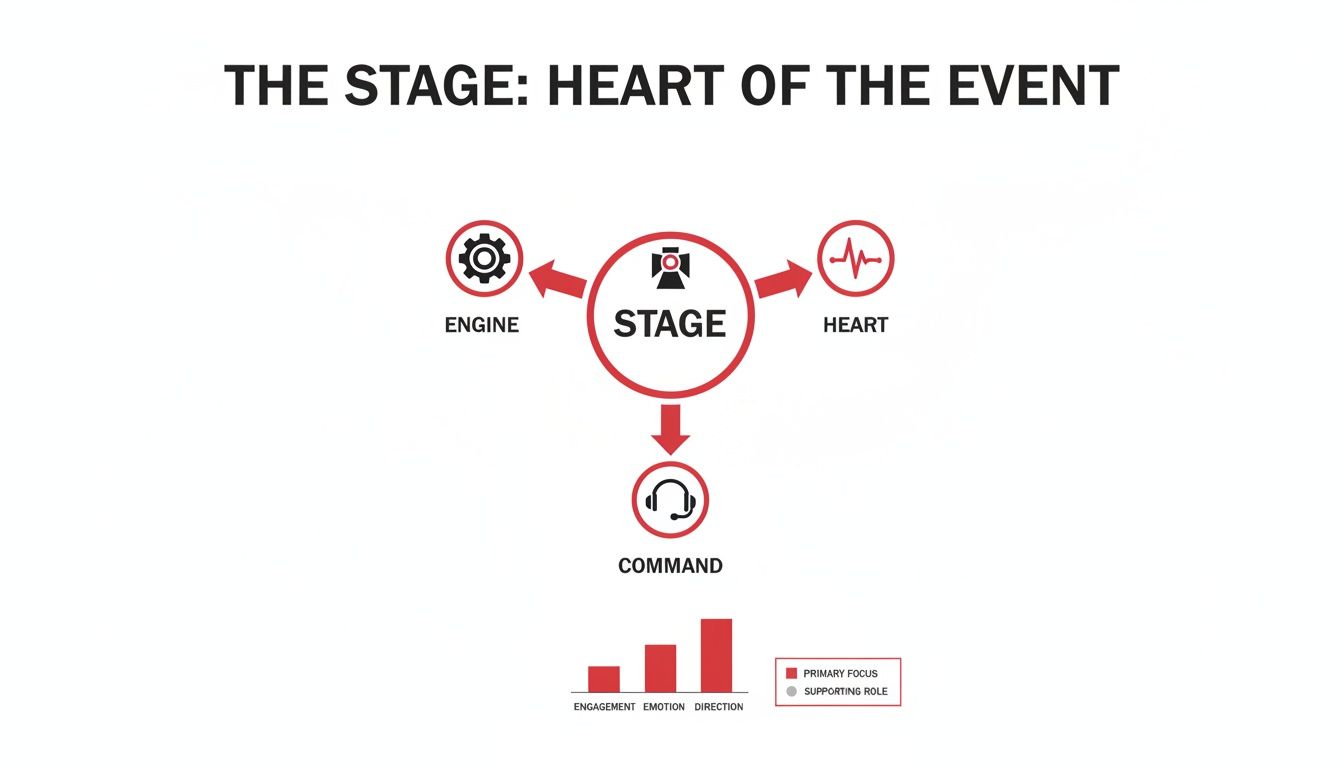
This visual gets right to the point: your stage choice directly powers, energizes, and controls the entire flow and feel of your event. With that in mind, let's dig into the options that bring this idea to life.
To help you quickly compare your options, here’s a simple side-by-side breakdown.
Quick Guide to Event Stage Types
Use this side-by-side comparison to choose the right stage based on event type, setup speed, and customization needs.
| Stage Type | Best For | Key Feature | Common Application |
|---|---|---|---|
| Mobile Stage | Outdoor events with tight timelines | All-in-one, rapid deployment | Community festivals, roadshows, concerts in a park |
| Modular Stage | Custom layouts and uneven surfaces | Ultimate versatility and adaptability | Corporate events, indoor galas, fashion runways |
| Riser | Elevating a specific person or element | Simple, targeted height boost | Keynote speakers, drum kits, DJ booths |
| Festival Stage | Large-scale, high-capacity productions | Massive load-bearing and rigging | Major music festivals, stadium concerts |
This table is a great starting point, but let’s get into what makes each of these stage types tick.
Mobile Stages: The Concert in a Box
Imagine you need a professional-grade concert setup in the middle of a city park, and it has to be ready to go—fast. That’s the magic of a mobile stage. These incredible rigs are basically self-contained stages that unfold directly from a trailer. They often come complete with a built-in roof, basic lighting supports, and even spots for banners.
Their number one advantage is pure speed. A skilled crew can get a mobile stage show-ready in just a few hours, which is a tiny fraction of the time a traditional build takes. This makes them the undisputed champs for tours, one-day festivals, and community events where load-in and load-out times are tight. Here at Showboss KC, we deploy them all the time for outdoor concerts and charity 5Ks where efficiency is everything.
Modular Stages: The LEGOs of Event Design
So, what happens when your event is in a funky-shaped ballroom or on a sloped festival lawn? That's where modular stages really shine. Just think of them as the ultimate set of building blocks for event planners. They’re built from interlocking decks and supported by adjustable legs, allowing them to be configured into almost any shape, size, or height imaginable.
This incredible versatility makes them perfect for:
- Custom Layouts: Think T-shaped runways for a fashion show or multi-level platforms for a corporate awards ceremony.
- Uneven Ground: They easily conquer hills, slopes, or bumpy surfaces to create a perfectly level and safe performance area.
- Tiered Seating: You can easily build tiered risers for a choir, a panel of speakers, or a VIP viewing section.
Their adaptability means that no matter what quirks your venue throws at you, you can build a stage that looks like it was custom-made for the space.
A stage isn’t just a piece of equipment; it's a strategic tool. The type you choose communicates the scale, professionalism, and style of your event before a single word is spoken or a note is played.
Risers: The Spotlight Elevators
Sometimes you don't need a massive stage; you just need to give someone—or something—a little lift. That’s the job of a riser. These are smaller, individual platforms designed to elevate a specific element, making sure everyone in the audience has a great view.
You’ll see them used constantly to raise a keynote speaker above the crowd, create a platform for a drum kit so the drummer isn't hidden, or build a small, dedicated space for a DJ booth. Risers are simple, incredibly effective tools for managing sightlines and creating a clear focal point, whether at a smaller event or as part of a much larger stage design.
Festival Stages: The Heavyweight Champions
When you’re planning a massive production—a major music festival, a huge corporate keynote in an arena, or a televised broadcast—you need a festival stage. These are the true heavyweight champions of the staging world, engineered from the ground up to handle immense weight and incredibly complex technical demands.
Built with heavy-duty truss systems, these structures are designed to safely suspend literal tons of equipment. We’re talking massive speaker arrays, intricate moving light rigs, and enormous LED video walls. A festival stage is a serious investment in infrastructure, requiring detailed engineering plans and a highly experienced crew to build it safely and correctly. There are no shortcuts here.
How to Figure Out the Right Stage Dimensions
Picking a stage size can feel like a shot in the dark. Go too small, and your performers are tripping over each other. Go too big, and they look lost on a vast, empty platform. The trick is to stop thinking about it as just a floor and start seeing it as a functional workspace for people, gear, and a whole lot of action.
There’s a simple rule of thumb that event pros use to get in the ballpark. It’s not a perfect science, but it gives you a solid place to start.
The Rule of Thumb for Stage Sizing:
A great starting point is to plan for one square foot of stage for every two attendees. So, if you're expecting 200 guests, you'd begin by looking at a stage around 100 square feet (like a 12'x8' stage). This helps make sure the stage feels proportional to the room and the crowd.
Of course, that’s just the first step. The real magic happens when you figure out exactly what and who needs to fit on that stage.
Calculating Your Space Needs
Time to take a "stage inventory." You need to list every single person and piece of equipment that will be up there. It’s easy to think about the performers, but don't forget their full setup. A keynote speaker with a simple lectern has a much different footprint than a five-piece band with a drum kit and a wall of amps.
Here are a few common scenarios to get you thinking:
- Solo Presenter: For a speaker and a lectern, a small 8'x4' riser is often all you need.
- DJ Booth: A standard DJ setup with a table, coffin case, and speakers needs at least 8'x8' to feel comfortable.
- Full Band: A 4- or 5-piece band is going to need some breathing room. A 24'x16' stage is a good minimum to fit drums, amps, monitors, and performers without it feeling cramped.
- Panel Discussion: For a seated panel of four, plus a moderator, a 20'x12' stage gives you enough space for chairs, a small table, and clear sightlines for the audience.
Corporate events are a huge part of the live gathering scene, and they almost always need professional staging. In fact, a whopping 60% of all event revenue comes from in-person events where stages are used to create those big brand moments. And with 83% of meetings now including an in-person component, the need for well-planned stages at conferences and trade shows isn't going anywhere. You can dig into more stats on how live events are driving the industry.
Understanding Load Capacity
Once you have the dimensions nailed down, you have to think about weight. Load capacity is all about how much weight a stage can safely hold, and it's non-negotiable for safety. Think of it like a bridge—it’s not just the total weight that matters, but how that weight is spread out. Stage decks are rated in pounds per square foot (PSF).
A standard stage is often rated for 125 to 150 PSF, which is plenty for people and basic gear. But if you’re planning to fly massive LED video walls, hang heavy speaker arrays, or rig a complex lighting setup, you'll need a stage with a much higher rating.
This is critical: you must tell your production company everything you plan to put on that stage. They need to know so they can provide a structure that is properly rated and braced. When it comes to weight, never guess.
Integrating AV and Lighting for Maximum Impact
A bare stage is just a platform. It’s the technology—the lights, the sound, the screens—that truly breathes life into it, turning a simple structure into the dynamic heart of your event.
The stage and your audio-visual (AV) gear have to work together. When they do, an ordinary event becomes an unforgettable, immersive experience for every single person in the room.
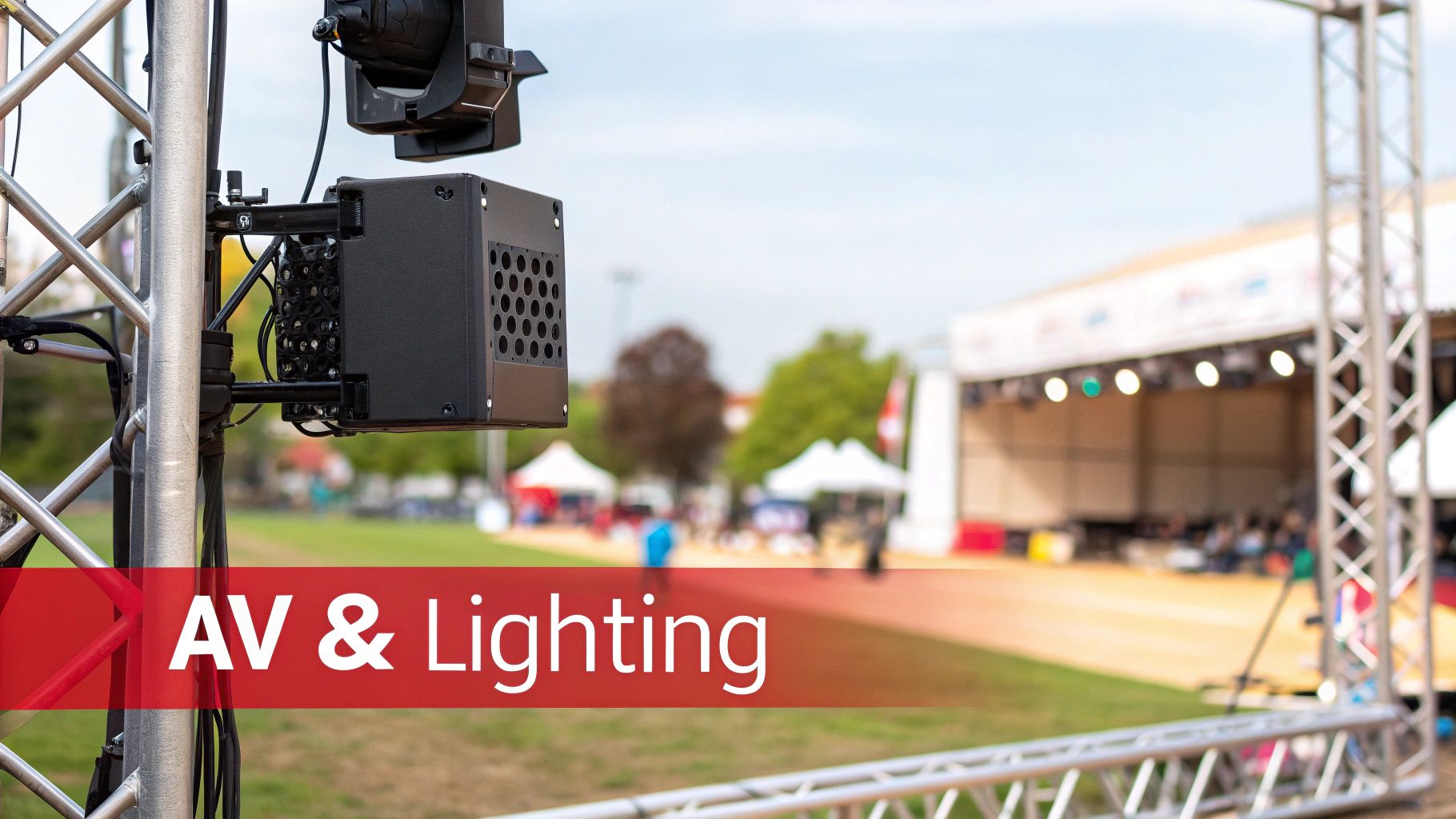
Ever notice that massive metal skeleton towering over a concert stage? That’s called trussing, and it's the real unsung hero of any production. It's the framework that lets you safely hang complex lighting rigs, powerful speaker arrays, and huge LED video walls.
A solid truss design means every piece of tech is perfectly positioned to do its job, whether it's hitting a speaker with the perfect spotlight or delivering crystal-clear audio all the way to the back row. Without it, your biggest creative ideas are literally grounded.
The Power and Placement of Your Technology
Power is the lifeblood of your entire production. This is one of those details that's easy to forget about until it's too late, and an overloaded circuit can bring your whole show to a dead stop.
You need a straightforward conversation with your venue and production team about your power needs, which are measured in amps and volts. Don't worry, you don't need to be an electrician. Just be ready with a list of every single piece of gear that needs to be plugged in.
An event's technical success is built on a foundation of thoughtful planning. From power distribution to equipment placement, every detail contributes to a seamless experience where the technology feels invisible, allowing the message and performance to shine.
A pro team like Showboss KC will take that list and calculate the total power draw. From there, we figure out if the venue’s house power can handle it or if we need to bring in external generators. This kind of planning prevents those last-minute emergencies and keeps the show running smoothly. If you want to get a better handle on what's involved, it's worth exploring the essentials of audio-visual equipment for events.
Creating Immersive Experiences with Integrated Systems
When your stage and AV are working in perfect harmony, you're not just putting on a show—you're creating an entire environment. It’s about more than just letting people see and hear. It's about crafting a mood and energy that perfectly match your event’s goals.
Here’s what that looks like in the real world:
- Dynamic Lighting: At a concert or gala, lights can be programmed to pulse with the music, shift colors to match brand themes, or create dramatic spotlights for key moments. The stage becomes a living, breathing part of the show.
- Crystal-Clear Audio: For a conference, we can fly line array speakers from the truss to aim sound with laser precision. This guarantees that everyone, from the front row to the back corner, hears every word perfectly.
- Stunning Visuals: An LED video wall can become a powerful backdrop for custom graphics, live camera feeds, or sponsor logos, turning the stage into a massive communication tool that pulls the audience in.
To really dial in the visual vibe, you can explore different types of professional stage lighting equipment that fit your theme and budget. When the tech and the platform are so perfectly intertwined, they become one cohesive, powerful experience.
Mastering Safety Regulations and ADA Compliance
Beyond the cool lighting rigs and killer sound systems, the single most important part of your stage is its structural integrity and accessibility. Let's be real: a great event is a safe event, and that starts from the ground up by following strict safety protocols and legal requirements. Cutting corners here isn't just a bad idea—it puts people at risk and opens you up to massive liability.
From the moment a stage is built, every single piece has to contribute to a secure environment. This is about way more than just making sure the surface is level. We're talking about a comprehensive approach to stability, with key elements like secure bracing and cross-bracing to prevent any swaying. And for any platform over 30 inches high, properly installed guardrails are an absolute must to prevent falls. The flooring itself has to be totally even and clear of any trip hazards.
These things aren't suggestions; they're the non-negotiable baseline for any professional event.
Navigating ADA Compliance
An event isn't truly successful unless everyone can be a part of it. That’s where the Americans with Disabilities Act (ADA) comes in. This isn't just a guideline—it's federal law with crystal-clear rules for public spaces, including event stages. Overlooking these requirements means excluding people, and that’s just not an option.
An ADA-compliant stage has to include a few key features:
- Accessible Ramps: Ramps need a gentle slope, specifically a 1:12 ratio. That means for every one inch of height, you need 12 inches of ramp length. This ensures safe and manageable access for wheelchairs.
- Sufficient Width: Both the ramps and any pathways on the stage itself need to be wide enough for mobility devices, which generally means a minimum clearance of 36 inches.
- Handrails: Sturdy, continuous handrails are required on both sides of a ramp to give people the support and guidance they need.
When you work with a production company like Showboss KC, we build these requirements into the plan from day one. Accessibility isn't an add-on; it's part of the core design.
Safety isn’t a single checkbox; it's a continuous process of risk assessment and proactive planning. From the first screw to the final teardown, every decision must be viewed through the lens of protecting your audience, performers, and crew.
Preparing for Weather and Outdoor Risks
Taking your event outside adds a whole new layer of complexity to safety planning. Mother Nature doesn't follow a script, so your stage has to be engineered to handle whatever she throws at it. This is especially true for mobile stages and big festival rigs that are completely exposed.
Any professional staging provider will know the wind rating of their equipment—that's the maximum wind speed a stage can safely handle before a show has to be paused or called off. You also need a rock-solid contingency plan for rain, covering everything from protecting all the electrical gear to managing slippery surfaces.
The global events market is absolutely booming—it's projected to hit $2.5 trillion by 2035—and the scale of productions is growing right along with it. This massive growth puts a huge spotlight on professional-grade safety and compliance. You can read more about these trends in event marketing statistics. Ultimately, partnering with a vendor who lives and breathes safety gives you invaluable peace of mind, letting you focus on creating an incredible experience for your guests.
Your Essential Event Staging Checklist
Alright, let's pull all these pieces together. Thinking about stages can feel abstract, but a good plan turns those ideas into a concrete, actionable roadmap. This checklist is your new best friend—think of it as the practical guide to get you from that first site visit to the final handshake with your vendors, ensuring nothing critical slips through the cracks.
A solid plan is truly the foundation of a flawless event. This tool will help you stay organized, know the right questions to ask, and make smart decisions that lead to a safe, impressive, and stress-free production.
The Site Inspection Checklist
Before you even think about signing a contract, you absolutely have to walk the site. This is your chance to play detective, spotting potential headaches and confirming the venue can actually handle what you have in mind.
- Ground Stability and Surface: Is the ground perfectly level? If not, you’re already looking at a modular stage with adjustable legs. For outdoor gigs, get a feel for the ground. Is it soft? What happens if it rains—are you staring at a mud pit?
- Access and Load-In Path: How are you getting the gear in? Seriously, can a semi-truck or even a large trailer get anywhere near where the stage needs to be? Measure any gates, eyeball tight corners, and look up for low-hanging obstacles. A clear path is non-negotiable.
- Power Availability: Find every single power source. Note the outlet types and, more importantly, the available amperage. Will it be enough for your lights and sound? If the answer is no, you need to start pricing out generators immediately.
- Overhead Clearance: Inside, get a precise measurement of the ceiling height. Outside, you're looking for sneaky low-hanging tree branches or power lines that could kill your plans for a stage roof or truss system.
Taking your site inspection seriously prevents those gut-wrenching, expensive, last-minute surprises. Everything you discover on this walkthrough directly impacts your vendor conversations and shapes the entire technical game plan for your event.
Key Questions to Ask Your Staging Vendor
Choosing the right partner is just as critical as choosing the right gear. A vendor's answers to these questions will tell you everything you need to know about their experience, honesty, and commitment to safety.
- What’s actually included in the rental price? Get specific. Does the quote cover the decking, stairs, delivery, setup, and teardown? What about add-ons like skirting, guardrails, or that crucial ADA ramp?
- Can I see your proof of insurance and safety certifications? This is a big one. A pro company won't hesitate to show you their certificate of liability insurance. Ask them about their safety record and what kind of training their crew has.
- What’s your plan B for bad weather? For outdoor stages, you need to know their protocol for high winds, lightning, and torrential rain. A reputable vendor will have clear safety limits and a ready-to-go action plan.
- Who is my go-to person on-site during the event? Knowing who to call when things get hectic is a lifesaver. You need a direct line for quick communication and problem-solving during setup and the show itself.
- What are the total labor costs, including any potential overtime? Make sure the quote spells out every single labor fee. You don't want to be surprised by overtime charges for a late-night teardown or a complicated build.
A fantastic tool for on-site crews is the guide to the Take 5 safety checklist, which helps them do quick risk assessments before starting a task. When you ask a potential vendor about their safety processes, it shows you're serious about running a secure event. To see how a professional team like ours handles this from start to finish, check out our complete overview of staging the event.
Your Event Staging Questions, Answered
Jumping into the world of event staging can feel a little overwhelming. There are a lot of moving parts, and you need real answers to build a solid plan and budget. Let's tackle some of the most common questions we hear from event planners just like you.
How Much Does It Cost to Rent a Stage for an Event?
There's no single price tag for a stage—it all comes down to the size, type, and complexity of your setup. A simple 8’x4’ riser for a single speaker at a conference might only run you a few hundred dollars. On the flip side, a big 40’x32’ mobile stage with a full roof system for a city festival? That's going to be in the thousands.
A few key things will shape your final quote:
- Dimensions and Type: Are we talking a basic modular platform or a full-blown mobile stage that rolls in on a truck?
- Load-Bearing Needs: A stage just needs to hold a person is one thing. A stage that has to support tons of LED walls, lighting rigs, and a full band is a whole different ballgame.
- The Extras: Don't forget the cost of stairs, ADA ramps, guardrails, and the professional crew needed to deliver, build, and tear it all down safely.
The best move is always to ask for a custom quote. That way, you know you're only paying for exactly what your event needs.
How Far in Advance Should I Book a Stage?
Timing is everything, especially in the busy spring and fall event seasons here in Kansas City. As a general rule of thumb, try to lock in your stage three to six months in advance. This gives you the best shot at getting what you want without the last-minute stress.
Now, if you're planning something massive—a huge festival or a multi-day corporate blowout—you'll want to push that timeline out to six to twelve months. That extra time is crucial for handling detailed site visits, custom design work, pulling permits, and making sure all your vendors are on the same page. A two-month lead time might fly for a small indoor gig, but booking early is always the smart play.
Can a Stage Be Set Up on Uneven Ground?
Absolutely. This is a super common challenge, and professional staging is built to handle it. Whether you're on a sloped grassy park or a bumpy parking lot, a good system can adapt. This is where modular stages really shine. With their adjustable legs and heavy-duty framework, a skilled crew can create a perfectly level and rock-solid platform, no matter what's underneath.
A thorough site inspection is non-negotiable for any outdoor event. It’s the only way for a production team to spot potential headaches and figure out the exact leveling gear needed to create a safe foundation for your talent and their equipment.
What Is Included in a Typical Stage Rental?
Your standard rental package will usually get you the basics: the stage deck itself, the support structure, one set of stairs, and all the labor for a normal setup and teardown. From there, you can customize everything.
Need to add stage skirts for a polished look? No problem. Guardrails for safety or an ADA-compliant ramp for accessibility? We can do that. It's important to remember that all the technical gear—trussing for lights, speakers, and those big LED video walls—are almost always quoted separately. To see how all those pieces fit together, it helps to understand the basics of what is stage production. Always double-check your quote to make sure you know exactly what’s included.
Ready to build the perfect stage for your Kansas City event? The experts at Showboss KC are here to help. We provide turnkey mobile and modular staging solutions with integrated audio, lighting, and video to make your vision a reality. Contact us today for a custom quote!