

The wedding processional is so much more than just a walk down the aisle. Think of it as the opening scene of your wedding day, the beautiful first chapter that sets the tone for everything to come. It’s a carefully choreographed moment that introduces your most cherished people and builds that incredible, heart-pounding anticipation before you finally appear.
A standard wedding processional order is a classic for a reason. It usually starts with honored family members taking their seats, followed by the officiant, the groom's party, the bridesmaids, and then, the grand finale: the bride's entrance.
Your Guide to a Flawless Walk Down the Aisle
That traditional order is a fantastic blueprint, but it's not set in stone. The real magic happens when you adapt it to tell your unique story and reflect your family and style. This sequence isn't just about logistics; it’s a powerful way to honor your loved ones, celebrate your wedding party, and create a wave of emotion that leads right up to the moment you lock eyes with your partner at the altar.
Getting a feel for this structure is the perfect starting point for creating a ceremony that feels both deeply meaningful and completely you. It gives your day a touch of timeless grace that guests will recognize and appreciate.
Why the Order Matters
The processional truly sets the stage. Every person's entrance is a deliberate beat in the rhythm of your ceremony, each moment building on the last. This thoughtful progression is designed to:
- Honor Key People: It gives parents, grandparents, and your wedding party their own special moment in the spotlight.
- Build Anticipation: The sequence is pure storytelling, strategically building excitement with each new person who walks down the aisle.
- Create a Smooth Flow: A well-planned order ensures your ceremony kicks off without a hitch—no confusion, no awkward gaps, just pure elegance.
A thoughtfully planned processional does more than just start the ceremony—it tells the first part of your marriage story. It's the prologue that introduces the main characters and sets a heartfelt, celebratory tone for the vows to come.
Trying to line up all these moving parts can feel like a lot, but a little expert guidance goes a long way. For couples in the Kansas City area, teaming up with a pro for your wedding planning ensures every detail, from the first step down the aisle to the final song of the night, is picture-perfect.
Of course, after the beautiful processional and heartfelt "I dos," the party is just getting started! As you think about the celebration ahead, you can find some fantastic wedding reception entertainment ideas to keep the energy high and your guests dancing all night long.
The Traditional Christian Wedding Processional Order
When you picture a wedding ceremony, this is probably the sequence that comes to mind. The traditional Christian wedding processional is classic for a reason—it’s a time-honored structure that masterfully builds emotion and anticipation, culminating in that unforgettable bridal entrance. Think of it as a form of storytelling, introducing the most important people in a couple’s life one by one.
It all starts by honoring the family. First, the grandparents are seated. Then, the parents of the groom find their places, and finally, the mother of the bride is escorted to her seat, which signals that the ceremony is about to officially begin. This beautiful tradition pays respect to the foundations from which the new family will grow.
The Wedding Party's Entrance
With the family seated, the processional truly gets underway. The officiant takes their place at the altar, often entering from the side. The groom and his best man are next, either following the officiant from the side or making their own walk down the aisle to stand and face their guests.
Now it's time for the wedding party. The groomsmen and bridesmaids proceed down the aisle, either walking individually or paired up. Their entrance creates a beautiful visual frame at the altar, setting the stage for the most anticipated moments still to come. The maid or matron of honor is the last of the bridesmaids to walk, taking her position closest to where the bride will stand.
The standard wedding processional order is more than a tradition; it’s a powerful emotional crescendo. Each person's walk down the aisle is a note in the song, building harmony and anticipation until the final, breathtaking chord—the bride's appearance.
Next up, we have the most charming participants. The ring bearer, trusted with the symbols of the union, and the flower girl, scattering petals to prepare the bride's path, bring a sweet touch of innocence and joy. Let's be honest, these little ones often create some of the most memorable and heartwarming photos of the day.
For a quick overview, here’s how the traditional Christian processional typically unfolds.
Standard Christian Processional Order At a Glance
This table provides a quick-reference guide to the sequence of entry for a traditional Christian ceremony, from the first family members to the bride's grand entrance.
| Order of Entry | Participant(s) | Brief Role Description |
|---|---|---|
| First | Grandparents | The first to be seated, honoring the family elders. |
| Second | Parents of the Groom | Seated after the grandparents. |
| Third | Mother of the Bride | Her seating is the final signal that the ceremony is about to begin. |
| Fourth | Officiant, Groom & Best Man | Take their places at the altar, often entering from a side entrance. |
| Fifth | Groomsmen & Bridesmaids | Walk the aisle, often in pairs, to form the wedding party at the front. |
| Sixth | Maid/Matron of Honor | The last of the bridal party to walk before the bride, standing in the place of honor. |
| Seventh | Ring Bearer & Flower Girl | Young attendants who precede the bride, adding a touch of charm and innocence. |
| Eighth | The Bride & Escort (Father) | The final, climatic entrance. Guests traditionally stand as the bride makes her way to the altar. |
This classic structure provides a reliable and beautiful flow that has stood the test of time.
The Bride's Grand Reveal
Finally, the moment everyone has been waiting for. The music shifts, and every guest rises to their feet for the bride's entrance. She is traditionally escorted by her father, who walks on her right side (with her on his left arm). This walk is deeply symbolic, representing her family's blessing and support as she steps into a new chapter of her life.
This entire sequence remains a cornerstone for countless ceremonies. In fact, traditional Christian wedding processional orders are the foundation for about 62% of ceremonies in some countries. That iconic moment of the bride walking with her father is a cherished memory captured by photographers in 89% of weddings globally. You can dive into the full research on these ceremonial statistics.
This visual flow chart breaks down the key steps to designing your perfect processional, from establishing a blueprint to achieving a seamless execution.

As the infographic shows, a successful processional is built on a solid plan that you can then personalize to reflect your unique story.
A Look at Jewish and Interfaith Processional Traditions
If you've been to a few Western weddings, you probably have a good idea of what the processional looks like. But the Jewish wedding processional paints a much different, incredibly symbolic picture. Instead of the groom waiting up front, this tradition brings both families into the ceremony right from the start, creating a powerful visual of two households becoming one.
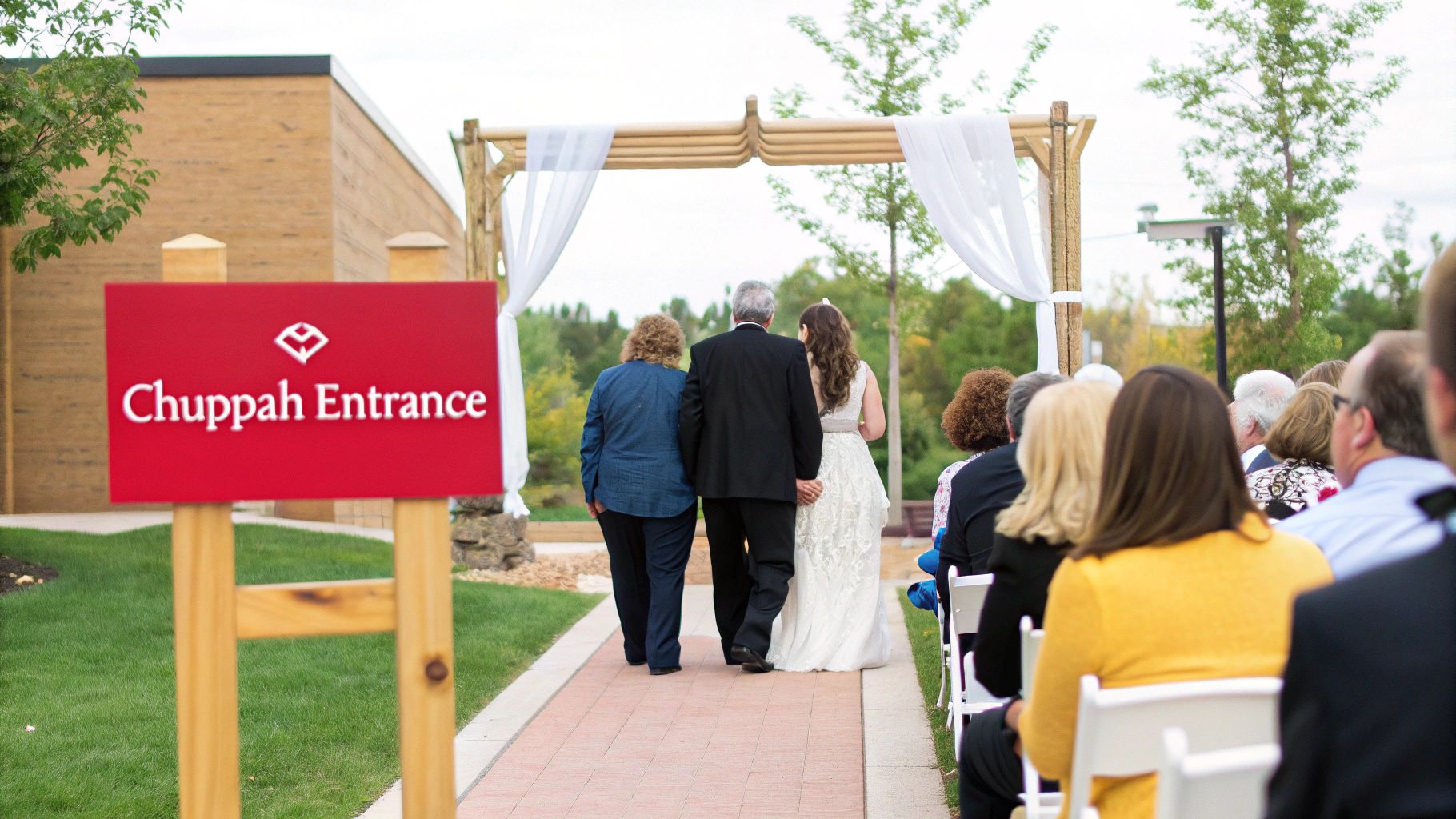
The whole ceremony is centered around the chuppah—a beautiful canopy that symbolizes the new home the couple is about to build together. Everyone walks toward this sacred space, and the order of who walks when is packed with meaning, highlighting community, family, and heritage.
A Unique and Symbolic Order
Here’s the biggest difference you'll notice: in a Jewish processional, both the bride and groom are typically escorted down the aisle by both of their parents. It's a beautiful moment that says, "We aren't just starting this new life on our own; we're bringing the full, unwavering support of our families with us."
The sequence usually unfolds like this:
- Rabbi and/or Cantor: They begin by taking their place under the chuppah.
- Grandparents: The family elders are honored first, as grandparents from both sides are escorted to their seats.
- Groomsmen: They enter, often in pairs, and find their places.
- Best Man: He makes his way down the aisle alone.
- The Groom with His Parents: Here it is—the groom is escorted by both his father and mother.
- Bridesmaids: They follow, usually walking in pairs.
- Maid/Matron of Honor: She walks alone, signaling the bride's imminent arrival.
- The Bride with Her Parents: To complete the picture, the bride is escorted by her father and her mother, creating a perfect image of unified family support.
This communal vibe is really catching on, especially for couples who want family to be a cornerstone of their ceremony. It echoes traditions seen globally, like in India, where 40% of weddings are multi-day events built around family help. The groom entering flanked by both parents also feels incredibly modern, mirroring the push for equality seen in 24% of secular Canadian ceremonies. The bride’s arrival with both parents under the chuppah’s canopy is the final, powerful symbol of a full familial blessing. You can dive deeper into how traditions are evolving by checking out these global wedding statistics.
Crafting a Meaningful Interfaith Processional
For couples blending different backgrounds, the processional is the perfect chance to honor both sides of the family and their traditions. The whole key is just to communicate, be open, and find a rhythm that feels authentic to your unique story.
An interfaith processional isn’t about choosing one tradition over another; it’s about weaving them together to create a new tradition that is uniquely yours.
Here are a few ideas I've seen work beautifully for an inclusive ceremony:
- Combine Escorts: Maybe the groom walks with his parents (a nod to Jewish tradition), and the bride is escorted just by her father (more common in Christian ceremonies).
- Alternate Participants: You could have the Rabbi and a Pastor, or an Officiant from another faith, walk in together to kick things off.
- Symbolic Seating: Ditch the whole "bride's side" and "groom's side" thing. Encourage open seating to physically show your families and friends mingling and joining together as one.
In the end, it doesn’t matter if you follow a classic Jewish order or create a blended sequence from scratch. The goal is always the same: to start your ceremony in a way that feels personal, meaningful, and like a true reflection of the life you're building together.
Personalizing Your Processional for Modern Families
The beauty of a modern wedding is that the "rules" are really just suggestions. While the standard processional order is a great blueprint, it’s your family’s unique story that makes the walk down the aisle truly unforgettable. Today's families are wonderfully diverse, and your processional should be a celebration of that.
Many couples are navigating blended families, and the processional is the perfect moment to honor everyone who has shaped your life. If you have a stepparent who has played a significant role, for instance, you don't have to leave them out—create a special moment just for them.
Honoring Every Loved One
There are so many thoughtful ways to include stepparents or other key figures without sticking to rigid tradition.
- A Shared Escort: Why not have both your father and stepfather walk you down the aisle, one on each arm? It's a beautiful image of unity.
- The Second Walk: One parent can walk you halfway, where the other is waiting to complete the journey with you to the altar.
- Seating with Honor: A stepparent can have their own moment, walking down the aisle to be seated in the front row, just like other parents.
Honoring a parent who has passed away is another deeply personal choice. You could leave a single seat empty in the front row, perhaps with a flower or a small sign. Or, carry a small photo locket in your bouquet. These quiet, meaningful gestures often speak volumes.
Reimagining Roles and Entrances
Modern processionals are also breaking free from old-school gender roles, making way for more authentic and creative entrances. Let's be honest, the idea that one partner waits while the other is "given away" just doesn’t resonate with everyone anymore.
Your processional is the very first thing your guests see—it’s the visual kickoff to your partnership. Whether you walk together, separately, or meet in the middle, the entrance should feel like a true reflection of your journey as a couple.
Here are a few popular alternatives that celebrate equality and personal style:
- Walk Together: So many couples are now choosing to walk down the aisle together, hand-in-hand. It’s a powerful symbol that you’re entering this marriage as a unified team from the very first step.
- Two Separate Aisles: If your venue can accommodate it, this is a dramatic and symbolic option. Each partner walks down their own aisle at the same time and meets at the front, representing two lives converging into one.
- Meet in the Middle: One partner can walk partway down the aisle and wait for the other, and then you can complete the final steps to the altar together.
Ultimately, the goal is to design a sequence that feels completely you. The music plays a huge part in setting the tone for these moments, and getting the timing right is key. As you're planning, it's worth reading up on how to choose a wedding DJ who can nail the cues for your custom processional.
Coordinating Music and Cues for Perfect Timing
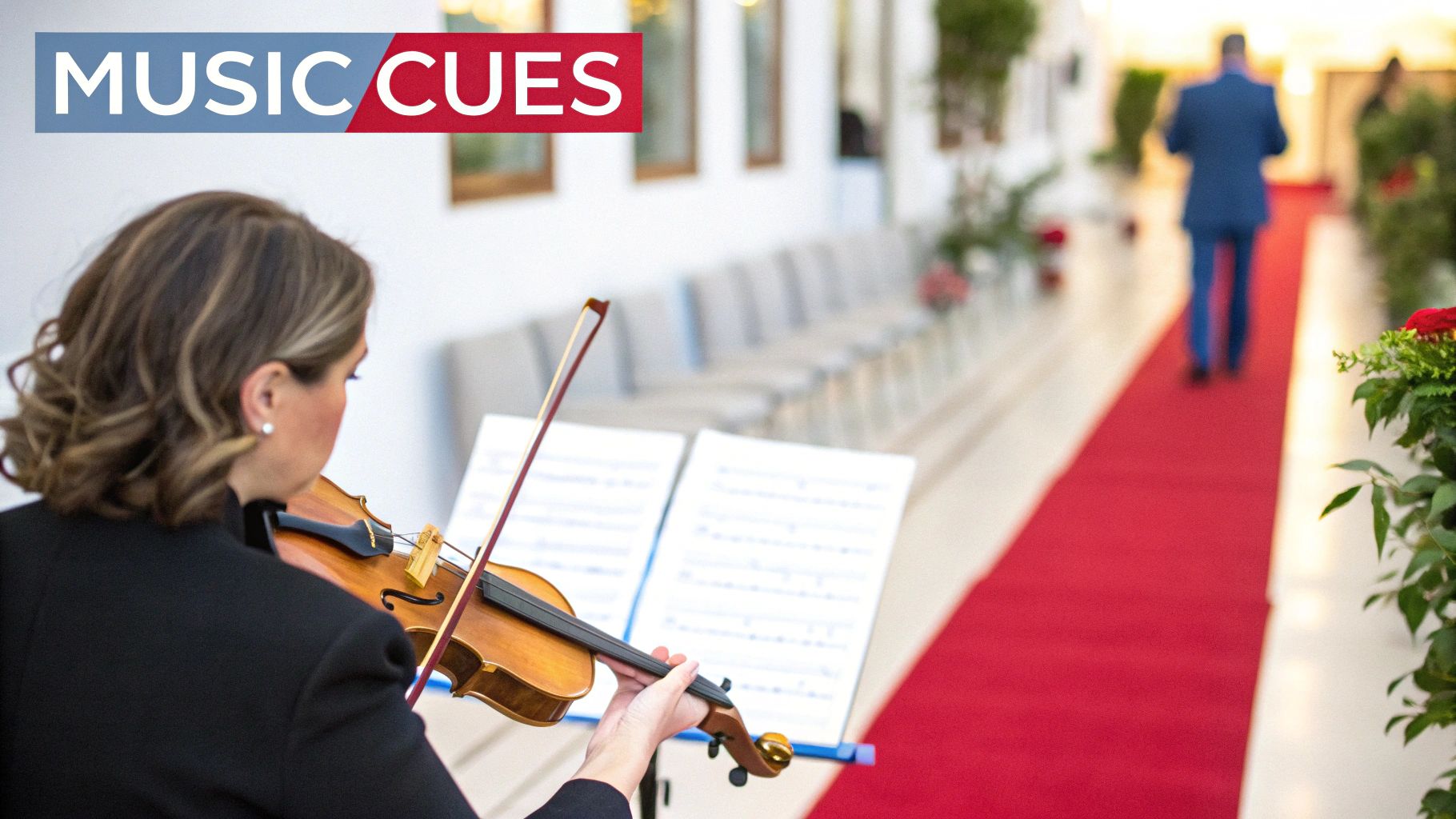
A truly unforgettable processional is more than just a walk down the aisle—it's a perfect marriage of movement and music. The right soundtrack doesn't just fill the silence; it builds emotion, creates a little drama, and turns a simple walk into the grand opening of your ceremony.
Think of your processional music as a story with a beginning, a middle, and a breathtaking finale.
A popular and highly effective strategy is to choose different pieces of music for different groups. This is a fantastic way to signal shifts in the ceremony's energy and build anticipation for what's coming next.
Creating Your Processional Soundtrack
To really nail the emotional arc, I always suggest structuring your music cues around the standard wedding processional order:
- Song One: The Seating of the Family. A gentle, warm piece is perfect here as grandparents and parents are escorted to their seats. This sets a respectful and loving tone right from the start.
- Song Two: The Wedding Party's Entrance. As the wedding party begins their walk, switch to a track that’s a bit more celebratory but still controlled. This signals to everyone that the ceremony is formally beginning.
- Song Three: The Grand Entrance. This is the showstopper. The music should change dramatically to announce the final, most anticipated entrance. This is the cue that tells every single guest to rise to their feet.
To make this happen flawlessly, you absolutely need a detailed plan. Creating a DJ wedding playlist with specific start and stop times for each song is the key to getting those seamless, goosebump-inducing transitions.
The perfect processional isn't just about who walks when—it's about how the music makes everyone feel in that moment. A well-timed song change can elevate your entrance from a simple walk to a truly cinematic reveal.
Executing with Precision
For perfect timing, you must designate a point person. This is usually your wedding coordinator, but it could also be a trusted friend or the venue manager. Their job is to give visual cues to your DJ or musicians.
Give this person a copy of the processional order and the music timeline. They become the director of the show, signaling the start of each song and making sure each group begins their walk at just the right moment.
Finally, coach your wedding party on pacing. It's so easy to get nervous and rush, but the best processionals are slow and deliberate. Tell everyone to walk at about half their normal speed and to leave several rows of space between each person or pair. This prevents a traffic jam at the altar and gives your photographer plenty of room to capture beautiful, uncrowded shots of everyone.
Of course, the processional is just one piece of the puzzle. A comprehensive wedding day timeline ensures all the moving parts, including these vital music cues, are perfectly aligned for a stress-free day.
Answering Your Top Processional Questions
As you get down to the wire with your ceremony plans, a few key questions always seem to pop up. Nailing down these final details is the secret to a smooth, stress-free walk down the aisle. Let’s clear up some of the most common things couples ask about the wedding processional.
One of the biggest questions we get is about who stands where at the altar. It’s not just about getting the photos right; there’s a ton of history behind it all.
Who Stands on Which Side at the Altar?
In a traditional Christian ceremony, the bride stands to the groom's left as they face the officiant. This tradition actually comes from an old (and not-so-romantic) custom where the groom needed to keep his right hand free to draw his sword and defend his bride! Following that logic, the bride’s guests would sit on the left and the groom’s on the right.
Of course, a lot of modern couples are happily ditching this rule for "open seating." It’s a simple, beautiful gesture that symbolizes the two families truly coming together as one and encourages everyone to mingle right from the start.
Another common worry? What to do when your wedding party doesn't quite fit the traditional lineup.
What If We Do Not Have a Flower Girl or Ring Bearer?
It is 100% okay to skip the flower girl or ring bearer. Many couples don't have little ones in their family they’re close to, or they just prefer a ceremony that feels a bit more grown-up. You can simply leave this part out of the processional, and no one will think twice.
If you want a fun alternative, we’ve seen couples have a well-behaved dog walk the aisle (make sure your venue is cool with it!) or even ask a grandparent to be an honored "flower grandmom" or ring bearer. It’s always a huge hit.
The best thing about a modern wedding processional is its flexibility. Don't feel locked in by tradition. The most unforgettable ceremonies are the ones that feel authentic to the couple and celebrate the people they love, no matter what role they play.
The layout of your venue itself can also throw a curveball. A really long aisle, for example, needs a bit of extra thought to keep everything flowing gracefully. You want to avoid any awkward gaps or making anyone in your wedding party feel like they have to sprint to the front.